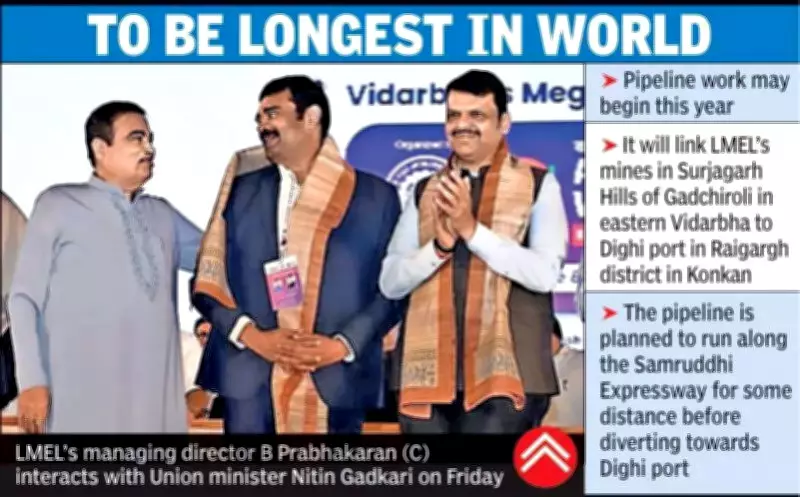
Lloyds Metals Announces Ambitious 950-Kilometer Iron Ore Slurry Pipeline Project
In a groundbreaking move for India's industrial infrastructure, Lloyds Metals and Energy Limited (LMEL) has unveiled plans to construct the world's longest iron ore slurry pipeline. This monumental project will stretch an impressive 950 kilometers, connecting the company's mining operations in the Surjagarh Hills of Gadchiroli district in eastern Vidarbha to the strategic Dighi port located in Raigad district within the Konkan region.
Surpassing Global Records and Transforming Transport Economics
Once completed, this pipeline will eclipse the current global record held by Brazil's Minas-Rio slurry pipeline, which spans 529 kilometers. The LMEL initiative represents a significant leap in industrial engineering and logistics optimization. Iron ore serves as the fundamental raw material for steel production, and transporting it via slurry pipeline—where finely pulverized ore particles remain suspended in water—offers substantial cost advantages over traditional rail or road transportation methods.
LMEL currently stands as the sole iron ore mining operator in Gadchiroli district and is concurrently developing an integrated steel plant within the same region. The proposed pipeline route will strategically follow the Samruddhi Expressway corridor connecting Nagpur to Mumbai for a considerable distance before diverging toward its final destination at Dighi port.

Strategic Route and Domestic Supply Chain Integration
The pipeline's trajectory has been meticulously planned to serve multiple industrial hubs along its path. It will initially reach Chandrapur, proceed through Jalna, and ultimately terminate at Dighi port. This routing will enable the pipeline to supply iron ore to domestic gas-fired steel plants located along the corridor, creating an integrated supply chain that enhances regional industrial development.
During the Advantage Vidarbha-Khasdar Audyogik Mahotsav, LMEL's Managing Director B Prabhakaran provided crucial insights into the project's progress. "We have already secured approximately half of the necessary approvals required to commence this ambitious undertaking," Prabhakaran revealed to TOI. "Given the current pace of groundwork and preparatory activities, we anticipate that physical work on laying the pipeline could potentially begin within this calendar year."
Building on Existing Infrastructure and Experience
LMEL is not new to slurry pipeline technology. The company already operates a 98-kilometer pipeline that connects its Surjagarh mines to its steel manufacturing facility at Konseri. This existing infrastructure has demonstrated the economic and operational benefits of slurry transport. "The Dighi pipeline will represent an entirely separate and independent initiative," Prabhakaran clarified, emphasizing the scale and distinct nature of the new project compared to their existing infrastructure.
Symbolic Transformation of a Former Conflict Zone
The pipeline project carries symbolic significance beyond its industrial implications. During the inauguration of Advantage Vidarbha, Union Minister Nitin Gadkari referenced the pipeline as emblematic of Gadchiroli's remarkable transformation. The district, once notorious as a Maoist-affected region, is now emerging as an industrial hub through mining and steel ventures.
Gadkari recounted a poignant anecdote highlighting this dramatic change: "There was a time when security concerns were so severe that during my visits to the district, the superintendent of police would implore me with folded hands to board my helicopter and depart immediately after official functions. The officer expressed genuine fear that any security incident involving me would jeopardize his career, despite my traveling with fifty commandos as part of Z-category security."
Contrasting this historical reality with present circumstances, Gadkari observed, "Today, Prabhakaran moves freely throughout Gadchiroli without any security entourage. This transformation underscores how industrial development and economic opportunities can fundamentally alter regional dynamics and security landscapes."

The LMEL slurry pipeline project thus represents multiple layers of progress—technological innovation in industrial logistics, economic optimization for steel production, regional infrastructure development, and the socio-economic transformation of previously troubled territories into centers of industrial growth and opportunity.