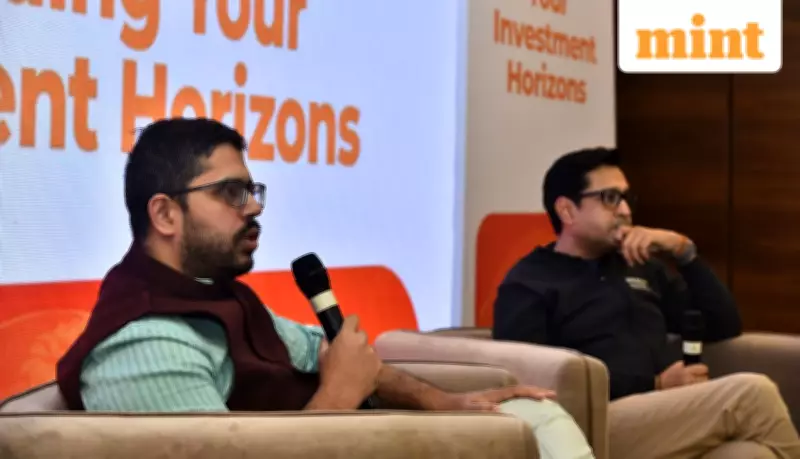
At the Mint Horizon event in Kolkata, a thought-provoking discussion on global investing began with a seemingly counter-intuitive yet instantly familiar idea. Neil Borate, Editor-in-Chief at thefynprint, opened by stating, "All of you already invest overseas. In fact, us Indians have been doing it for thousands of years." He pointed to gold as the prime example, noting that India does not produce gold, yet households have imported it for centuries as a store of value. According to Borate, global investing is not a recent financial trend but a deeply ingrained behavioral instinct for Indians.
Gold as India's Traditional Exit from the Rupee
Borate explained that gold has long served as the Indian public's default exit from the rupee. Whenever concerns arise about currency weakness or de-dollarisation, investors often ask whether they should buy gold instead. However, he argued that this framing misses the larger point. Whether investors choose gold or overseas assets, the intent remains the same: reducing dependence on a single currency and diversifying risk. The choice is not ideological but structural, rooted in historical practices.
Why Geographic Diversification Matters
This idea naturally led to the case for geographic diversification. To illustrate why spreading investments across countries is crucial, Borate referred to a diversification chart from ET Wealth that tracks equity market performance globally. Each color on the chart represents a different country or index, showing constant rotation rather than permanent leadership. "Different countries do well at different points of time," he said. He noted that Germany currently appears near the top largely because the Nasdaq is excluded; if included, Nasdaq would lead, followed by Germany and India. The key insight, Borate stressed, is recognizing that global returns are inherently uneven, not just identifying current leaders.

Returns Are Powerful, But Structure Still Matters
To ground this in experience, Borate shared a personal example. In 2012, he persuaded his father to invest ₹5 lakh in a Nasdaq ETF, which is now worth roughly ₹85–90 lakh, translating to a compound annual growth rate of over 20%. "We didn't anticipate it would be this good, or we would have put in much more," he admitted. However, Borate emphasized that access and structure matter as much as headline returns. Due to Reserve Bank of India limits on how much domestic mutual funds can invest overseas, several international feeder funds now trade at a premium. This creates an embedded cost of 3–5% upfront, which many investors unknowingly pay.
Currency Risk: A Structural Reality
From fund mechanics, Borate widened the lens to currency history. At independence, the rupee traded at around ₹3 to the dollar; today, it is close to ₹90. He highlighted that the sharpest fall occurred in 1966, when the government devalued the rupee by 56% after the Indo-Pak war. His point was that currency depreciation is not a one-off crisis but a long-term structural reality investors must account for in portfolios.
Concentration Risk Over a Century
Another chart Borate showed revealed how countries' shares of global equity markets have shifted over the past century. Britain, once nearly 24% of global markets, now represents around 3%. The United States dominates today, but its rise has not been linear, with periods of decline due to surges in other markets like Japan during its bubble years. "When people talk about long-term equity returns, they're not accounting for the fact that long-term domestic equity returns can be pretty dismal," Borate said. He argued that India has also had stretches with limited domestic options, and early diversifiers into US equities benefited disproportionately.
Practical Routes to Global Exposure
Against this backdrop, Borate outlined five practical routes for Indian investors seeking global exposure today:

- Domestic feeder funds that invest overseas through Indian mutual fund structures.
- Domestic multi-asset funds combining Indian equities, overseas equities, and gold, which reroute fresh money into domestic assets when overseas limits are hit.
- Direct investment in US stocks and ETFs via the Liberalised Remittance Scheme, allowing up to $250,000 per year.
- GIFT City retail funds, with investments starting at around $5,000.
- Alternative Investment Funds in GIFT City, with minimums as low as $10,000 for accredited investors (net worth of $1 million or annual income of $200,000).
Why GIFT City Changes the Compliance Equation
Borate detailed the structural advantages of GIFT City investing: assets are not subject to US estate tax, Schedule FA reporting is not required, and funds are regulated by the International Financial Services Centres Authority, providing an Indian regulator for issues. He stressed that global investing should not be mistaken for US-only investing, noting his own ETF holdings span Mexico, Brazil, Indonesia, Vietnam, South Korea, US energy, and US small-cap stocks.
Gold and the Behavioral Cost of Poor Timing
With gold rising 1–4% on some days while equities declined, Borate acknowledged recent price action dominates investor psychology. He shared that he invested ₹5 lakh in gold in 2012, the same year as the Nasdaq ETF, and it delivered flat returns for six years before achieving a CAGR of around 11%. "If you pick the wrong asset at the wrong point of time in its cycle, you can have a pretty miserable long-term journey," he cautioned.
How Professional Investors Structure Global Portfolios
This caution set the stage for professional insights. Neil Parikh, CEO of PPFAS Mutual Funds, explained that PPFAS runs a portfolio management service in GIFT City with discretionary and non-discretionary strategies. "The investment part is one, but the compliance part, the tax part, the operations part is still quite tough for individuals," he said. PPFAS holds global stocks like Microsoft and Google but faces regulatory limits, and also invests in Europe with holdings such as Unilever.
Home Bias, Tax Efficiency, and Operational Reality
Parikh addressed home country bias by comparing it to travel behavior: "Even when we go abroad for a holiday, after four or five days people want comfort food." To counter this, PPFAS focuses on globalized businesses with diversified revenue streams. He explained tax challenges in GIFT City funds, where short-term gains and dividends are taxed at 42.7%, discouraging churn. Workarounds include routing investments into Irish or Luxembourg funds. Operationally, he cautioned that GIFT City processes are not fully digital, with paperwork taking 10–15 days, causing many investors to drop out.
Uncertainty, AI, and Why Risk Matters More Than Timing
Addressing geopolitics and AI, Parikh said uncertainty is permanent. He warned against chasing hot sectors, drawing parallels with telecom and airlines in the 1990s. For him, overseas investing is primarily about managing risk: "Putting at least 20–25% of your equity portfolio abroad reduces risk considerably." On gold, he reiterated it should not exceed 10% of a portfolio and cannot be fundamentally valued.
Making Global Investing Accessible to Individuals
Subho Moulik, founder of Appreciate, concluded by focusing on direct global investing. He pointed out that India's inflation has historically exceeded US inflation, leading to average rupee depreciation of 3.5–4% annually. Moulik explained that Appreciate operates as a GIFT City broker with digital onboarding and is regulated by SEBI. US assets are held with custodians, the LRS limit is $250,000 per year, and new investors should prioritize index exposure. Last year, indices delivered around 18%, but he cautioned such returns are never guaranteed.
The Core Takeaway
Across the stage, the message was consistent. Global investing is not about abandoning India or chasing the next winning market. It is about recognizing currency risk, respecting market cycles, and building portfolios designed to endure and compound over time, leveraging India's ancient instincts for modern financial resilience.