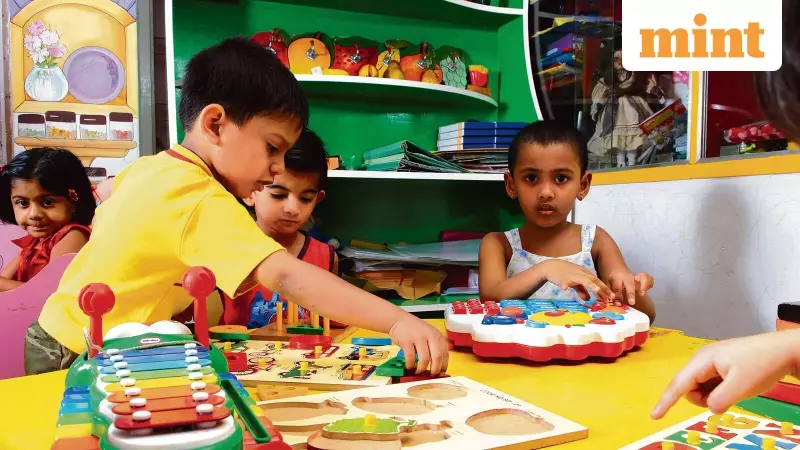
For families in India's major metropolitan areas, providing a quality education for their children has transformed into one of the most significant and relentless financial commitments. Beyond the substantial headline tuition fees, parents are navigating a labyrinth of additional costs, from coaching and transport to uniforms and school activities, creating a cumulative burden that demands strategic, long-term financial planning.
The Staggering Reality of Education Inflation
Data reveals a concerning trend: education inflation in India consistently outpaces the general Consumer Price Index (CPI). For private education, particularly in metro cities, annual cost increases typically fall within the 8% to 12% range. This rapid escalation means the total cost of schooling can double approximately every six to seven years.
"Urban private school fees have surged by 150% to 170% over the past decade," stated Madhupam Krishna, a Sebi-registered investment advisor and chief planner at WealthWisher Financial Planner and Advisors. This steep climb forces families to approach education spending with the same gravity as planning for a home loan or retirement, integrating it as a fixed, non-negotiable component of their monthly budget.

Beyond Tuition: The Hidden Cost Creep
The financial strain extends far beyond the school's fee slip. Experts break down the comprehensive expense structure. Sumeet Mehta, CEO & co-founder of the LEAD Group, notes that total annual fees in metros can range from ₹50,000 for state board schools to a staggering ₹10 lakh for International Baccalaureate (IB) institutions, with CBSE, ICSE, and IGCSE schools occupying the middle ground.
Transport adds another ₹15,000 to ₹1 lakh, while books and uniforms can cost ₹10,000-20,000. Most parents also resort to tuitions and extra classes, which can create an additional annual hole of ₹30,000 to ₹2 lakh. Usha Mohan, Managing Director of K-12 Consultants, highlights that branded schools often charge one-time admission or building fees of ₹50,000 to ₹1 lakh, significantly inflating first-year costs.
Extracurricular activities like dance, music, sports, and summer camps further strain budgets, costing between ₹5,000 to ₹20,000 per month per child. For Pune-based Anupam Kumari and her husband Abhijeet Kumar, who spend ₹20,000 per child monthly on school fees, extracurriculars add another ₹7,000–₹8,000. They face annual fee hikes of 15–20%.
Expert Strategies for Stress-Free Planning
Financial advisors urge parents to establish clear boundaries. A fundamental rule is that a child's total schooling and related expenses should not exceed 10–15% of the household's total income. Exceeding this threshold can jeopardize savings for emergencies, retirement, and the child's own higher education.
Srinivasan, director and founder of Shree Sidvin Investment Advisors, advises parents to plan for the full 12 to 15-year duration of schooling from the outset, as switching schools later can be difficult for the child. He recommends a "rolling buffer" strategy for the core school years (ages 6-18). The goal is to build a corpus covering two to three years of fees, invested in balanced or aggressive hybrid funds, so parents aren't solely reliant on monthly income.
For a school charging ₹2–3 lakh annually, this means accumulating ₹6–9 lakh. At the start of each academic year, one year's fees are withdrawn, and the corpus is replenished through Systematic Investment Plans (SIPs) or windfalls like bonuses.
An alternative approach, suggested by Madhupam Krishna, is the Systematic Withdrawal Plan (SWP) strategy. Parents start early, projecting future costs with an 8–10% annual inflation rate, and build a dedicated portfolio through SIPs. When fees are due, a predetermined amount is withdrawn annually, ideally only the gains, allowing the principal to remain invested and grow, combating inflation over time.

The consensus is clear: in today's economic landscape, education is a monumental expense that cannot be left to chance. Proactive and disciplined financial planning, starting as early as possible, is essential to secure a child's academic future without derailing the family's other financial aspirations.