

Buildings around the globe are no longer confined to linear forms or conventional designs. Some structures push the boundaries of imagination, drawing inspiration from everyday objects, abstract concepts, and artistic expression. These buildings serve not only as functional spaces but also as sources of inspiration and awe. Here are eight such unusual structures that challenge conventional building design.
The Big Basket Building (USA)
The Big Basket Building, also known as the Longaberger Basket Building, is located in Ohio, USA. Designed to resemble a giant picnic basket, it once served as the headquarters of the Longaberger Company. The structure features basket-like detailing, including handles and woven textures, making it one of the most unusual commercial buildings in the world.
Ilinden Memorial (North Macedonia)
The Ilinden Memorial, situated in Kruševo, North Macedonia, is a striking abstract monument dedicated to revolutionaries and fallen heroes. Its futuristic, rounded forms and stained-glass windows create a strong emotional and symbolic impact. The structure represents freedom, resistance, and unity, making it one of Europe's most distinctive memorial buildings.

The Cube Houses (Netherlands)
The Cube Houses in Rotterdam, designed by architect Piet Blom, are tilted cube-shaped homes built on hexagonal pylons. Each cube is rotated at an angle, creating a forest-like urban landscape. The design maximizes space while offering a unique living experience that challenges traditional housing concepts.
Bubble Palace (France)
The Bubble Palace, or Palais Bulles, in Théoule-sur-Mer, France, was designed by Antti Lovag. It features rounded, bubble-like rooms and flowing organic shapes inspired by nature. The design completely rejects straight lines, creating a futuristic and almost surreal living space overlooking the Mediterranean Sea.
Dancing House (Czech Republic)
The Dancing House in Prague, designed by Frank Gehry and Vlado Milunić, is inspired by a pair of dancers. One tower is rigid while the other appears fluid and curved, symbolizing movement and harmony. It stands out dramatically among classical buildings in Prague's historic cityscape.
Little Crooked House (Poland)
The Little Crooked House, located in Sopot, Poland, looks as if it has melted or bent under heat. Inspired by fairy-tale illustrations, its distorted walls and playful curves make it one of the most photographed buildings in the country. It houses shops, cafés, and offices.
Piano Building (China)
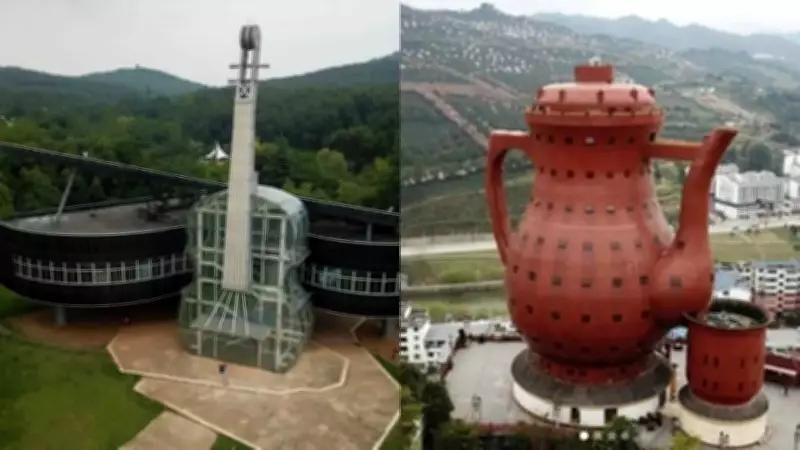
The Piano Building in Huainan, China, is designed in the shape of a grand piano with a violin leaning against it. Built as an exhibition space, it symbolizes musical harmony and creativity. Its glass structure and oversized instruments make it a popular architectural attraction.
Meitan Teapot Museum (China)
The Meitan Teapot Museum in Guizhou, China, is a massive building shaped like a traditional teapot. It celebrates the region's tea culture and includes exhibition spaces inside the structure. Its unusual design makes it both a cultural landmark and a tourist attraction.
These extraordinary structures demonstrate how architecture can go beyond functionality and become a form of artistic expression. From baskets and teapots to dancing forms and distorted houses, each building challenges traditional design norms. Together, they show how creativity in architecture can transform everyday objects and ideas into iconic landmarks that inspire people across the world.






