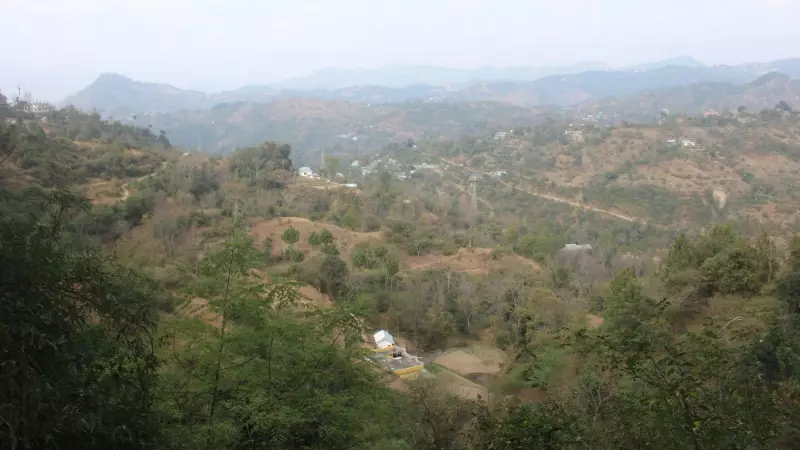
The proposed development of a Rs 1,374-crore satellite township near Shimla has ignited fierce resistance from residents of nine villages who say the project threatens to erase their ancestral heritage and livelihoods. The Jathiya Devi township, planned just 14 km from the state capital, is intended to decongest Shimla but has left local communities fearing displacement from fertile farmlands and sacred temples they have called home for generations.
A Way of Life Under Threat
For 37-year-old Neeraj Thakur, life in Majhola village has followed a steady rhythm: harvesting fresh vegetables from his family's land and selling them at the Jathiya Devi junction. That rhythm was shattered on December 25, 2025, when land acquisition notices were pasted, revealing his village was among those earmarked for the massive project. "We were told that all our villages, including agricultural lands and houses, would be acquired," Neeraj says. He views the plan as fundamentally unjust: building homes for newcomers by displacing those rooted there for centuries.
The anxiety spread rapidly through the hills after officials issued notices under Section 5 and Rule 8 of the Right to Fair Compensation and Transparency in Land Acquisition, Rehabilitation and Resettlement Act, 2013. The notices called for suggestions and objections to a Social Impact Assessment (SIA) study by December 29, 2025.

The Scale of Displacement and Deep-Seated Fears
The project's blueprint is vast. The SIA report identifies 249 hectares (approximately 2,959 bighas) across eight villages in Shimla district—Chanan, Panti, Aanji, Shilli Baghi, Majhola, Shilru, Dhanokari, and Kyaragi—and one in Solan district, Manjiyari. The assessment estimates that 386 households would be directly affected, with 158 families potentially losing their primary source of income.
Residents question the necessity of acquiring entire, productive villages. "Years ago, HIMUDA acquired 282 bighas in Chanan and Majhola, but those were infertile hills, ghasnias," says 44-year-old Chaman Lal from Shilli Baghi. "We fail to understand why authorities want to acquire entire villages this time."
The fear extends beyond economic loss to a profound cultural and spiritual rupture. Bal Kishan, a 55-year-old priest and farmer from Kyaragi, emphasizes the deep connection to the land. "It is not easy to leave behind farmland and temples where our deities reside. This means losing everything we have ever known," he states, capturing the sentiment of a united opposition.
Even in nearby villages like Bagna, uncertainty looms. Eighty-four-year-old Hira Singh worries about the practicalities of compensation for future generations. "My three brothers and I own 12 bighas. When that is divided among our sons and grandsons, what will each of us receive? Agriculture is our livelihood. The government must clarify compensation before proceeding," he insists.
Official Assurances and the Township's Promise
Facing public outcry, Himachal Pradesh Housing and Urban Development Authority (HIMUDA) officials have offered assurances. Surender Kumar Vashisht, CEO and Secretary of HIMUDA, stresses that acquisition will not be forced. "We are not going to acquire any piece of land against the wishes of locals," he says, clarifying that the December 29 public hearing—attended by around 300 villagers—was merely a first step to gather feedback.
Vashisht outlines a more selective approach: "We will exclude residential houses and fertile farmlands from any acquisition plan. There will be provisions allowing people to retain land for kitchen gardening." He argues that locals will ultimately benefit from the development, claiming some are already willing to give up land voluntarily.
Manjeet Sharma, Sub-Divisional Magistrate of Shimla (Rural), echoes that the SIA is only a draft report. "Acquisition can proceed only after due process and consent," he affirms.
The township itself is envisioned as a modern solution to Shimla's overcrowding. Planned for 135 hectares—including 35 hectares of government land—it aims to spread urban growth into rural peripheries. The Detailed Project Report (DPR) outlines:

- Residential zones (55.16 hectares) for high, middle, and low-income groups.
- Commercial (13.36 hectares) and non-polluting industrial zones (15.7 hectares).
- Green belts and riverfront areas (approx. 33 hectares combined).
- Smart roads, utility zones, and helipad connectivity.
Its location, just 2 km from Jubbarhatti's Jubilee Airport and 14 km from Shimla city, was chosen for accessibility. The first phase alone plans 895 residential units.
As the debate continues, the conflict encapsulates a classic development dilemma: the push for urban expansion and modern infrastructure versus the protection of agrarian livelihoods, ancestral homes, and intangible cultural heritage. The future of the nine villages now hinges on a fraught process of negotiation, compensation, and consent.