

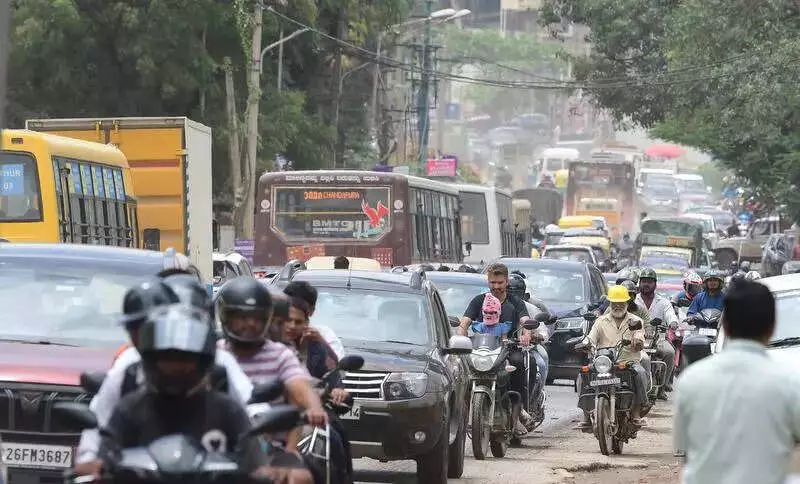
In a development that has intensified debates over Bengaluru's infrastructure costs, the Adani Group has placed the lowest bid for constructing a major 17-kilometer tunnel road. The proposed corridor, intended to connect Silk Board Junction to Hebbal, has drawn a staggering quote of Rs 22,267 crore from the conglomerate.
A Bid Far Exceeding Government Estimates
The bid submitted by the Adani Group is notably higher than the government's initial projection. Based on a detailed project report prepared by Bengaluru Smart Infrastructure Ltd (B-Smile), the state's estimate stood at Rs 17,698 crore. This translates to a substantial gap of nearly Rs 4,600 crore, raising immediate red flags about the project's financial planning and eventual burden on the public exchequer and commuters.
Deputy Chief Minister and Bengaluru Development Minister DK Shivakumar addressed these concerns, attempting to clarify the government's financial exposure. He stated that the state's commitment would be capped at 40% of the originally estimated project cost. "Beyond that, investment has to be made by private players. That is why the project is being taken up on a build-operate-transfer (BOT) basis," Shivakumar explained.

Scrutiny and Skepticism from Multiple Quarters
The minister also indicated that the quoted cost would undergo rigorous examination. He referenced his review of Metro projects and tunnel projects in Mumbai, where costs are around Rs 1,200 crore per kilometer, implicitly questioning the rationale behind the current bid. The project was tendered in two packages, and sources within the Greater Bengaluru Authority (GBA) revealed that Adani's bid overshoots the government estimate by 24% for package 1 and 28% for package 2. These significant gaps are expected to necessitate cabinet-level scrutiny before any final award decision is made.
The bidding process itself saw limited participation, adding to the controversy. Of the four initial bidders, only two reached the financial stage. Hyderabad-based Vishwa Samudra Engineering Ltd was the sole other qualifier. Dilip Buildcon was disqualified under a clause barring companies with a history of structural collapses, while Rail Vikas Nigam Ltd withdrew after its joint venture partner failed technical evaluations.
Opposition and Experts Warn of Long-Term Burdens
The opposition BJP has seized upon these issues, demanding the government drop the tunnel project altogether. BJP MP from Bengaluru Central, PC Mohan, cautioned that the absence of major global tunneling firms from the tender pointed to a poor risk-reward balance under the BOT model. In this framework, private concessionaires are required to fund 60% of the cost and recover their investment through toll collections over decades.
Mohan and independent mobility experts have highlighted additional risks, including limited soil testing and traffic data, which could lead to further cost escalations once construction begins. Experts critical of the project warn that the initial Rs 22,267-crore figure could balloon sharply, with construction potentially stretching over a decade. This scenario would leave commuters bearing a dual financial burden—paying tolls to the private operator while also contributing taxes that funded the state's 40% share.
The future of the ambitious tunnel road now hinges on a high-level government examination of the bid's viability, amidst growing concerns over its financial implications for Bengaluru's citizens.






