

Ahmedabad's Major Road Development Project Faces Roadblock Over Footpath Design Dispute
A significant infrastructure development initiative in Ahmedabad, involving six crucial roads in the Law Garden and Mithakhali localities, has been brought to an abrupt halt following intense public backlash and political intervention. The ambitious project, valued at approximately Rs 100 crore, has been suspended indefinitely due to a contentious design controversy surrounding footpath widths that has sparked widespread protests among residents.
Standing Committee Orders Complete Work Stoppage
The dispute reached a critical point when the Ahmedabad Municipal Corporation's standing committee decided to suspend all development activities across all six roads included in the precinct project. This decisive action came after mounting pressure from citizens who expressed strong objections to the proposed design specifications, particularly concerning the allocation of space for pedestrian pathways versus vehicular traffic.
Standing committee chairman Devang Dani issued a firm directive to municipal authorities, instructing them to prepare and obtain approval for a comprehensive new Footpath Policy before any further road development can proceed in the city. All ongoing construction work and proposed projects will remain in suspension until this policy framework is finalized and officially cleared through proper channels.

The Immediate Flashpoint: CG Road to Mithakhali Circle Stretch
The controversy first erupted on an 18-meter-wide road segment connecting CG Road with Mithakhali Circle, where the approved design allocated substantial space for wide footpaths, designated parking areas, and utility zones. Collectively, these non-vehicular elements occupied approximately half of the total road width, leaving only 9 meters available for traffic movement.
"The city has roads of varying widths, and it is not advisable to have uniform footpath widths everywhere," explained Chairman Devang Dani. "Building 2-meter-wide footpaths on both sides of an 18-meter road is impractical. I have instructed the civic chief to prepare a Footpath Policy that determines appropriate footpath widths based on the total road width. Until this policy receives approval, all related work will remain stalled."
Project Details and Approved Road Stretches
According to sources within the Ahmedabad Municipal Corporation, the road and building committee meeting held on July 7, 2025, formally approved the development of six specific road segments as precinct zones. The total project cost was sanctioned at Rs 99.90 crore, with an additional Rs 13.02 crore allocated for Goods and Services Tax (GST) requirements.
The six road stretches approved for development, with a combined length of 6,680 meters, include:
- NCC Chowk to Subhadrapura Junction (1,320 meters)
- Mount Carmel to Jalaram Underpass (2,070 meters)
- GICEA to Panchvati Circle (520 meters)
- Mithakhali Circle to Wagh Bakri Tea Lounge (970 meters)
- Mount Carmel to Commerce Six Roads (1,360 meters)
- Shree Virchand Gandhi Chowk to Mithakhali Circle (440 meters)
Comprehensive Development Vision and Implementation Partners
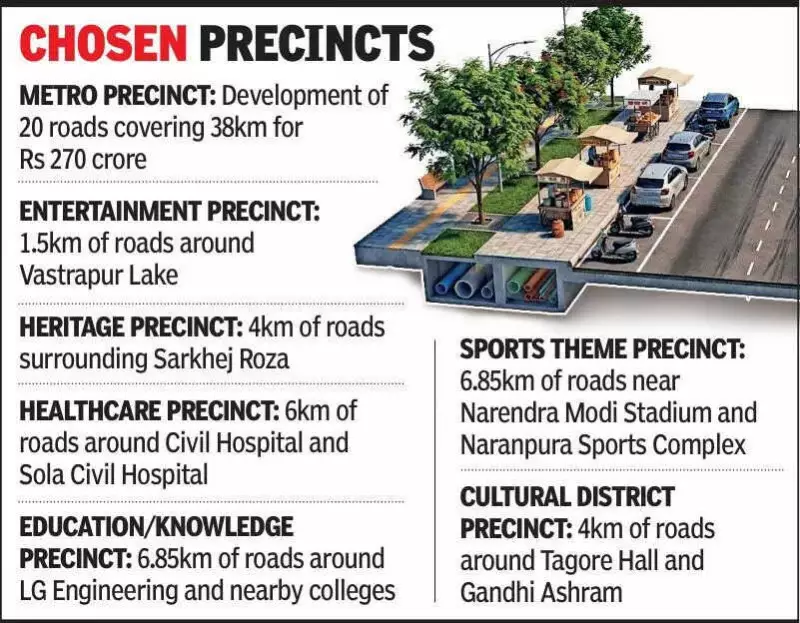
The precinct development plan envisioned transforming these arterial roads with numerous urban enhancement features, including:
- Organized street parking facilities
- Plantation-lined pedestrian walkways
- Designated vending zones for street vendors
- Gazebos and public seating benches
- Public art installations and landscaping elements
- Integrated and themed lighting systems
The execution contract for this substantial project was awarded to Skyway Infra Projects Private Limited, while the architectural and design aspects were handled by HCP Design Planning and Management, a prominent firm in urban planning and infrastructure design.
Resident Concerns and Design Objections
The controversy gained momentum during initial construction on a 500-meter stretch between Kukda Circle and Mithakhali Circle, where local residents raised strong objections to the proposed design. The plan featured 2.1-meter-wide footpaths on both sides of the road, accompanied by dedicated parking and utility zones.

Residents argued that this configuration would significantly reduce the available carriageway width, potentially creating severe traffic bottlenecks on an already congested corridor. Their concerns highlighted the practical challenges of balancing pedestrian infrastructure with vehicular flow requirements in densely populated urban areas.
The suspension of this major infrastructure project underscores the growing importance of community consultation in urban development initiatives and the need for flexible, context-sensitive design approaches that accommodate both pedestrian safety and traffic management considerations.





