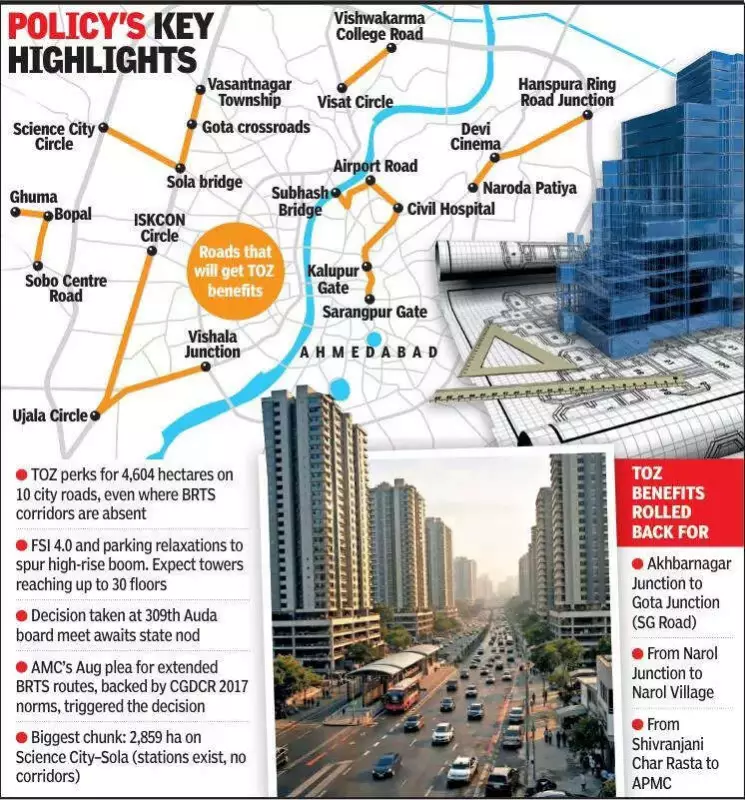
In a significant move poised to reshape the city's skyline, the Ahmedabad Urban Development Authority (Auda) has given its nod to a major expansion of the Transit Oriented Zone (TOZ) policy. The decision will extend lucrative benefits, including a higher Floor Space Index (FSI) of 4.0 and parking concessions, to a vast 4,604 hectares of land lining ten major arterial roads in the city.
What the TOZ Expansion Entails
The approval was granted during Auda's 309th board meeting held on December 17. The proposal will now be forwarded to the state government for its final approval. Under this plan, land falling within a 200-meter buffer zone on both sides of the specified roads will be designated as a TOZ. This planning tool is designed to encourage dense, vertical growth along mass transit corridors, potentially allowing for high-rise buildings ranging from 70 to 100 meters in height, depending on plot specifications.
Intriguingly, these benefits will apply even on stretches where physical Bus Rapid Transit System (BRTS) corridors are not currently present. This strategic decision is based on provisions in the Comprehensive General Development Control Regulations 2017, which permit the extension of TOZ benefits when BRTS routes are altered or extended.

Key Roads and Rationale Behind the Move
The ten major roads identified for the TOZ expansion are:
- Bopal village to Ghuma village
- Science City Circle to Sola Bridge
- Sola Bridge to Gota Crossroads up to Vasantnagar Township (SG Road)
- Bopal village to Sobo Centre
- Iscon Circle via Ujala Circle to Vishala Junction
- Subhash Bridge to Airport Road
- Visat Circle to Vishwakarma College Road
- Zundal Circle to Amba Township
- Naroda Patiya via Devi Cinema to Hanspura Ring Road junction
- Sarangpur Gate via Kalupur Gate, Chokha Bazaar, and Civil Hospital up to Airport Road
Auda clarified that the move aligns with the Ahmedabad City Development Plan 2021, which was approved on December 20, 2014. That plan originally proposed a TOZ along the city's BRTS and Metro Rail Transit corridors. The authority also cited an August 21 letter from the Ahmedabad Municipal Corporation (AMC), which pointed out that several BRTS routes had been extended after the 2014 plan was formulated.
Impact and Specific Cases
Once implemented, new construction projects within these zones will be eligible for the enhanced FSI of 4.0 and reduced parking norms. Auda noted that 82 Local Area Plans already fall within existing TOZ areas, and development approvals there are reviewed jointly with the AMC.
The proposal breaks down the 4,604 hectares into specific cases: 2,859 hectares are along the Science City Circle-Sola Bridge road where BRTS stations exist but no dedicated corridor is built. Another 77 hectares along the Bopal-Ghuma road have a fully operational BRTS corridor. The remaining 1,668 hectares cover roads where BRTS routes are proposed but the physical corridors are absent.
Auda also highlighted that currently, the benefit of higher FSI is being provided on the Metro Corridor Phase 2 route, and TOZ regulations can only be fully applied after the state government approves the MRT corridor.
This large-scale expansion is expected to accelerate urban development, promote the use of public transport, and fundamentally alter the architectural profile along these key transit routes in Ahmedabad.