

Chandigarh Prepares for Vertical Transformation in Built Landscape
Chandigarh, renowned for its iconic low-rise urban design masterminded by architect Le Corbusier, is poised for a significant evolution in its architectural profile. The Chandigarh administration is advancing plans to permit higher-rise construction in the city's southern and peripheral sectors. This strategic shift aims to optimize scarce land resources amidst rapid population growth and escalating housing demands.
Administration Prioritizes Peripheral Vertical Expansion
UT Chief Secretary H Rajesh Prasad emphasized that "periphery vertical expansion" represents the essential pathway forward to meet the city's developmental needs, given severe constraints on available land for new projects. He assured that the heritage core encompassing Sectors 1 to 30 will remain strictly protected and unaffected by these proposed changes.
Prasad elaborated that the administration is considering enhanced flexibility in allowable building heights across residential, commercial, and institutional categories within peripheral areas. "Holistic development of the city is a priority," he stated, adding, "We are committed to ensuring healthy generation of housing, employment, and income while adhering to established heritage, safety, and environmental parameters, along with Supreme Court directives."

Infrastructure Upgrades and Policy Alignment
The proposed high-rise policy will be implemented alongside substantial upgrades to supporting infrastructure in affected zones. While a comprehensive high-rise framework remains under finalization, the administration has indicated in principle that construction norms in Chandigarh's peripheral sectors will broadly align with those already operational in neighboring cities like Mohali and Panchkula, where taller buildings are more prevalent.
This urban planning shift aligns with central government directives to optimize land use within the Union Territory. The administration is actively reviewing and deregulating several building controls, including floor area ratio (FAR), ground coverage, and height restrictions. A dedicated committee led by the Deputy Commissioner has been formed to study these elements in detail. Additionally, minimum land requirements for educational institutions are under examination to enable more efficient development.
Private Sector Partnership and Housing Strategy
Under the emerging approach, the UT administration will prioritize robust infrastructure creation while transferring the bulk of housing and land development responsibilities to the private sector. "The administration will act as a facilitator," Prasad noted. "Land will be auctioned at market rates through fully transparent e-auctions. Liberal FAR and ground coverage provisions will be introduced to make housing more affordable."
This initiative arrives against a backdrop of chronic housing shortages. The Chandigarh Housing Board (CHB) has seen limited new supply, with its most recent general housing scheme dating back to 2016 and offering merely 200 flats.
Horizontal Versus Vertical Urban Character
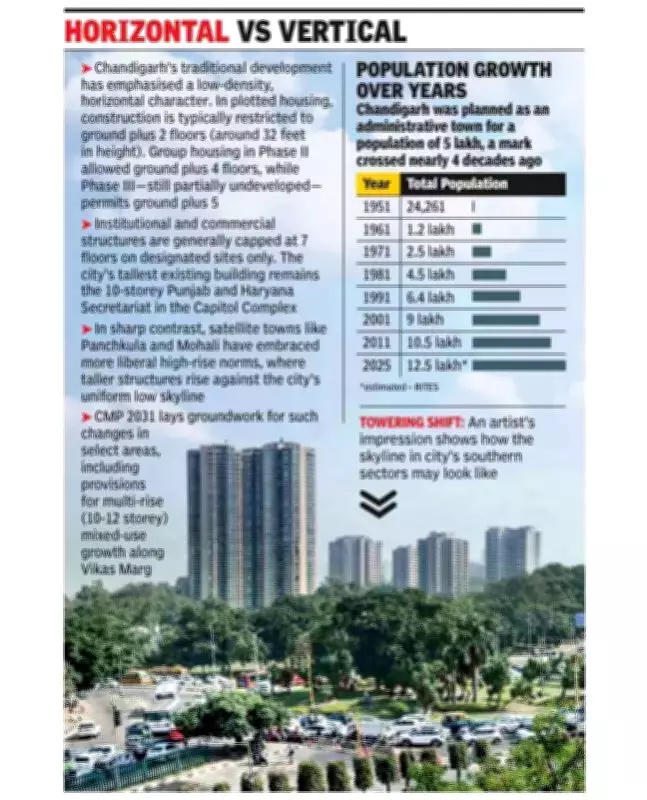
Chandigarh's traditional development has emphasized a low-density, horizontal character. In plotted housing, construction is typically restricted to ground plus two floors (approximately 32 feet in height). Group housing in Phase II allowed ground plus four floors, while Phase III—still partially undeveloped—permits ground plus five floors.
Institutional and commercial structures are generally capped at seven floors on designated sites only. The city's tallest existing building remains the 10-storey Punjab and Haryana Secretariat in the Capitol Complex.
In sharp contrast, satellite towns like Panchkula and Mohali have embraced more liberal high-rise norms, creating visible differences along Chandigarh's borders where taller structures rise against the city's uniform low skyline.
The Chandigarh Master Plan 2031 already lays groundwork for such changes in select areas, including provisions for multi-rise (10-12 storey) mixed-use development along the 7.5 km Vikas Marg stretch. This area is envisioned as a transit-oriented hub spanning 230 acres for residential, commercial, and institutional uses.

Relentless Demographic Pressure Driving Change
Originally designed for a population of about 500,000, Chandigarh now houses well over 1.2 million residents. Much of this population surge was accommodated in sprawling rehabilitation colonies on the city's outskirts. These areas are often densely populated and continue to grapple with longstanding deficiencies in basic amenities and infrastructure.
Nearly half of the city's residents—approximately 50%—reside in rented accommodation, highlighting severe constraints on homeownership options within Chandigarh proper. This rental dependency poses particular difficulties for long-term residents, including many who struggle to purchase or secure a home upon retirement, owing to the lack of a vibrant primary housing market and sharply rising affordability barriers.
The acute shortage of affordable owned housing inside the Union Territory has spilled over into neighboring areas, spurring rapid real estate growth in satellite towns like Zirakpur and Kharar. These locales experienced significant development, largely propelled by Chandigarh-based families and professionals seeking more attainable homeownership opportunities while remaining in close proximity to the city for work, education, and urban conveniences.





