

Women Renters in Chennai Confront Moral Policing and Broker Harassment Amid Growing Market Acceptance
The rental housing market in Chennai presents a complex reality for independent women seeking accommodation. Despite encouraging data showing increased participation, many face persistent challenges including moral policing by landlords, intrusive broker behavior, and restrictive living conditions that overshadow the city's gradual shift toward greater acceptance.
Personal Struggles in the Search for Housing
Priyanka M, a professional working in a private firm who recently relocated from Tiruvallur, endured a grueling six-month search before securing a rental property in Egmore. During this period, she viewed nearly sixty different houses, facing repeated rejections and scrutiny.
"We have to return home by 10 pm, no parties, no parents or relatives without prior information," explained Priyanka, detailing the restrictive conditions imposed by many landlords. These rules often form the starting point for negotiations rather than standard rental terms.

Shreya P, who moved from Salem and now resides in T Nagar, encountered different but equally frustrating obstacles. Her house-hunting experience was marked by excessive broker calls, moral scrutiny regarding her profession and lifestyle, and random inquiries through social media flatmate groups.
"To avoid this, many women move on to social media flatmate groups. But there too, there are brokers who take our numbers and hound us," she revealed. Shreya eventually turned to verified property platforms and community networks to minimize broker dependence and avoid harassment.
Broker Intrusion and Landlord Scrutiny
Rosy, a 48-year-old single mother working in a private firm and living with her daughter, described facing uncomfortable questioning from both brokers and landlords during her search for housing near her workplace.
"I found it hard to get a house near my office. Landlords have the usual set of rules, and brokers want to know very personal things," she explained, highlighting the invasive nature of many rental inquiries.
S N Srikanth, a member of the Chennai Real Estate Agents Association, acknowledged that moral policing primarily occurs in smaller flats and independent houses managed by individual landlords.
"We find this issue dissipating from multi-storey buildings. There is a change happening," he noted, suggesting that larger residential complexes may offer more progressive environments.
Encouraging Market Data Contrasts with Ground Reality
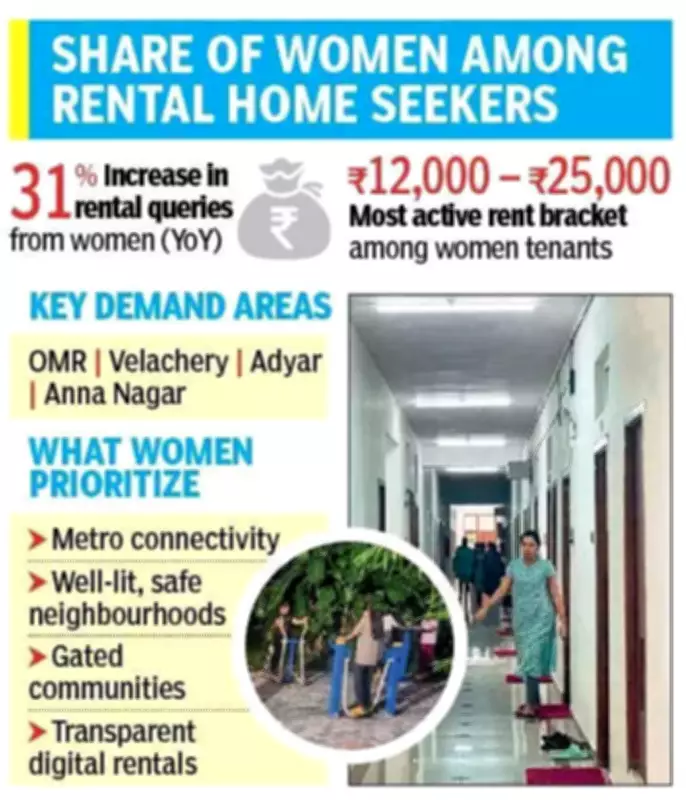
Despite these personal struggles, market statistics reveal significant growth in women's participation in Chennai's rental market. According to a comprehensive study by Nobrokercom, women now constitute 27% of rental home seekers in the city, with queries increasing by 31% year over year.
Demand concentrates primarily in key areas including OMR, Velachery, Adyar, and Anna Nagar, with most searches targeting properties in the ₹12,000–₹25,000 monthly range. These neighborhoods typically offer proximity to IT parks, educational institutions, and metro corridors.
The Premium for Safety and Infrastructure
Saurabh Garg, Co-Founder of NoBroker, explained that female tenants in Chennai demonstrate a strong preference for gated communities and professionally managed apartment complexes.
"There is a clear rental premium in neighbourhoods that offer a combination of metro access, strong social infrastructure, better street lighting, and gated community living," he stated. "However, this premium cannot be attributed to safety alone. Instead, it reflects an entire ecosystem that includes security, maintenance convenience, community presence, and better landlord acceptance."
These preferred developments typically feature controlled entry and exit points, CCTV surveillance, security personnel, power backup systems, and organized maintenance support—all factors that reduce day-to-day friction and perceived vulnerability for women tenants.
"As a result, rents in such developments are typically 30–35% higher than nearby standalone buildings or low-rise independent houses," Garg added, quantifying the safety premium women are willing to pay.

Shifting Trends in Landlord Behavior and Living Arrangements
Landlord attitudes are gradually evolving, particularly in larger apartment complexes and gated societies where owners show significantly greater openness to renting to women tenants.
Another notable trend involves the concentration of shared living arrangements within organized housing developments. "Over 70% of females sharing occupancies are observed inside large apartments and gated communities," Garg revealed.
The demand pattern has also shifted substantially. Currently, 2BHK units are preferred by 35% of women renters, surpassing the historical dominance of 1BHK configurations. This indicates an increasing preference for shared living arrangements where two working professionals or students split rent within organized apartment complexes.
While market numbers suggest Chennai is becoming more accommodating to independent women renters, and property technology platforms work to minimize broker interference, the ground reality remains challenging for many. The gap between statistical progress and personal experience highlights the need for continued evolution in rental practices, broker professionalism, and landlord attitudes toward women tenants in India's southern metropolis.





