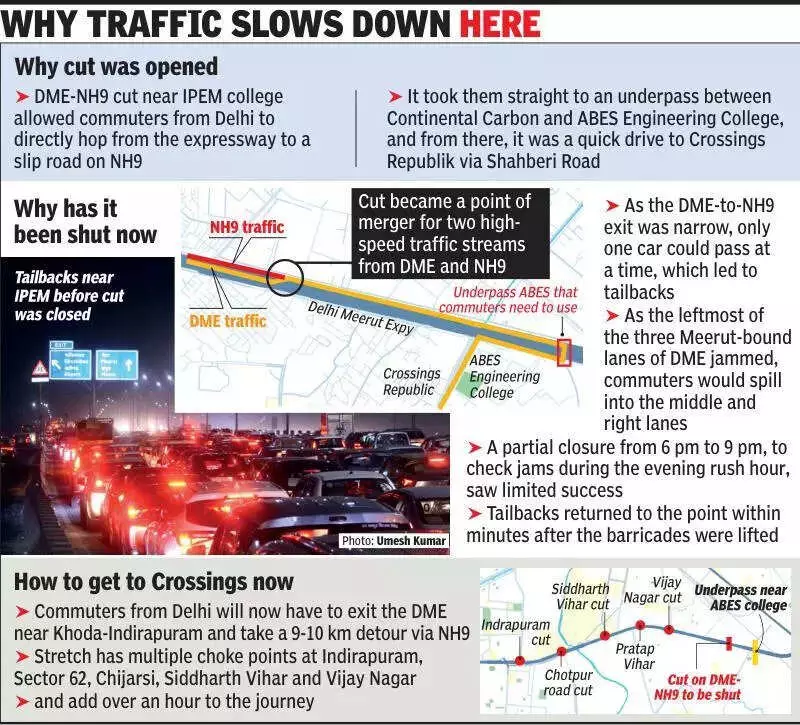
In a significant reversal for daily commuters, the National Highways Authority of India (NHAI) has completely shut down a critical access cut on the Delhi-Meerut Expressway (DME) in Ghaziabad. The cut, located near IPEM College at the 18.6-km mark, will remain closed for at least six months until mid-2026 for a major redesign, following its failure as a traffic choke point.
From Relief to Gridlock: The Short Life of a Promising Cut
The access point was inaugurated in 2024 by then Ghaziabad MP and Union Minister Gen VK Singh (retd), culminating months of protests by residents of Crossings Republik. They had argued that the lack of a direct connection from the DME to NH9 forced them into long, tedious detours. For a brief period, the cut delivered on its promise, offering a swift route from the expressway onto a slip road leading to the ABES underpass and then home via Shaberi Road.
However, the design flaw quickly became apparent. The merging point near IPEM College turned into a severe bottleneck. Officials explained that the exit from the DME to NH9 was extremely narrow, allowing only one vehicle to pass at a time. This single lane became a chaotic funnel where traffic from the DME merged with a high-speed stream of vehicles coming from Delhi on NH9.

Structural Failure Leads to Complete Closure
Authorities first attempted a partial closure from 6 pm to 9 pm daily starting December 1 to ease evening rush hour snarls. This trial proved futile. "We tried closing the cut between 6 pm and 9 pm from Dec 1 to assess whether snarls would ease. After a week, we found that nothing had changed," an NHAI official stated. Traffic jams would reappear within minutes of the barricades being lifted, confirming that the congestion was a structural issue, not a circumstantial one.
Consequently, from Saturday midnight, the NHAI, in a joint decision with the traffic department, ordered a full closure for a minimum of six months. The official emphasized, "We have not closed the cut permanently." The period will be used to widen the junction, integrate the slip road better with NH9, and expand the merging point from four lanes to five.
Residents Back to 'Square One' with Longer Commutes
For Crossings Republik residents, the closure feels like a major setback. Prabhakar Mishra, a resident and media professional, lamented the return of exhausting commute times. "With the cut, it took me 35-40 minutes from Delhi to my home... Now we are back to square one," he said. He estimates that his 40-minute commute will now stretch beyond two hours due to congestion on NH9.
The alternative route involves exiting the DME near Khoda-Indirapuram and joining NH9, which adds nearly 10 kilometers and several known bottlenecks. SC lawyer and resident SK Mohanty listed at least five jam-prone spots on this route: Indirapuram, Sector 62, Chijarsi, Siddharth Vihar, and Vijay Nagar. "Even on a good day, crossing all of them takes over an hour. The total commute to Delhi will easily touch two hours now," Mohanty warned. The frustration is palpable, with many residents threatening fresh protests if the NHAI does not provide a workable alternative soon.
The urgency for a functional design is underscored by the massive traffic volume on this corridor. The DME and NH9 together carry nearly 3.98 lakh passenger car units (PCU) daily, with about 50,000 PCU on the DME stretch alone. The expressway was built as an access-controlled route for uninterrupted travel, a purpose defeated by this ill-designed junction. The next six months will be a test of patience for commuters awaiting a permanent solution.