

Gujarat's Major Cities Divided Over Implementation of New Seismic Building Code
The implementation of India's revised seismic building code has created a significant rift among Gujarat's leading municipal corporations, potentially leading to a policy deadlock over construction norms in the state's most populous urban centers. This division centers on the enforcement timeline and technical requirements of the updated standards, with different cities adopting conflicting approaches that could impact thousands of construction projects.
Seismic Zone Upgrades and Differing Enforcement Approaches
The Bureau of Indian Standards' revised structural code — IS 1893:2025 — has officially reclassified Ahmedabad, Surat, Vadodara, and Rajkot from Seismic Zone 3 (moderate earthquake risk) to Zone 4 (high earthquake risk). This upgrade mandates stricter earthquake-resistant design standards for all new construction projects. However, municipal authorities have responded with dramatically different implementation strategies that reflect varying interpretations of transition provisions.
Ahmedabad Municipal Corporation has taken an uncompromising position, issuing a circular that requires immediate compliance with the new code for all building plans submitted after November 3, 2025. On January 19, AMC further directed structural engineers to submit formal affidavits confirming their adherence to the updated structural requirements. This aggressive enforcement approach has reportedly stalled approximately 15 major high-rise developments within the city, creating significant tension between municipal authorities and the construction industry.

Contrasting Approaches in Other Major Cities
In stark contrast to Ahmedabad's position, municipal corporations in Surat, Vadodara, and Rajkot continue to approve construction projects under the 2016 version of the seismic code (IS 1893:2016). These civic bodies cite a six-month transition window granted by the central government that maintains the validity of earlier standards until May 3, 2026. Officials in these cities have also sought formal clarifications from the state government regarding implementation timelines and technical requirements.
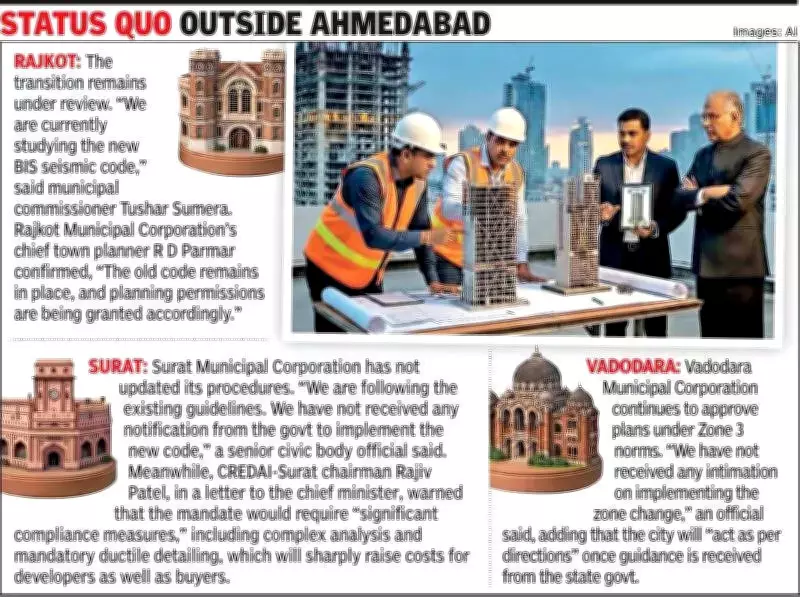
"We are currently studying the new BIS seismic code," explained Rajkot Municipal Commissioner Tushar Sumera, reflecting the cautious approach adopted outside Ahmedabad. Rajkot Municipal Corporation chief town planner R D Parmar confirmed that "the old code remains in place, and planning permissions are being granted accordingly."
Similar positions have been articulated in Vadodara and Surat, where municipal authorities report they have not received official notifications regarding the zone change implementation and continue operating under existing guidelines while awaiting state government direction.
Construction Industry Concerns and Technical Challenges
Developers in Ahmedabad have urgently appealed to AMC to permit use of the older code until the central government's transition deadline, citing substantial financial and technical complications. The Zone 4 classification requires buildings to withstand significantly higher seismic forces and incorporate mandatory 'ductile detailing' — specialized construction techniques that ensure structures bend rather than collapse during earthquakes.
"AMC's insistence on exclusive adherence to the new code from November 3, 2025 is inconsistent with the Centre's transition provision," asserted Rajesh Vaswani, chairman of Credai Ahmedabad. He revealed that approximately 15 project plans, including buildings taller than 45 meters, are currently stalled due to the enforcement disagreement.
Builders emphasize that projects in advanced planning stages cannot easily switch standards mid-process. According to Credai representatives, "Constructing half a building under the old code and the rest under the new code is technically unfeasible" and would create structural integrity concerns.

Financial Implications and Industry Advocacy
The construction industry warns that the new seismic requirements will substantially increase development costs. Credai Surat chairman Rajiv Patel, in a letter to the chief minister, cautioned that the mandate would require "significant compliance measures," including complex structural analysis and mandatory ductile detailing that would sharply escalate construction expenses for both developers and eventual residents.
Tejas Joshi, president of Credai Gujarat, advocated for more collaborative implementation, suggesting that "AMC should hold discussions with structural engineers before enforcing the new norms." He expressed willingness to work with municipal authorities and engineering professionals to create awareness among builders and stakeholders about the updated requirements.
Potential Policy Implications and Resolution Pathways
The current division among Gujarat's municipal corporations creates uncertainty for the state's construction sector and raises questions about uniform safety standards across major urban areas. The situation highlights the challenges of implementing national building code revisions at the municipal level, particularly when transition periods are interpreted differently by various local authorities.
As the May 2026 transition deadline approaches, stakeholders await clarification from state government officials that could resolve the current impasse. The outcome will significantly influence construction practices, project timelines, and seismic safety standards across Gujarat's rapidly growing urban landscape for years to come.





