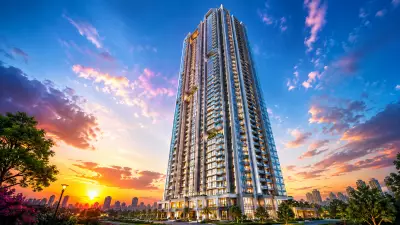
The year 2025 has dramatically reshaped Hyderabad's real estate landscape, marking a definitive shift from an affordable destination to a luxury fortress. The sector's wrap-up is dominated by mega Rs 100-crore land deals, a forest of skyscrapers soaring past 50 floors, and a relentless wave of high-end project launches. Amid this big-ticket frenzy, a critical question echoes among aspiring homeowners: Has Hyderabad permanently shed its affordability tag? Predictions for 2026 are divided, but the consensus tilts towards a resounding 'yes'.
The Sky-High Surge: Land Costs and Luxury High-Rises
Industry insiders point to a staggering 85% spike in housing costs between 2020 and 2025. Today, a price tag of Rs 1 crore or more is the new normal across the city, placing homeownership out of reach for an estimated 70% of Hyderabad's population. The city now ranks just behind Delhi-NCR and Mumbai in average property values, surpassing Bengaluru, Chennai, and Pune.
"This pattern is unlikely to change even in the new year," stated A Sumanth Reddy, Chairman of the National Association of Realtors India. He attributes the crisis to a developer-led mad rush to construct high-rises, even in areas with no genuine market demand. "Why do we need a 70-plus-floor project in a small market like Ghatkesar? Predictably, base prices get pushed to Rs 1-1.5 crore due to rising construction costs," he explained.

The root cause is the spiralling cost of land, which has skyrocketed by 80% to 100% in recent years. Architect Srinivas Murthy highlighted a domino effect: "Abnormally high-value deals on the western corridor have influenced other pockets like Uppal, where land now costs over Rs 100 crore an acre, despite lacking similar infrastructure or demand. This has created a severe imbalance impacting housing costs."
Shrinking Options and the Fear of Fraud
Compounding the problem is the shift in home sizes. The market in 2025 was flooded with announcements for lavish 3,500 to 7,000 square feet apartments in 60-floor-plus towers, moving away from the earlier average of 2,000-2,500 sq ft. The per-square-foot rate now fluctuates between Rs 7,500 and Rs 12,000. The pipeline for 2026 promises more of the same, with several projects aiming to cross the 70-floor mark, while sub-2,000 sq ft homes have become a rarity.
"Developers are desperate to sell to a shrinking buyer pool. So, instead of three 2,000 sq ft houses, they market one 6,000 sq ft home to raise funds, significantly raising the final cost," Murthy elaborated. This trend, realtors warn, could push desperate middle-class buyers towards the unorganised sector. Aju Thomas, President of Trinity Partners, noted that buyers must now look at least 40 km from the core city, to areas like Tukkuguda, for homes below Rs 1 crore, enduring brutal commutes. "If this continues, barring the 1% elite, all will be forced to consider smaller projects without credibility or RERA approval," he feared.
Unlimited FSI: A Well-Intentioned Policy Gone Awry?
A key structural issue is Hyderabad's unique unlimited Floor Space Index (FSI), in place since 2006. Unlike other Indian cities where FSI is capped at 2 to 2.5, Hyderabad imposes no such limit on how much can be built on a plot. Veera Babu of Cushman & Wakefield India called it an "alarming trend," with FSI in some locations already double that of other metros, putting excessive pressure on civic infrastructure.
This policy, intended to democratise the market by increasing supply and lowering prices, has backfired. "Unlimited FSI has pushed the market into a vicious loop," said Sumanth Reddy. "Builders create more built-up space for higher profits, and landowners quote exorbitant prices to cash in." Ashwin Rao of Akshara Group agreed the objective of creating affordable supply has failed.
Roadmap for 2026: Can Affordability Return?
The industry proposes several corrective measures for the coming year:

- Create a single downtown for high-rises (like Manhattan in New York) and cap construction in other areas to preserve them for middle-class housing.
- Draft a land-use master plan with dedicated zones for essential services and affordable housing, where prices are controlled.
- Strengthen infrastructure, especially roads and public transport, to enable people to live affordably farther from work hubs without crippling commute costs.
- Decentralise commercial growth currently concentrated on the western corridor to spread out the housing market and break monopolies.
Some developers, particularly those operating east of the IT corridor, see a glimmer of hope. Tapas Patel of Om Sree Builders noted a growing interest from IT buyers in areas like Yapral and Kompally, where prices remain around Rs 6,000-6,500 per sq ft. However, the overarching trend suggests the distance between affordable homes and workplaces will only widen in 2026, with core areas becoming the exclusive domain of luxury, multi-crore real estate.