

Karnataka RERA Imposes Strict Penalties for Delayed Quarterly Project Reports
In a significant move to strengthen homebuyer protections, the Karnataka Real Estate Regulatory Authority (K-Rera) has announced a penalty of Rs 25,000 per quarter for promoters who delay or fail to submit mandatory quarterly progress reports (QPRs) for the financial year 2025-26. This decision, made under the Real Estate (Regulation and Development) Act, 2016, aims to ensure greater transparency and accountability in the state's real estate sector.
Mandatory Reporting Requirements and Penalty Structure
Through a circular issued on Tuesday, K-Rera reiterated that all registered real estate project promoters must upload quarterly updates on the authority's web portal within 15 days of the end of each quarter. The authority emphasized its statutory powers to issue directions and impose penalties for any contravention of these obligations by developers.
However, in a conciliatory gesture, K-Rera has extended a final one-time opportunity for promoters to submit their Q1, Q2, and Q3 reports without penalty if filed on or before February 20, 2026. The circular, which came into force from January 20, states that recovery proceedings for delayed or non-submission will commence from February 20, 2026.

Mixed Reactions from Stakeholders
The penalty announcement has elicited varied responses from different stakeholders in the real estate ecosystem:
- Homebuyer Associations: Welcomed the move as a step toward disciplining builders. Srinivasa Rao Talla, Secretary of Bangalore City Flats Owners Welfare Association, noted that regular reporting helps both authorities and homebuyers track project progress, enabling suo motu action when timelines aren't met.
- Homebuyer Advocates: Expressed concerns that the penalty amount might be insufficient. Dhananjaya Padmanabhachar, Convenor of Karnataka Home Buyers Forum, pointed out that RERA allows penalties up to 5% of project cost and questioned why K-Rera hasn't released a project completion policy yet.
- Developer Representatives: Argued that quarterly filings are largely procedural and technical. Builders suggested penalties should be nominal and proportionate, citing genuine operational challenges like delayed certifications and busy periods for Chartered Accountants during tax seasons.
Authority and Industry Perspectives
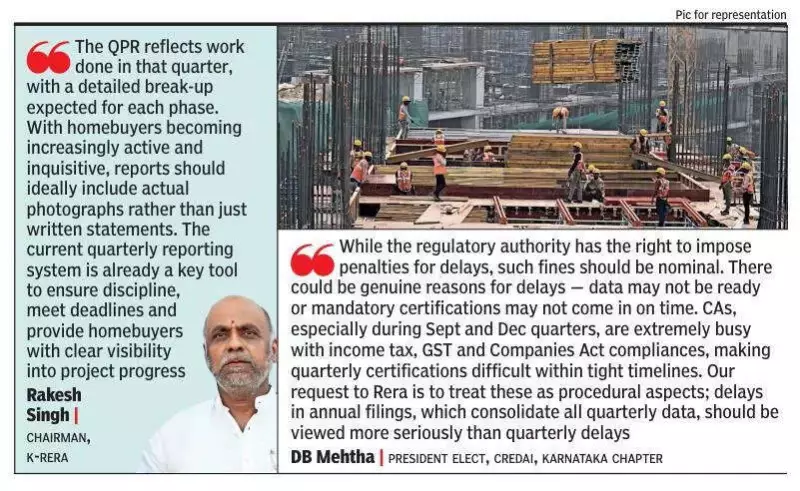
Rakesh Singh, Chairman of K-Rera, emphasized that QPRs should reflect actual work completed each quarter with detailed phase-wise breakdowns. He advocated for including actual photographs rather than just written statements, noting that homebuyers are becoming increasingly active and inquisitive about project progress.
DB Mehtha, President Elect of CREDAI Karnataka, acknowledged the authority's right to impose penalties but requested leniency for quarterly delays, suggesting that annual filings which consolidate all quarterly data should be treated more seriously than individual quarterly submissions.
Implementation Challenges and Historical Context
MS Shankar, General Secretary of Forum for People's Collective Efforts, highlighted implementation concerns, noting that despite a similar circular in 2020, no projects are properly mapped in the system. This raises questions about K-Rera's seriousness in enforcing the current directive, especially given the authority's historically lenient approach to violations requiring quarterly updates.
The quarterly reporting system has become a crucial tool for ensuring discipline, meeting deadlines, and providing homebuyers with clear visibility into project progress. As Karnataka's real estate market continues to evolve, this penalty structure represents an attempt to balance regulatory enforcement with practical considerations for developers while prioritizing consumer protection in one of India's most dynamic property markets.






