

The Hidden Financial Burden of Mumbai's Housing Redevelopment
In Mumbai, middle-class housing societies are often lured by enticing redevelopment proposals promising larger apartments in brand-new towers equipped with modern amenities like banquet halls, gyms, and swimming pools. However, the harsh reality sets in much later, after the project is complete and old residents move into their new homes. A little-known and seldom-discussed issue in Mumbai's redevelopment market is the dramatic surge in monthly outgoings and property taxes that families must bear upon shifting to a new building.
Staggering Cost Increases in Redeveloped Properties
In a newly constructed luxury tower in Bandra West, original residents who received 20% larger apartments in the redeveloped property are now paying monthly outgoings and municipal taxes as high as Rs 26,000. This is a sharp contrast to their previous expenses in the old building, where each flat owner paid barely Rs 5,000 per month, inclusive of all taxes. In another redeveloped building in Bandra, the average monthly outgoings per owner, excluding property tax, have risen to Rs 12 per square foot, up from just Rs 3 per square foot earlier.
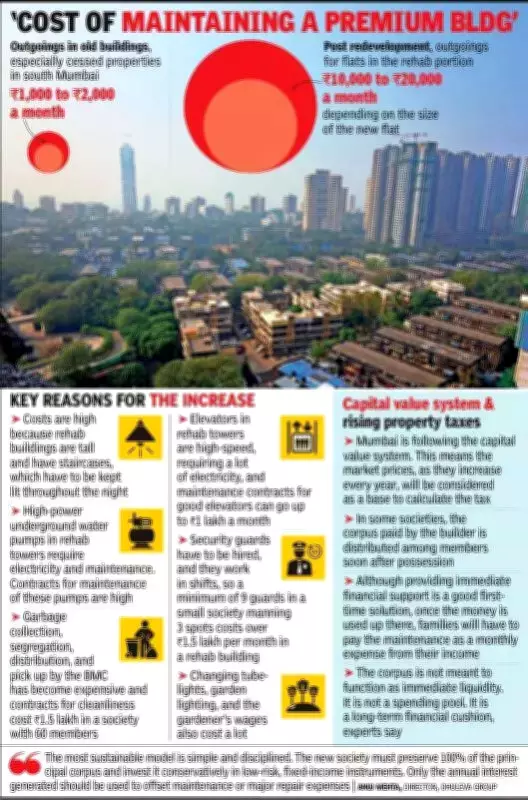
In south Mumbai, tenants of old cessed buildings protected under the Rent Act previously paid minimal rents of Rs 100 to Rs 200 per month. Post-redevelopment, their monthly outgoings for a 1,000-square-foot flat can skyrocket to Rs 10,000 to Rs 20,000. For larger, more luxurious homes of 2,000 square feet, these costs can escalate to Rs 30,000 to Rs 40,000 per month. Property experts note that maintenance charges in rehabilitation buildings in south Mumbai typically range between Rs 10 and Rs 30 per square foot, while in premium buildings, operational expenses can reach Rs 60,000 to Rs 75,000 monthly or more, depending on the scale and amenities offered.

Root Causes of the Financial Strain
Property market sources explain that these elevated costs reflect the reality of maintaining modern infrastructure and amenities. "Post possession, many residents notice an increase in maintenance charges. This increase is not arbitrary; it reflects the true cost of maintaining a premium building. In older structures, maintenance was low because facilities were minimal," they stated.
Developer Sanjay Devnani highlighted that maintenance charges in a new building often increase drastically after redevelopment, sometimes by more than three times. "There are multiple factors responsible for this significant rise. In older buildings, if maintenance standards are low, monthly maintenance charges are usually minimal. Additionally, property taxes are calculated based on older ready reckoner rates as applicable to aged buildings. In such cases, maintenance charges may be around Rs 2,500 per month. However, once the building is redeveloped, the quality of maintenance improves significantly," he elaborated.
After redevelopment, flats are typically larger and assessed at current ready reckoner rates for property tax purposes, leading to one of the major escalations due to high property taxes. Moreover, the inclusion of modern amenities in larger projects significantly increases the maintenance cost per square foot, often rising 5-6 times the older rates.
Expert Insights and Sustainable Solutions
Anuj Mehta, director of Dhuleva Group, proposed a sustainable model to mitigate these costs. He illustrated that if a society receives Rs 2 crore as a principal corpus and invests it at an annual return of 7–8%, it can generate Rs 14 to Rs 16 lakh per year. "That recurring income can meaningfully cushion operational expenses without eroding the principal. Once the corpus is depleted, the society loses its financial safety net," he explained.
Developer Nayan Shah added, "If the corpus amount is invested wisely, almost 80% of the monthly costs can be covered." However, Devnani noted a common challenge: "We recommend the corpus to be kept with society rather than being given to individuals to help in maintenance-free society, but most societies disagree due to some members' greed."

Policy Implications and Resident Concerns
Housing expert Chandrashekhar Prabhu warned that what appears to be a beneficial arrangement may not always serve the best interests of the so-called beneficiaries. "Mumbai is following the capital value system. This means market prices, as they increase every year, will be considered as a base to calculate the tax. Earlier, it was the rateable value system, when the rateable value was equivalent to 11 months' rent. When we switched from rateable value to capital value, we did not realise the taxes would increase on the basis of the latest sale transactions and everyone, irrespective of when the building is built, will have to pay as per the market. The depreciation clause does very little to ease the burden, leaving the resident to wonder what crime he has committed to be forced to pay unexplainable increases without an increase in amenities. In order to avoid a public outcry, the government has exempted flats less than 500 sq ft from payment of property taxes. But the rest of the city has to suffer," said Prabhu.
This situation underscores the need for greater awareness and careful financial planning among residents considering redevelopment offers in Mumbai's competitive real estate landscape.





