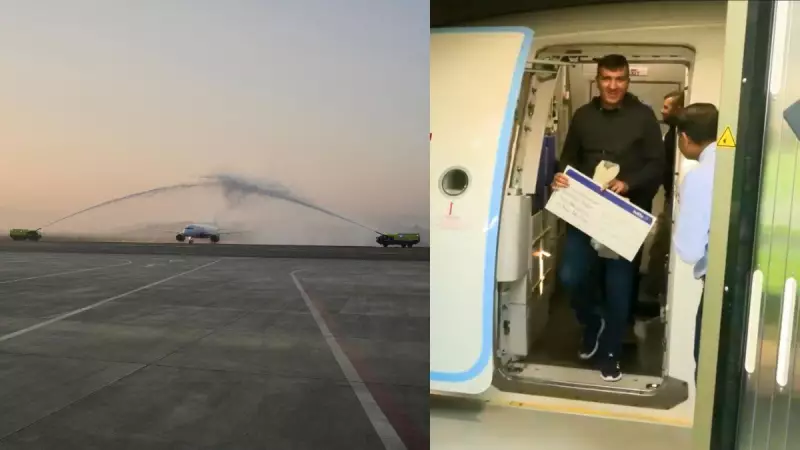
In a landmark event for Indian aviation, the much-anticipated Navi Mumbai International Airport (NMIA) officially commenced commercial operations on Thursday, December 25, 2025. The historic moment was marked by the arrival of the first scheduled flight, which was greeted with a traditional water cannon salute, signaling the opening of a critical new gateway for the Mumbai Metropolitan Region.
A Historic Touchdown at the New Gateway
The honor of operating the inaugural commercial flight fell to IndiGo, India's largest carrier. An IndiGo aircraft, arriving from Hyderabad's Rajiv Gandhi International Airport, touched down on the new tarmac, becoming the first passenger flight to land at the greenfield airport. As the plane taxied, it passed under arches of water sprayed by airport fire tenders—a ceremonial salute reserved for significant aviation milestones. This visual spectacle was captured on video and widely shared, symbolizing the culmination of years of planning and construction.
The airport's operations began under the code name 'NMIA' for Navi Mumbai International Airport. The launch follows the recent inauguration of the airport's first phase by Prime Minister Narendra Modi. The project has been developed through a public-private partnership, with the City and Industrial Development Corporation (CIDCO) of Maharashtra as the nodal agency and the Adani Group holding a majority stake and managing operations.

Infrastructure and Strategic Importance
Located in Ulwe, Navi Mumbai, the airport is strategically positioned to decongest the existing Chhatrapati Shivaji Maharaj International Airport (CSMIA) in Mumbai. It is a crucial piece of infrastructure designed to handle the soaring air traffic demand in the financial capital and its surrounding areas. The first phase of the airport includes a single runway, a terminal building with a capacity to handle millions of passengers annually, and associated facilities.
The commencement of flight operations is expected to provide a significant boost to the region's connectivity and economic growth. It will enhance accessibility to Navi Mumbai and the broader Konkan region, promoting business, tourism, and real estate development. Authorities have emphasized that the airport is built with sustainability and future expansion in mind, with plans for multiple phases that will eventually include a second runway and increased terminal capacity.
What This Means for Travelers and the Region
For passengers, the new airport offers a modern alternative with state-of-the-art amenities. It is designed to improve the overall travel experience with efficient processes and reduced congestion compared to the saturated Mumbai airport. The initial flight schedule is expected to ramp up gradually, with more airlines and destinations being added in the coming weeks and months.
The successful start of operations is a testament to the collaborative efforts of multiple stakeholders, including the central and state governments, regulatory bodies, and private developers. It marks a major step forward in India's infrastructure development story, addressing the critical need for enhanced aviation capacity in one of the world's most populous urban regions.
The launch on December 25, 2025, positions NMIA as a key driver for the economic future of Maharashtra, promising to unlock new potential for trade, investment, and regional development for decades to come.