

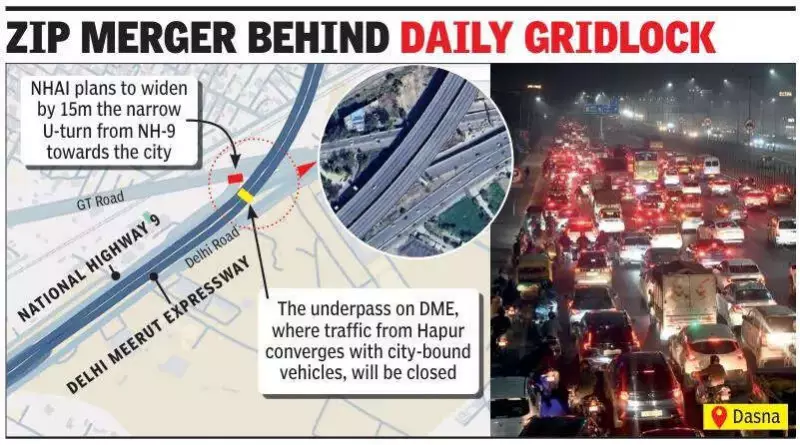
The National Highways Authority of India (NHAI) has launched a decisive plan to untangle the persistent and severe traffic jams at a critical junction near Dasna in Ghaziabad. This spot, where the Delhi-Meerut Expressway (DME) and National Highway 9 (NH-9) split and merge, is a daily nightmare for commuters, causing long queues that often spill back onto the expressway itself.
Pinpointing the Problem: A Merge Point in Chaos
Following recent corrective measures at the Vijay Nagar-Crossings Republik junction, NHAI is now turning its full attention to the Dasna choke point. Officials highlight the sheer volume of vehicles that pass through this nexus daily. NH-9 alone handles approximately 300,000 vehicles per day, while the DME sees over 60,000. The complexity arises as DME traffic from Delhi merges onto NH-9, which then converges again at a flyover leading towards Ghaziabad city via Govindpuram.
A senior NHAI official explained that the immediate and primary focus is on a specific U-turn. The U-turn from NH-9 towards the city side is currently too narrow, creating a major bottleneck where DME and NH-9 traffic streams combine. This congestion frequently backs up onto the DME, exacerbating delays. The solution is straightforward but significant: widen this U-turn by 15 meters to provide an adequate turning radius, especially for heavy vehicles heading into the city.

A Multi-Pronged Strategy for Smoother Flow
Widening the U-turn is just one part of a broader traffic management overhaul. NHAI has outlined several concurrent measures to systematically decongest the area:
- Creating an Additional Lane: An extra lane will be formed on NH-9 by merging the existing service road along the stretch.
- Installing Concrete Barriers: Barriers will be placed at locations near Dasna where there is currently no clear separation between NH-9 and the DME. This is intended to prevent dangerous driving maneuvers and stop traffic streams from cutting chaotically across each other.
- Addressing a Second Bottleneck: Officials have identified another trouble spot on the Delhi-bound carriageway of NH-9. Here, traffic from Hapur merges with vehicles coming from the city side via an underpass, causing further snarls.
Revised Circulation Plan for Hapur Traffic
To solve the Hapur merge issue, NHAI plans a strategic rerouting. The underpass used by city-side traffic to merge onto Delhi-bound NH-9 will be closed to eliminate the conflict point. Instead, this traffic will now proceed towards Hapur on NH-9, take a U-turn a short distance from Dasna, and then join the Delhi-bound stream smoothly.
Similarly, traffic coming from Hapur on NH-9 and aiming for Delhi will be directed to take a U-turn near Bamheta. This revised circulation plan has already been shared with the local traffic department, and NHAI is expected to commence work on these projects shortly.
The concerted effort underscores NHAI's focus on improving crucial infrastructure nodes in the National Capital Region. If successfully implemented, these interventions promise to bring much-needed relief to the thousands of commuters and transporters who endure the Dasna gridlock every day.






