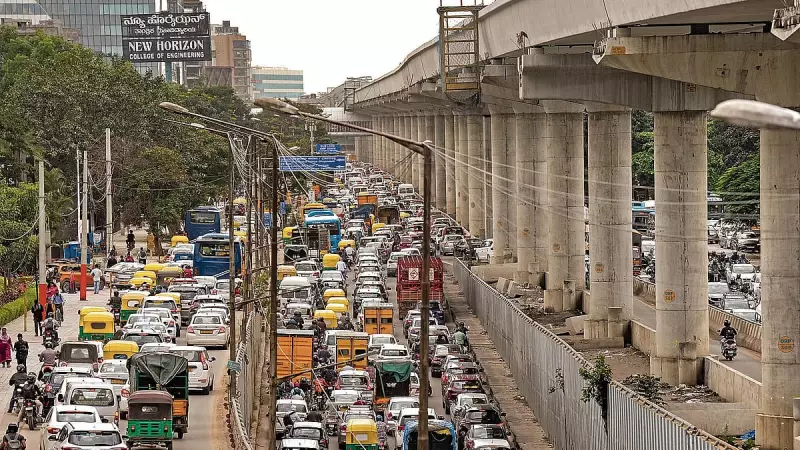
In a major move aimed at tackling the city's notorious traffic gridlock, the Greater Bengaluru Authority has unveiled a comprehensive and ambitious blueprint for the revamp of the crucial Outer Ring Road (ORR). The massive project, with an estimated cost of Rs 450 crore, promises to transform one of the city's most congested arterial roads into a more efficient and user-friendly corridor.
A Multi-Pronged Strategy for Decongestion
The detailed plan, presented by the authority, focuses on creating a signal-free corridor along significant stretches of the ORR. This will be achieved through the strategic construction of new flyovers, underpasses, and the optimization of existing junctions. The objective is to ensure seamless vehicular movement, particularly for through traffic, which is frequently bogged down at major intersections.
Beyond just aiding motorists, the blueprint places a strong emphasis on pedestrian safety and non-motorised transport. The authority has planned the development of wide, continuous footpaths and dedicated cycle tracks along the ORR. This initiative is designed to encourage sustainable modes of transport and provide safe passage for walkers and cyclists, who are often the most vulnerable on this high-speed road.

Key Infrastructure Projects and Enhancements
The Rs 450 crore investment will be channeled into several critical infrastructure components. A significant portion is earmarked for the construction of new grade separators at key conflict points. Furthermore, the plan includes major improvements to drainage systems to prevent waterlogging during Bengaluru's heavy rains, which is a perennial cause of traffic snarls.
The revamp also envisages better integration with public transport, although specific details on Bus Rapid Transit (BRT) or metro feeder services are part of broader discussions. The authority has stressed that utility shifting—relocating water, sewage, and telecommunication lines—will be a crucial and complex preliminary phase of the project execution.
Implications for Bengaluru's Commuters and Future
The successful implementation of this blueprint is expected to bring substantial relief to the hundreds of thousands of commuters and professionals who use the ORR daily to connect to the city's major tech hubs like Bellandur, Marathahalli, and Sarjapur. Reduced travel time, lower fuel consumption, and decreased vehicular emissions are the primary anticipated benefits.
However, the authority acknowledges the challenges ahead. Executing a project of this scale in a densely populated and active corridor will require meticulous planning to minimize disruption during construction. The plan represents a critical test for the Greater Bengaluru Authority's capability to deliver large-scale infrastructure projects efficiently. If successful, it could set a precedent for similar revamps of other choked corridors in the city, marking a significant step forward in Bengaluru's ongoing battle against traffic congestion.
The unveiling of this detailed plan signals a firm commitment from the civic body to address infrastructure deficits. Residents and commuters will now be keenly observing the transition from blueprint to reality, hoping for a smoother ride on the Outer Ring Road in the years to come.