

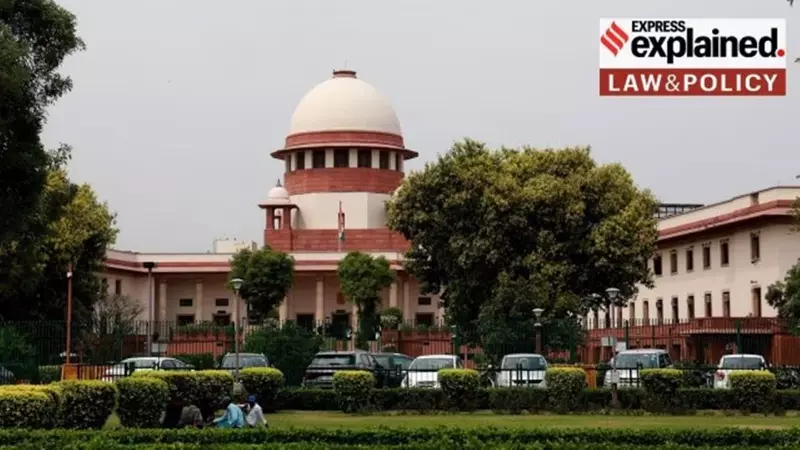
The Supreme Court of India delivered a crucial verdict on Thursday. It clarified a key point about real estate insolvency. The court stated that the stage of completion of a project cannot halt the legal insolvency process. This ruling settles a long-standing tension between developers and lenders.
Core Legal Questions Answered
The judgment addressed two major questions. First, can a builder avoid insolvency by claiming the project is 'substantially complete'? Second, can a housing society intervene early to stop the insolvency process? The Supreme Court answered both with a firm 'no'.
The Ahmedabad Project Dispute
The case involved a residential and commercial project in Ahmedabad named "Takshashila Elegna". The developer, Takshashila Heights India Private Ltd, took loans worth Rs 70 crore. It defaulted on repayments, turning the account into a non-performing asset. Edelweiss Asset Reconstruction Company acquired the debt.

After a failed restructuring attempt, Edelweiss approached the National Company Law Tribunal. It sought to initiate the corporate insolvency resolution process under Section 7 of the Insolvency and Bankruptcy Code. The NCLT initially dismissed the plea. It cited the project's viability and substantial completion, arguing insolvency would hurt homebuyers.
The National Company Law Appellate Tribunal overturned this decision. It ordered the insolvency process to begin. The developer and the Elegna Co-operative Housing Society then appealed to the Supreme Court.
Rejecting the 'Viability' Defence
The developer argued the insolvency petition was merely a pressure tactic for recovery. It claimed the project was nearly finished. It also argued that unsold inventory could cover the debts. The developer cited the Supreme Court's 2022 Vidarbha Industries judgment. That ruling suggested the NCLT had discretion to keep a company out of insolvency for valid reasons.
The Supreme Court bench, comprising Justices J B Pardiwala and R Mahadevan, rejected this argument. It clarified the Vidarbha Industries case was an exception based on specific facts. It was not a general rule.
Justice Mahadevan wrote the inquiry under Section 7(5)(a) is strictly confined to determining debt and default. It leaves no scope for equitable or discretionary considerations. The court held that once a debt and a default are established, admission into insolvency is mandatory.
Considerations like ongoing operations, partial project completion, or anticipated receivables are extraneous to the statutory mandate. The court emphasized that assessing a company's financial health is not the tribunal's job at the admission stage. That responsibility belongs to the Committee of Creditors.
The CoC consists of financial lenders who take control during the insolvency process. The court observed the commercial wisdom of the Committee of Creditors is paramount. It is not ordinarily open to judicial review. Questions regarding feasibility fall squarely within the CoC's domain. They cannot be examined at the threshold stage.
Limiting Housing Society Intervention
The second major issue involved the Elegna Co-operative Housing Society. The society argued it represented homebuyers. It claimed a right to be heard before the insolvency process began, as the outcome would affect its members.
The Supreme Court upheld the NCLAT's decision to reject the society's intervention. It drew a clear distinction between individual homebuyers and a maintenance society. Under the IBC, individual homebuyers are classified as "financial creditors". A housing society formed for maintenance is not.
The court held a society is a distinct juristic entity separate from its members. Unless it has advanced funds, executed allotment agreements, or received allotments, it cannot claim financial creditor status.
The court explained the initial stage of filing an insolvency petition is a proceeding in personam. It is a private dispute between the creditor and the debtor. Proceedings under Section 7 are essentially bipartite at the admission stage. Unrelated third parties, including other creditors, have no independent right of audience at this stage.

The court cautioned that allowing societies to intervene would create an extra-statutory layer of representation. It would also enable errant corporate debtors to obstruct and delay insolvency proceedings under the guise of purported collective interests.
Safeguards for Homebuyers
While strictly enforcing the insolvency code, the judgment acknowledged the vulnerability of homebuyers. The bench clarified the fundamental object of the IBC is resolution and revival, not mere recovery.
To ensure homebuyers are not prejudiced by big lenders' decisions, the court issued specific directions to the CoC. It must act with transparency. Any extraordinary or non-routine decision taken by the CoC must be supported by cogent reasons duly recorded in writing.
Specifically, if the CoC decides not to hand over possession of completed units to buyers or recommends liquidating the company, it must record cogent and specific reasons. The court also mandated that the information memorandum must mandatorily disclose comprehensive details of all allottees.
This ensures individual homebuyers are recognised and their interests recorded once the process begins. Even though a housing society cannot intervene at the start, homebuyers' rights are protected within the formal insolvency framework.
The Supreme Court's ruling provides much-needed clarity. It strengthens the insolvency process by removing ambiguous defences. It also balances creditor rights with homebuyer protections, reinforcing the IBC's core objectives.





