

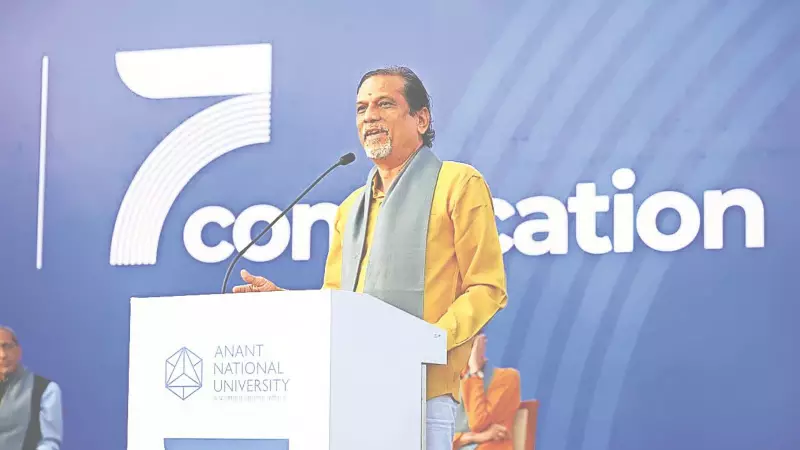
In a powerful address to graduating students, Sridhar Vembu, the Chief Scientist and co-founder of Zoho Corporation, issued a clarion call to tackle the growing crisis of urban livability in India. He spoke at the seventh convocation ceremony of the Anant National University in Ahmedabad on Saturday, December 7, 2025.
The Crisis of Modern Urban Expansion
Sridhar Vembu presented a stark observation: as Indian cities continue to expand in size, they are simultaneously becoming "more unlivable." He identified this as a fundamental urban planning problem that the current generation of students must now solve. The ceremony, held in Ahmedabad, was also attended by Ajay Piramal, President of Anant National University, Dr. Sanjeev Vidyarthi, the Provost, and members of the university's board.
Rejecting Imported Architecture for Climate-Responsive Design
Vembu critically examined the roots of contemporary architecture, tracing much of modern design philosophy back to the German Bauhaus School of the early 20th century. He questioned the global dominance of the "rectangular concrete block" style, arguing it is ill-suited for India's diverse climatic conditions.

"We must question this because it is not suitable for our climate today," Vembu asserted. He urged a return to designing with local materials and techniques that respond intelligently to the environment. Drawing inspiration from India's rich architectural heritage, like the Chola temples he admired from childhood, he lamented the disconnect between historical excellence and contemporary practice.
"Our history is there. We have great temples, Taj Mahal, all of it. But what have we done in contemporary India? What are we doing?" he asked the gathered students.
Leading by Example: Zoho's Traditional Building Projects
Vembu highlighted his company's practical initiatives to walk the talk. He revealed that Zoho has constructed a school in the traditional "Thanjavur agraharam style," scheduled to open on Pongal next year. Furthermore, his own office building in Tenkasi is a "compressed mud-based building" that operates without any air-conditioning system.
"So many people comment: how come it is so much cooler inside?...All this was our traditional knowledge...our homes were built this way hundred years ago," he stated, contrasting this with the uniform concrete structures being built across India today.
A Call to Action for the Next Generation
Vembu directly charged the graduating class with finding solutions. He suggested a practical starting point: "One way to start is to design the micro 50-acre campuses well." His message was clear: the expertise and will to create livable, sustainable cities exist within India's own history and knowledge systems, waiting to be rediscovered and applied.
The convocation saw at least 299 students receive degrees across various disciplines including Bachelor of Design, Bachelor of Architecture, Master of Design, and fellowships in Sustainability, Built Environment, and Climate Action.






