Space Zone India (SZI), a Chennai-based private aerospace company, has achieved two successful hybrid rocket launches and developed indigenous propulsion technology without relying on venture capital. Founded in 2018 by aerospace technologist Anand Megalingam, the company has remained entirely bootstrapped, reinvesting revenue from engineering services and space education into research and development.
Bootstrapped Path to Innovation
Unlike many startups that prioritize fundraising, Space Zone India focused on engineering excellence and technological validation before seeking external investment. Over seven years, the company built advanced research infrastructure, including laboratories for hybrid propulsion, avionics, embedded electronics, satellite integration, and a static fire testing facility. It now employs over 30 engineers and researchers across multiple disciplines.
Founder and CEO Anand Megalingam stated: "From day one, every rupee we spent went into building and proving the technology--not into fundraising. We wanted to own the proof before inviting investors into the conversation."

Hybrid Propulsion Technology
The core of SZI's technology is its indigenous hybrid propulsion system, which uses a semi-cryogenic oxidizer to simplify ground operations. Unlike liquid propulsion, it avoids expensive turbomachinery and cryogenic infrastructure. Compared to solid propulsion, it offers operational flexibility and reduced regulatory constraints. The vehicle is designed for recovery, refurbishment, and reuse, lowering recurring launch costs.
Megalingam explained: "Our oxidiser is semi-cryogenic, which significantly simplifies ground operations. More importantly, the vehicle is designed for recovery, refurbishment and reuse. After the first flight, subsequent missions require refurbishment rather than building an entirely new rocket."
Two Successful Missions
The company's first milestone was the AKSLV (Dr. APJ Abdul Kalam Satellite Launch Vehicle), recognized as India's first privately developed hybrid rocket. This was followed by RHUMI-1, India's first reusable hybrid rocket launched from a mobile hydraulic platform. The mission demonstrated hybrid propulsion, reusable recovery, mobile launch capability, and atmospheric research payload deployment.
Early development faced challenges such as combustion pressure anomalies and injector redesigns. The engineering team treated setbacks as learning opportunities, conducting extensive ground testing before flight. Megalingam noted: "We redesigned injector heads multiple times, refined combustion performance and extensively tested recovery systems before committing to flight. Every anomaly was identified during ground testing, documented and resolved before flight."
International Recognition and Advisory
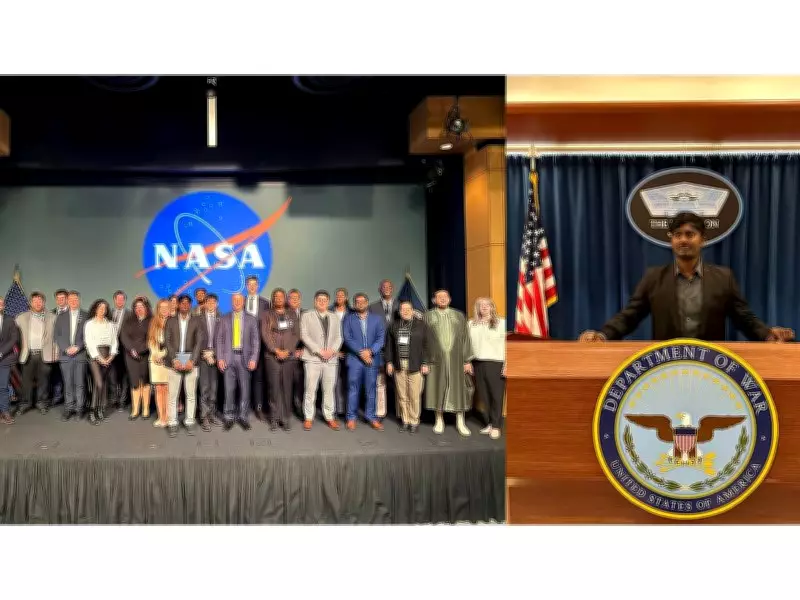
Megalingam was selected for the U.S. Department of State's International Visitor Leadership Program (IVLP), a flagship professional exchange program. During a month-long visit, he interacted with scientists from NASA, the U.S. Space Force, the U.S. Navy, the U.S. Air Force, and national laboratories, gaining exposure to advanced propulsion systems and commercial launch infrastructure.
The company receives guidance from distinguished scientists including Padma Shri Dr. Mylswamy Annadurai, former DRDO Chairman Dr. G. Satheesh Reddy, and former DGP Shri A.S. Rajan IPS. This advisory network strengthens technological development and organizational governance.
Defence and Commercial Potential
When asked about defence applications, Megalingam responded: "Our current focus is on advancing and maturing our hybrid propulsion technology for space applications. As we continue to improve the propulsion system, its performance and reliability, we will gain a clearer understanding of the broader applications that the technology may support in the future."
The global space economy is projected to exceed US$1.8 trillion by 2035, with India's commercial space sector valued at approximately US$8.4 billion. SZI aims to develop launch systems for missions up to 700 kilometres, targeting small satellite launches, atmospheric research, and commercial space services.

Investment Phase
Having completed its research phase and demonstrated flight-proven technology, SZI has entered formal investment discussions. The funding will scale an already validated platform, enabling final testing, manufacturing expansion, increased launch cadence, development of orbital propulsion technology, and growth into advanced defence technologies.
Megalingam concluded: "We now have two successful flight demonstrations, indigenous intellectual property and an engineering team that has spent seven years building this platform. The R&D phase is complete. Investment now enables final testing and manufacturing expansion, increased launch cadence, development of Game Changing Propulsion Technology towards orbital capability and growth into advanced defence technologies. Investors entering today are not funding a hypothesis--they are funding expansion."