

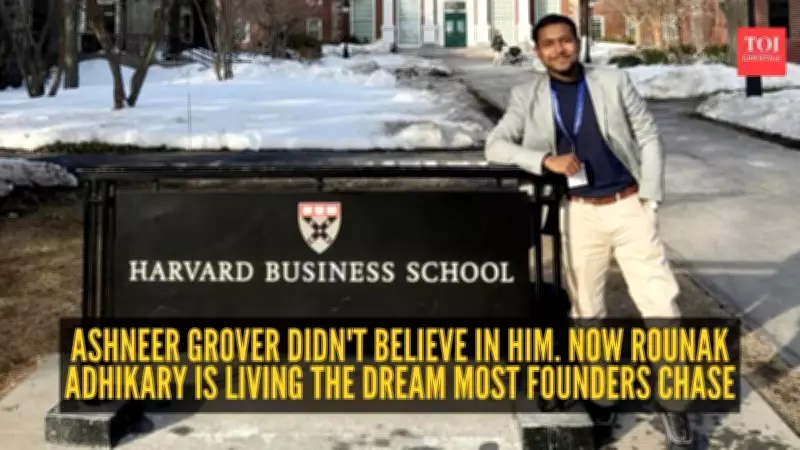
Most viral stories on the internet last a few days. This one took four years. Back in 2022, a young entrepreneur named Rounak Adhikary stood up at a public event, hoping to pitch his startup to Ashneer Grover. Before he could even get started, he was met with a blunt response that quickly became the moment everyone remembered. 'Tu baith jaa yaar.' The audience laughed. For many people, that kind of public dismissal would have lingered for years. It could have become the reason to stop trying. Instead, it became fuel.
Today, Rounak's startup, ProjectX, has been accepted into Y Combinator
ProjectX is the Silicon Valley accelerator that helped launch some of the world's biggest companies. But what makes his story powerful isn't the comeback. It's everything that happened before and after that viral moment. Because the truth is, life had been preparing him for rejection long before that day. Rounak spoke to The Times of India, and shared his inspiring story and all about his ongoing journey to further success.
'Life Had Already Trained Me For It'
When we asked Rounak whether that 'Tu baith jaa yaar' moment taught him anything about resilience, he didn't immediately talk about startups. He went much further back. 'By the time that moment happened, life had already trained me for it,' he says. Growing up, Rounak had a stutter. He was bullied throughout school until he was around 16. 'From very early on I had decided I'd have to fight for my own voice.' Books became his escape. While many teenagers were busy with typical school life, he immersed himself in nonfiction, science and business books. Cricket also became an outlet. He played at state level and university nationals before a lower-back stress fracture brought that chapter to an abrupt end. But the challenge that would eventually shape his future wasn't on a cricket field. It was sitting right in front of him at home.

The Slow Computer That Changed Everything
Rounak grew up in Madanpur, a small village in West Bengal. He remembers being the only child around him with access to a computer. The problem? The computer was painfully slow. Most people would've simply accepted it. Rounak didn't. 'I started engineering my own ways around it from the age of nine, and that became my window to the world,' says Rounak. That childhood frustration eventually became an obsession. Years later, it evolved into ProjectX and Infinity, a cloud-based operating system designed to make powerful computing accessible without depending on expensive hardware. What stands out while speaking to him is the conviction he carries. He keeps returning to one idea. 'Everything we call life was built by people no smarter than us.' It's a belief that seems to have guided nearly every major decision he's made. That same mindset helped him reach IIT Bombay as a researcher and course instructor at just 19. And it was also why he stood up that day to pitch ProjectX.
The Rejection Everyone Saw
When the opportunity came to speak in front of Ashneer Grover, Rounak saw it as a shortcut. A chance to accelerate his startup's journey. Instead, the attempt ended before it began. Looking back, though, he doesn't describe it as a devastating moment. 'It backfired publicly - but by then I was already immune to that kind of humiliation,' he says. The years of bullying had already taught him a lesson many people spend their entire lives learning. Other people's opinions don't get to decide your worth. What happened next is perhaps the most fascinating part of the story. Sitting beside him that day was his friend Moksh. After the incident, Rounak turned to him and made a prediction. 'I told him that in a few years, when ProjectX was real, I'd make a reel about this.' At the time, it probably sounded ambitious. Today, it sounds prophetic.

More Than 200 Rejections Later
Most success stories get condensed into neat social media posts. Reality rarely works that way. When we asked whether getting into Y Combinator felt like the perfect response to that viral moment, Rounak laughed. 'Of course.' But the road between those two moments was anything but smooth. More than 200 investors rejected him. Several venture capitalists told him to scrap the idea entirely. Cofounders left. Money ran out. He went bankrupt more than once. At different points, he found himself in debt. 'Right before YC I had less than ₹1 lakh in my bank account,' adds Rounak. Read that again. Less than ₹1 lakh. This wasn't a founder sitting on millions while talking about perseverance. This was someone trying to keep a dream alive while staring at uncertainty every single day. Yet somehow, he kept finding believers. First came grants from IIT Bombay. Then Startup India. Then Pontaq Ventures. There were fellowships, scholarships and opportunities that slowly started stacking up. He represented India at Tiger Launch at Princeton on a full scholarship after being selected from 17,000 companies. Then came the Stanford ASES Fellowship. Speaking engagements at Harvard Business School and Stanford. The Draper Deeptech Fellowship. Founders Inc. And eventually, Y Combinator.
Betting On A 0.6% Chance
One story from Rounak's journey perfectly captures how he thinks. Right before Y Combinator, he and two of his cofounders were supposed to fly back to India. Instead, they made a risky decision. They stayed back. Not because success was guaranteed. Because they believed. 'We skipped our flight back to India because we were convinced our launch would go viral in the US and that we'd get into YC.' The odds? Around 0.6%. Most people would've called it unrealistic. Rounak calls it conviction. 'I believed anyway, and it happened.'
Learning To Ignore The Applause
Public rejection is difficult. But what's even harder is building something for years when nobody is paying attention. When asked how he learned to stop seeking validation. His answer was simple. 'It came from the bullying, strangely enough.' He explains that years of being mocked for his stutter forced him to make a choice. Either allow other people's reactions to define him or stop depending on them altogether. 'I chose the second,' quips Rounak. Then he shared a line that perfectly explains why the Ashneer moment never broke him. 'Validation is nice, but it's noise. Conviction in the problem is the signal,' says Rounak. It's one of those rare answers that feels bigger than entrepreneurship.
The People He Never Forgot
Throughout our conversation, one thing became clear. Rounak doesn't view his journey as a solo mission. He repeatedly credits the people who stood beside him before there was any evidence he would succeed. His parents. His closest friends. His cofounders. 'The handful of people who believed in me before there was any proof to believe in.' And perhaps that's why, when I asked what kept him going during the years nobody was watching, his answer wasn't hustle or discipline. It was purpose. 'Purpose, plain and simple.' He says he wasn't working for recognition. He was working for the nine-year-old boy who struggled with a slow computer. For the teenager who got bullied. For every version of himself that needed someone to keep going.
Why His Story Is Resonating Across India
The reason millions of people connected with Rounak's viral story isn't because they're interested in cloud operating systems. It's because almost everyone has experienced rejection. Maybe not on a public stage. Maybe not in front of a crowd. But everyone knows what it feels like to be underestimated. To be told their idea won't work. To hear that they're aiming too high. Rounak believes India is only beginning to embrace underdog founders. 'For a long time the heroes here were the safe, established paths,' says the founder. That's changing now. And he thinks the next decade will belong to people willing to take risks on difficult, unproven ideas. 'Stories like mine resonate because people are realising that background, money, and a perfect résumé were never the prerequisites for building something that matters.' Then comes the line that perhaps sums up his entire journey. 'If a kid from a village in West Bengal with a slow computer can take on the definition of computing itself, then the barrier was never talent - it was permission,' adds Rounak.
The Last Word
Before ending our conversation, we asked Rounak what he would say if he could sit beside his 2022 self - the young founder who had just been told to sit down. His answer arrived instantly. 'I'd tell him what he already suspected: you're going to make it.' Then he paused. 'I think a lot about the nine-year-old Rounak who didn't have a good computer to even play games on, the 13-year-old who got bullied, and the 19-year-old who got told to sit down.' 'I build and work for all three of them - so that nobody has to go through what they did, ever again.' Four years ago, the internet watched someone tell Rounak Adhikary to sit down. What nobody realised was that he was already preparing to stand back up.
About the Author: Ankita Shukla is Assistant Editor - Lifestyle. She is a seasoned journalist with over 18 years of experience in fashion, entertainment, and lifestyle writing. She loves to pen thoughts on life, pop culture, all things artsy and fashion.
