

Indian Startup Ecosystem Redefines Success: Growth Over Funding
The Indian startup landscape is undergoing a significant transformation. Success is no longer measured solely by the amount of capital raised. Instead, founders and investors are increasingly focusing on sustainable growth and long-term viability. This shift in mindset reflects a maturing ecosystem that values resilience and strategic planning over rapid, often unsustainable, expansion.
The Unstoppables: A Platform for Founder Wisdom
To delve deeper into this evolution, Mint, in partnership with Fairfox EON, recently organized the second edition of 'The Unstoppables.' This Founders' Meetup and Learning Series took place on Friday. The event series draws its name from the relentless founders who are powering India's innovation economy. Its primary objective is to gather and share the vast knowledge present within the startup community. The aim is straightforward: to provide high-level insights and practical wisdom to entrepreneurs who are actively building and scaling their ventures in today's dynamic and ever-changing business environment.
Bootstrapped or Funded: A Critical Crossroads
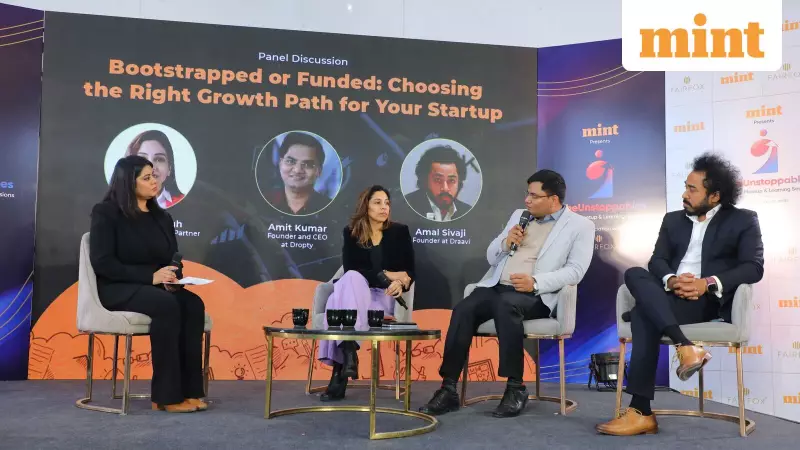
The event commenced with a compelling panel discussion titled 'Bootstrapped or Funded: Choosing the right growth path for your start-up.' This session aimed to unravel the crucial decision points every founder faces. It explored when, why, and if a startup should seek external capital. The discussion highlighted the delicate balance between maintaining full control through bootstrapping and accelerating growth with investor funding.

Moderated by Aayesha Varma from Hindustan Times, the panel brought together diverse viewpoints from seasoned industry experts. The speakers included Anisha Singh, Founder and Managing Partner at She Capital; Amit Kumar, Founder and CEO at Dropty; and Amal Sivaji, Founder at Draavi.
Blurring Lines and the Power of Sequencing
Anisha Singh, who possesses experience from both the founder and investor perspectives, observed that the traditional boundaries between bootstrapping and seeking funding are fading. She pointed out that a strategy called 'sequencing' is gaining popularity. This involves proving a business model's viability before approaching investors for capital, especially in the current cautious funding climate.
Offering guidance to bootstrapped founders aiming to scale, Singh emphasized perseverance. "It's not strictly about fundraising or bootstrapping. Given the tougher environment, I see bootstrapped founders proving their concept first and then raising money. If you truly believe in your vision, a rejection is not the final word," she advised.
Navigating the Realities of Indian Venture Capital
The conversation then turned to the unique challenges of the Indian investment market. Amit Kumar shed light on the contrasting expectations between Western and Indian investors. He noted that Indian investors often demand exceptionally high, immediate returns, which can create pressure.
Kumar suggested that raising funds can be comparatively simpler in markets like the US. "In India, many investors seek a 10X return, which may not be feasible going forward," he stated. He proposed that both founders and investors might need to adjust their expectations towards building sustainable, long-term businesses rather than chasing quick, massive exits.
The One-Way Ticket of External Capital
The panel also addressed when founders should think twice about raising money. They cautioned against the FOMO (Fear Of Missing Out) culture, where entrepreneurs seek funding simply because their peers are doing so.
Amal Sivaji stressed that entering the venture capital cycle is a profound commitment that alters a company's fundamental nature. "You need a clear, compelling reason to raise funds—be it market expansion or product development—not just because others are doing it. Once you start fundraising, it's a one-way ticket; there's no going back," he warned. Sivaji also shared insights on how early-stage founders can prepare a strong fundraising strategy and approach initial funding rounds with greater confidence.

Beyond Finance: Strategic Assets for Growth
While financial capital was a key theme, the event also highlighted the importance of physical infrastructure. Bhupesh Nagarkoti, Senior VP - Sales & Strategy at Fairfox IT Infra, discussed the commercial and residential real estate landscape in the Delhi NCR region.
Nagarkoti pointed out a notable shift in how modern entrepreneurs view their workspace. She explained that founders are increasingly seeing office spaces not just as an operational cost, but as a strategic asset. In the competitive battle for top talent, a well-designed, attractive workspace becomes a crucial tool to recruit and retain the best employees.
Charting a Personalized Founder's Roadmap
The Unstoppables session reinforced that there is no universal blueprint for startup success. Whether a founder chooses the disciplined path of bootstrapping or the accelerated route of venture capital, the decision must stem from the startup's product maturity and genuine market demand. It should not be driven by external pressures or industry trends.
As India's startup narrative continues to evolve, forums like these provide invaluable guidance. They equip the next generation of builders with the knowledge and resilience needed to navigate an increasingly complex business world. The focus is firmly on creating durable enterprises that contribute meaningfully to the economy.
This edition of Mint's The Unstoppables workshop for early-stage founders was presented in partnership with Fairfox EON.





