

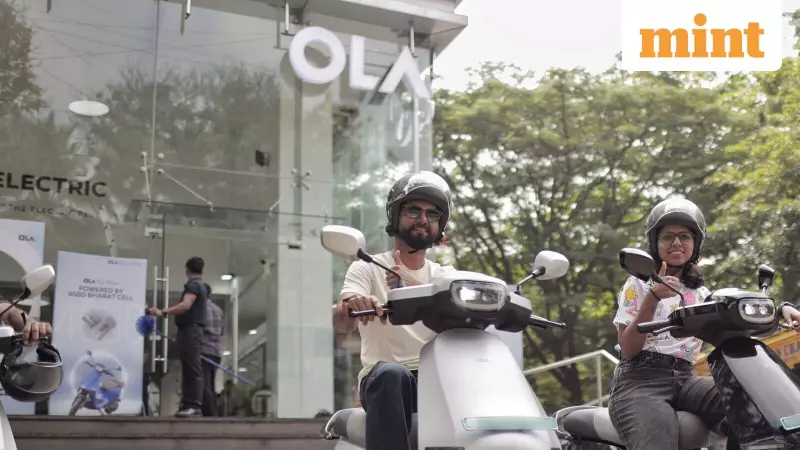
Bengaluru-based Ola Electric, the ambitious electric vehicle startup founded by Bhavish Aggarwal, is navigating a critical phase. A significant slump in sales, a sharp cut in revenue guidance, and the pressure to raise fresh capital have cast a shadow over its post-IPO journey, raising questions about its path to profitability and market dominance.
A Quarter of Surprises and Slashed Forecasts
The company's earnings call in November 2025 delivered a shock to analysts and investors. Founder and MD Bhavish Aggarwal revised the company's full-year revenue guidance downward by a substantial third, to ₹3,000-3,200 crore. This came just three months after projecting earnings of ₹4,200-4,700 crore. The rationale offered was a strategic shift prioritising profitability over volume, a move that left analysts like Arun Kejriwal of Kejriwal Research questioning its long-term sustainability.
The numbers starkly illustrate the challenge. In the September quarter (Q2 FY26), Ola Electric's revenue crashed by 43% year-on-year to ₹690 crore. Vehicle registrations, as per the Vahan portal, nearly halved to 50,372 units, pushing the company behind rivals Ather Energy, TVS, and Bajaj. The stock market reflected this pessimism, with shares plunging 24% in a month against a rising Nifty Auto index.

The Twin Pillars of a Potential Turnaround: Gen 3 & Gigafactory
Aggarwal's recovery plan hinges on two key elements: fixing the scooter business and leveraging its cell manufacturing capability. The company's early growth was marred by widespread complaints about its Gen 1 and Gen 2 scooters, leading to a show-cause notice from the Central Consumer Protection Authority in October 2024.
In response, Ola has pivoted entirely to its Gen 3 platform, with over 90% of Q2 FY26 sales coming from these new models. While Aggarwal claims industry-leading quality for Gen 3, experts like Deepesh Rathore of Insight EV argue that the negative perception from older models continues to weigh on sales, requiring significant investment to resolve legacy issues.
Simultaneously, the company is betting big on its Krishnagiri Gigafactory, India's first cell manufacturing plant. Having received PLI approval for 20GWh capacity, this facility is now producing cells for Ola's EVs. The company sees this vertical integration as a core competitive edge. In a significant diversification move, Ola launched Ola Shakti in October 2025, entering the Battery Energy Storage Systems (BESS) market for homes and businesses. It projects ₹1,000 crore in revenue from this segment by FY27.
Mounting Pressures and the Path Ahead
The road to recovery is fraught with financial hurdles. Despite raising ₹6,145 crore from its IPO in 2024, the sales slump has forced Ola Electric to announce two fundraises in 2025: ₹1,700 crore via bonds and ₹1,500 crore via equity. The company also faces a debt obligation of ₹2,114 crore until 2029-30.
Compounding these issues are challenges within the broader Ola ecosystem. Ola Cabs (ANI Technologies) saw its workforce halve and its credit rating downgraded by Moody's in November 2025, citing weak operational performance and liquidity concerns. Aggarwal himself has pledged 10% of his 30% stake in Ola Electric to raise funds for other group ventures.
The only recent positive was the two-wheeler business turning EBITDA margin profitable for the first time, though this was aided by not allocating ₹106 crore in expenses to specific business segments. An Ola Electric spokesperson termed FY26 a "deliberate year of recalibration," focusing on profitability and strengthening retail and service networks.
Industry observers believe a turnaround is possible if the Gen 3 scooter ramp-up succeeds and the gigafactory achieves scale. However, experts like Harshvardhan Sharma of Nomura Research Institute stress that cell manufacturing profitability requires a diversified approach beyond EVs, targeting the broader energy sector—a strategy Ola is now attempting with Ola Shakti.

Ultimately, the burden rests on Bhavish Aggarwal to steer Ola Electric through this turbulent phase. With investors watching closely and competition intensifying, the coming quarters will be decisive in determining whether the company can reclaim its momentum or remain stuck in a slow lane.





