

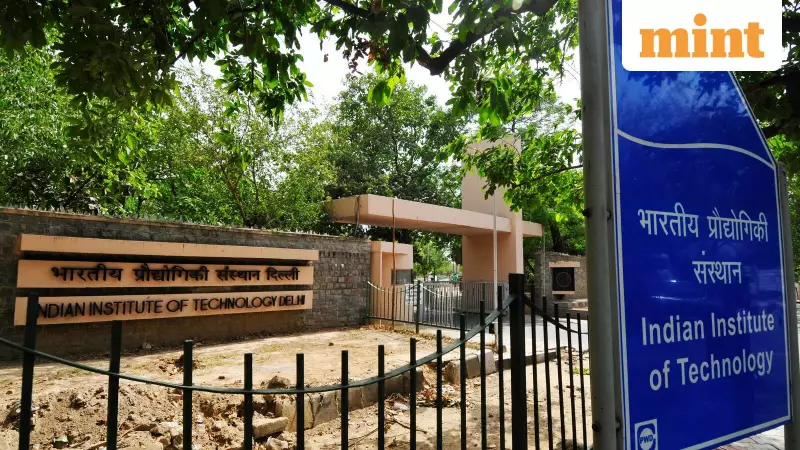
The annual placement season at India's premier Indian Institutes of Technology (IITs) has transformed into a fierce battleground. This year, venture-backed startups are aggressively challenging established tech giants and high-frequency trading firms for the country's best engineering talent, armed with lucrative financial packages.
The Startup Offensive: Bigger Salaries and IPO Dreams
Startups are not holding back. Companies like Razorpay, Fractal Analytics, Battery Smart, OYO, Navi, Meesho, and SpeakX are offering significantly higher salaries, substantial joining bonuses, and generous employee stock option plans (ESOPs). Their strategy is clear: use the promise of rapid wealth creation through impending Initial Public Offerings (IPOs) as a primary lure.
For instance, Navi, founded by Flipkart co-founder Sachin Bansal, is recruiting for fintech roles with salary packages ranging between ₹38.2 lakh and ₹45.2 lakh, plus bonuses and ESOPs. The company's HR head, Subeer Bakshi, confirmed their presence across major IIT campuses, emphasizing a compensation structure "wealth-aligned through Esops."

Similarly, IPO-bound Razorpay is offering around ₹20 lakh in compensation, a ₹3 lakh joining bonus, and ESOPs worth ₹20 lakh with a four-year vesting period. Even newer entrants like edutech startup SpeakX are entering the fray with packages "upwards of ₹50 lakh CTC," including a ₹10 lakh joining bonus and ₹10 lakh in ESOPs.
The Big Tech Counter: Stability and Brand Power
Despite the financial firepower from startups, a significant preference for stability persists among top-tier IIT students. Tech behemoths like Google, Microsoft, Amazon, and Nvidia, along with high-frequency trading firms such as Da Vinci Trading, continue to be the first choice for many. This trend was evident at IIT Madras and IIT Kanpur, where many of the top 20 students had "either backed out or were already placed" with such firms, and some did not attend startup interviews despite clearing initial tests.
The allure of global brand value, structured career progression, and the relative security of restricted stock units (RSUs) offered by big tech often outweighs the potentially higher, but riskier, rewards of startup ESOPs. As Aditya Singh of All in Capital noted, unlike big-tech RSUs, most startup ESOPs require employees to buy shares, and their value is contingent on a liquidity event like an IPO. "If the company never lists, the Esops may not translate into meaningful financial gain," he explained.
A Shift in Hiring Strategy and Campus Sentiment
The placement dynamics reveal a broader shift in the tech industry's hiring philosophy. With artificial intelligence now automating a significant portion of coding work—SpeakX reported AI writes "70% of our code internally"—companies are moving from mass recruitment to a focus on securing fewer, but exceptional, high-quality engineers. This justifies the elevated compensation packages for these premium hires.
Interestingly, the enthusiasm for early-stage startups appears to vary across institutions. While IITs show caution, the National Institutes of Technology (NITs) and Indian Institutes of Information Technology (IIITs) demonstrate a much higher interest in startup roles. This suggests a differing risk appetite or career priorities among students at these campuses.
The placement season, which began in September for newer IITs and NITs, kicked off for older IITs like Delhi, Bombay, and Madras on 1 December 2025. It serves as a crucial barometer for the engineering job market in India, indicating a competitive landscape where startups are forcing a recalibration of compensation but still fighting an uphill battle against the entrenched appeal of industry titans.






