

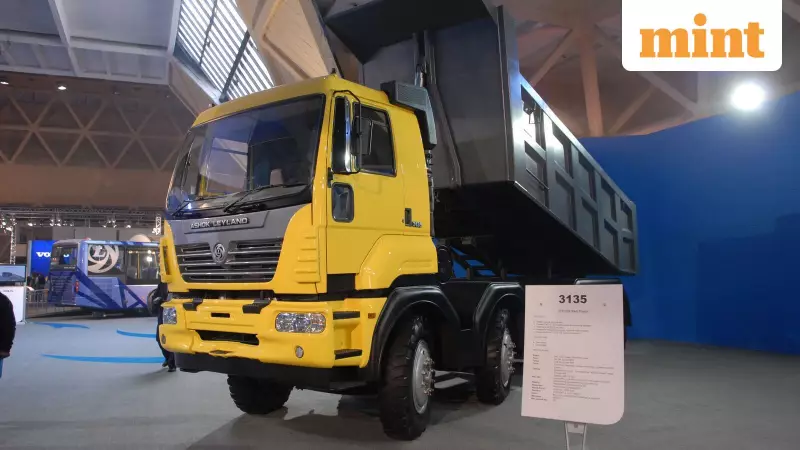
India's commercial vehicle (CV) sector is witnessing a powerful resurgence after a prolonged slowdown, and industry analysts point to Ashok Leyland as the prime beneficiary of this multi-year upcycle. A combination of regulatory tailwinds, improving economic indicators, and a long-overdue vehicle replacement phase is driving a broad-based recovery.
Structural Drivers Fueling the CV Comeback
The industry's turnaround follows six challenging quarters from April 2024 to July 2025, which included negative growth in the fiscal year 2025. The momentum is now building, supported by key reforms. A significant reduction in the Goods and Services Tax (GST) on trucks, tyres, lubricants, and spare parts—from 28% to 18%—is a major catalyst. This cut is projected to boost profits for small transporters by an impressive 30–50%.
Simultaneously, truck freight rates have seen double-digit growth since April 2025. Coupled with lower operating costs, this surge is enhancing fleet utilization and overall profitability for operators. These structural improvements are reducing vehicle payback periods by an estimated 4 to 6 months.

With the average age of India's commercial fleet hovering around 10 years, a robust replacement cycle has finally emerged as a critical demand driver. Historical trends suggest that such upcycles in the medium and heavy commercial vehicle (MHCV) segment can persist for up to six years. Financial firm InCred Equities forecasts industry volume growth of 10% in FY26, accelerating to 16% in FY27 to surpass the previous FY19 peak, before moderating to 7% in FY28.
Ashok Leyland's Multi-Pronged Growth Strategy
As India's second-largest CV manufacturer by volume, commanding a 19% market share, Ashok Leyland is perfectly positioned to capitalize on this revival. The company holds a dominant 31% share in the lucrative MHCV segment. In light commercial vehicles (LCVs), it ranks third with an 11% share, trailing Tata Motors and Mahindra & Mahindra.
The company's financial performance reflects the operating recovery. Its standalone revenue grew 9.3% year-on-year to ₹9,588 crore in the second quarter of FY26 (July-September 2025). A notable strength is the expansion of its non-CV businesses—aftermarket services, power solutions, and defence—which together now contribute roughly half of its consolidated revenue. This diversification provides a margin buffer and reduces exposure to the inherent cyclicality of the truck market.
During the September quarter, Ashok Leyland's Ebitda jumped 14.3% to ₹1,162 crore, with margins expanding by 50 basis points to 12.1%. The company also transformed a net debt position into a net cash surplus of ₹1,000 crore.
Volume Momentum and Export Ambitions
Sales data confirms the broadening recovery. The MHCV industry grew 4% in Q2FY26, with Ashok Leyland selling 21,647 trucks and 4,660 buses domestically. Its LCV volumes rose 6.4% to 17,697 units, outperforming the market. The company gained market share in the first half of FY26, increasing its MHCV hold by 50 bps and LCV share by 90 bps.
A standout performer is the exports segment, which surged 45% year-on-year to 4,784 units in Q2, driven by demand from the GCC, Africa, and SAARC regions. Ashok Leyland aims to export 18,000 units in FY26, up from 15,000 in FY25, with a three-year target of 25,000 units and a strategic focus on the ASEAN region.
Electric Transition and Future Outlook
Beyond the conventional engine cycle, Ashok Leyland is aggressively building its alternative fuel portfolio, including electric, CNG, LNG, and hydrogen vehicles. Its electric vehicle subsidiary, Switch Mobility, is transitioning from development to commercial viability. It sold approximately 600 electric buses and 600 e-LCVs in H1FY26, achieving profitability at both the Ebitda and PAT levels.
The company is also strengthening its control over the EV supply chain by entering battery manufacturing. Its Electric Mobility as a Service (eMaaS) business operated over 1,100 electric buses in Q2FY26 with 98% availability.

While the current upcycle presents a significant opportunity, the inherent cyclicality of the CV industry remains a risk. However, with multiple growth levers—from domestic replacement demand and infrastructure spending to export expansion and a maturing EV business—Ashok Leyland appears strategically positioned for sustained outperformance in the coming years.





