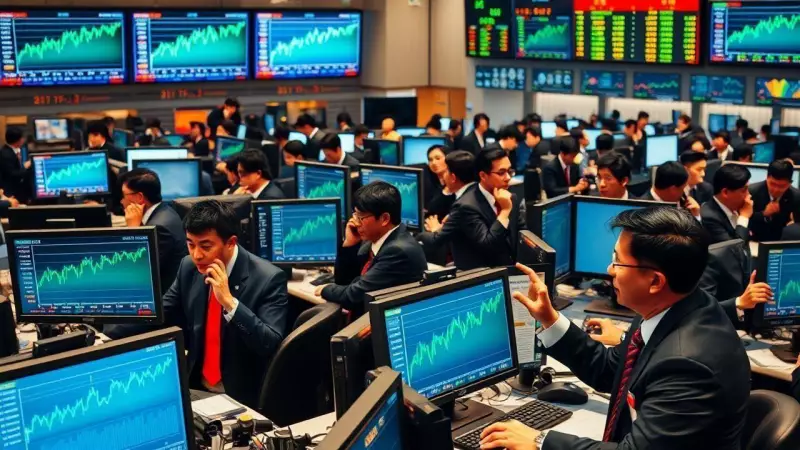
Stock markets across Asia posted solid gains on Friday, with investors positioning themselves ahead of crucial US employment data and a landmark Supreme Court ruling concerning former President Donald Trump's tariff policies. The trading day was characterized by broad-based optimism, particularly in Northeast Asia.
Regional Markets Show Strength
Japan's benchmark Nikkei 225 index surged by a remarkable 641 points, or 1.26%, to reach 51,758 around 9:45 AM Indian Standard Time. The rally reflected strong investor confidence and a positive start to the new year. South Korea's Kospi was also firmly in positive territory, adding 28 points to climb to 4,580.
Mainland Chinese markets joined the upward trend. The Shenzhen component index advanced by 0.5%, while the Shanghai Composite rose by 0.3%. These gains were partly supported by economic data showing Chinese consumer prices rising at their fastest pace in nearly three years. Hong Kong's Hang Seng Index (HSI) was relatively muted, edging up a mere 8 points to 26,158.

Seoul's Record-Breaking Run
Seoul's market stood out this week, hitting several record highs. The bullish sentiment was primarily fueled by optimism in the technology sector and expectations of robust corporate earnings. This performance underscored the region's strong momentum as it moved deeper into January.
All Eyes on US Data and Supreme Court
The focus for global traders now shifts squarely to the United States. The highly anticipated US non-farm payrolls report, due for release later in the day, is expected to significantly influence the Federal Reserve's monetary policy trajectory. Analysts note that a sharp disappointment in job numbers could revive speculation about another interest rate cut, while a stronger-than-expected report would likely dampen such expectations. The central bank had previously signaled a potential pause in its rate-cutting cycle after three consecutive reductions.
Simultaneously, investors are closely monitoring a pivotal case before the US Supreme Court. The court is examining the legality of the sweeping global tariffs implemented during the Trump administration. The ruling will determine whether the White House had the authority to impose these measures under declared economic emergency powers. A critical secondary question is whether companies that paid the duties should be reimbursed if the tariffs are deemed illegal. A decision against the government could have major implications for US economic and fiscal planning.
Wall Street's Mixed Session and Oil Volatility
On Wall Street, trading ended mixed on Thursday. There appeared to be a rotation underway, with some traders moving away from the large-cap technology stocks that drove last year's rally and toward smaller-cap companies. Meanwhile, oil prices continued their ascent, extending gains after a rally of over 3% on Thursday. Markets reacted to heightened geopolitical tensions after former President Trump warned Iran would face severe consequences if it targeted protesters amid civil unrest linked to an economic crisis. Earlier in the week, oil prices had dipped following Trump's announcement that Venezuela would ship millions of barrels of oil to the US after a change in its leadership.