

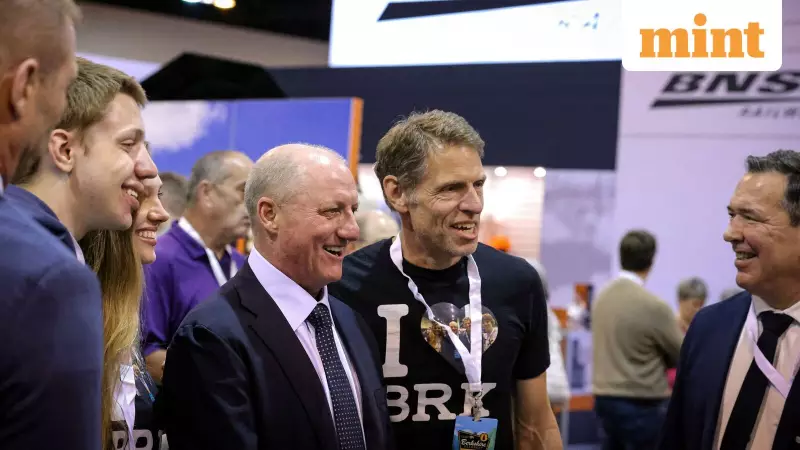
Warren Buffett's legendary tenure at the helm of Berkshire Hathaway has officially concluded. As of today, Greg Abel assumes the role of Chief Executive Officer, stepping into the shoes of the iconic "Oracle of Omaha." The transition, meticulously planned for years, places Abel at the controls of one of America's largest and most admired conglomerates. His immediate and most daunting challenge? Deciding the fate of the company's monumental cash reserve, which stood at a staggering $358 billion at the end of September.
The $358 Billion Question: To Spend or to Save?
The colossal cash pile represents both an enormous asset and a significant test for the new leader. Under Buffett, Berkshire has been a net seller of equities for 12 consecutive quarters, a signal that the veteran investor found market prices too high for meaningful long-term returns. This conservative stance, coupled with a pause in share buybacks for five straight quarters, has led to this unprecedented liquidity.
Abel has acknowledged the cash as an "enormous asset" that provides a crucial cushion during potential market downturns. However, analysts warn that holding such a large sum could lead to diminishing returns if the Federal Reserve cuts interest rates. The pressure is on for Abel to deploy this capital wisely, whether through a major acquisition, renewed stock purchases, or even the unprecedented step of issuing a dividend—something Buffett resisted for decades, barring a single 10-cent payout in 1967.

Who is Greg Abel? The Low-Profile Successor
Unlike his famously charismatic predecessor, Greg Abel has maintained a notably low public profile. The 63-year-old Canadian-born executive joined Berkshire over two decades ago when the company acquired MidAmerican Energy, where he was president. He steadily climbed the ranks, earning Buffett's unwavering trust. Since 2018, he has overseen all of Berkshire's vast non-insurance operations, a portfolio spanning railways (BNSF), energy, candy, footwear, and building materials.
Colleagues and friends describe him as fiercely competitive, a trait honed on the hockey rinks of his youth, which he credits for shaping his leadership and team-building skills. He is an assistant coach for his son's hockey team and values his role as a father and mentor. "If I had to be remembered as something right now, obviously I’d want to be remembered as a great father, but equally, a coach," Abel said at the 2025 annual meeting.
A Different Berkshire in a Different Era
Abel is not inheriting the same company Buffett built from scratch. Today, Berkshire is a behemoth with a market value exceeding $1 trillion, employing roughly 400,000 people. Its sheer size means growth will inevitably be slower, and investment decisions must be more prudent than ever. Buffett himself has designed Berkshire as a decentralized conglomerate, purchasing self-sufficient companies that can thrive independently of headquarters.
This structure means Abel doesn't need to be the next stock-picking oracle. His mandate is stewardship. Buffett has expressed full confidence, stating Abel "understands businesses extremely well" and should handle capital allocation independently. However, the market has shown some nervousness; Berkshire's Class B shares have dipped about 7% since Buffett's retirement announcement, a drop some attribute to the loss of the "Buffett premium."
Shareholders, while watchful, are giving Abel room to lead. They don't expect televised cameos or market-calming op-eds. Instead, they anticipate a steady, disciplined hand guiding Berkshire's next evolution. As Bill Stone of Glenview Trust noted, "Buffett and Munger took the company to this point. It may, in fact, be right that a different kind of person could take it further." The journey for Greg Abel and the $358 billion question begins now.






