

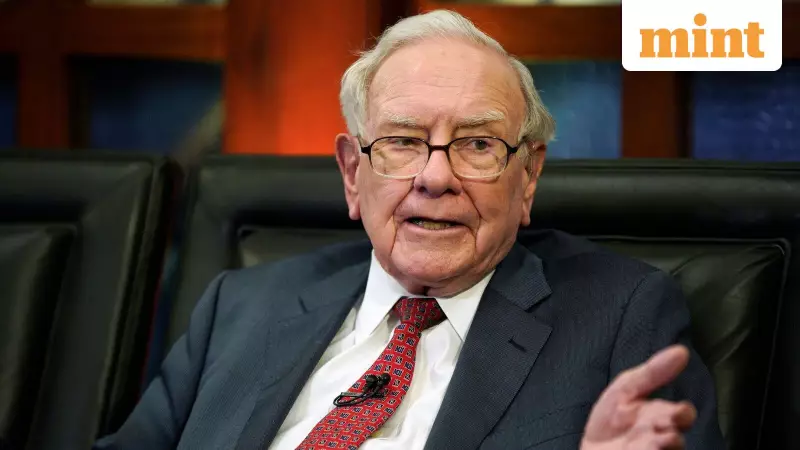
The year 2025 marked the end of an era for corporate America as Warren Buffett, the legendary investor and Chairman of Berkshire Hathaway, concluded his final year as the company's Chief Executive Officer. True to his reputation as a patient and disciplined dealmaker, Buffett navigated a year of record stock market highs by largely watching from the sidelines, allowing Berkshire's cash reserves to swell to an unprecedented level while preparing for a leadership transition that had been years in the making.
A Year of Strategic Caution and Record Cash
In a financial landscape dominated by artificial intelligence hype and volatile global trade tensions, Buffett's strategy was defined by restraint. Berkshire Hathaway sold $10 billion more in stocks than it purchased during the first nine months of the year, putting 2025 on track to be its third consecutive year as a net seller of equities. This cautious approach resulted in the company's cash pile ballooning to a historic $358 billion, a war chest Buffett famously builds to deploy during market downturns.
One of the most notable sales was a portion of Berkshire's massive stake in Apple Inc. Despite the tech giant's stock climbing 9.5% through late December, Buffett's company sold over 60 million Apple shares in the second and third quarters of 2025. This move came as many investors feared a bubble in the technology sector. However, Apple remains one of Berkshire's cornerstone "four giant" holdings.

The Final Major Deal and a Surprise Exit
While largely a seller, Buffett did authorise one final, significant acquisition. In 2025, Berkshire agreed to pay $10 billion in cash to acquire OxyChem, the petrochemicals producer owned by Occidental Petroleum. Analysts, like Morningstar's Greggory Warren, noted that this cash deal likely allowed Berkshire to secure the asset at an attractive discount, a classic Buffett manoeuvre.
However, the defining moment of the year came not from a financial transaction, but from a personnel announcement. In May 2025, during Berkshire's annual meeting in Omaha, Nebraska, Buffett revealed he would step down as CEO at year's end, handing the reins to Greg Abel, the Vice Chairman of noninsurance operations. The timing surprised even Abel. In a Thanksgiving letter to investors, Buffett expressed his full confidence in Abel's capabilities, particularly in understanding the complex property and casualty insurance business.
Navigating Challenges and the Post-Buffett Era
The year was not without its challenges for the conglomerate. A past investment turned sour when packaged food giant Kraft Heinz announced it would split in two, effectively undoing a 2015 merger financed by Berkshire and 3G Capital. Buffett had previously admitted in 2019 that they overpaid for the deal.
As the transition loomed, market sentiment shifted. Berkshire's stock price fell more than 6% following Buffett's departure announcement. Key executives also began to move on, with Geico CEO Todd Combs leaving for JPMorgan Chase and longtime CFO Marc Hamburg set to retire in June 2026. Bill Stone of Glenview Trust observed that without Buffett as the central magnet, Berkshire would start to resemble a "more normal company."
Throughout the year, Buffett remained characteristically candid. In March, weeks before former President Trump's import tariffs triggered a market crash, he warned that such tariffs were an "act of war." At the annual meeting, when questioned about the massive cash reserve, he affirmed he would not hesitate to spend $100 billion if the right opportunity arose, stating, "We will be bombarded with offerings that we’ll be glad we have the cash for."
Chris Bloomstran of Semper Augustus Investments Group, a longtime Berkshire investor, summarised Buffett's final act: "Warren exits in his final year having invested the same ways he did for six decades: patiently opportunistic and never placing the company in harm’s way." As the curtain falls on his CEO tenure, Buffett leaves behind a fortress-like company, a clear successor, and an indelible legacy of value-oriented, patient capitalism.






