

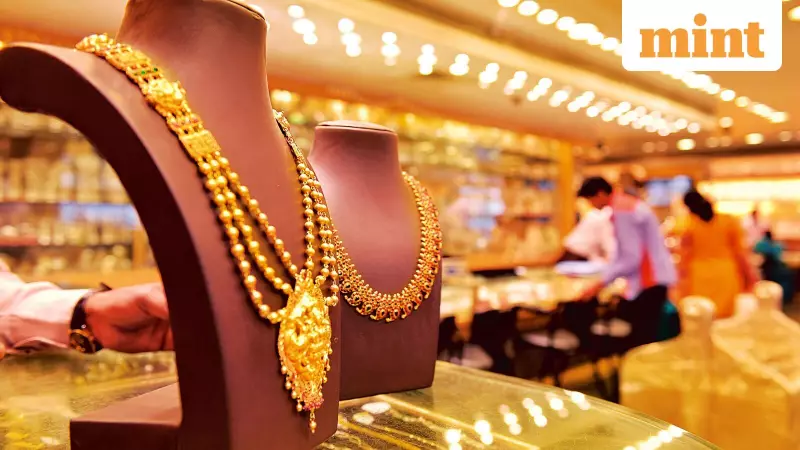
In a surprising market twist, the blistering rally in gold prices has completely failed to lift the fortunes of most listed jewellery companies in India. While gold has zoomed over 70% in the past year, a stark majority of gems and jewellery players on Dalal Street are languishing deep in negative territory.
The Great Divide: Gold vs. Jewellery Stocks
An analysis of the top 10 listed players by market capitalisation reveals a sharp divergence. Barring two notable exceptions—Titan Company, up 17%, and Thangamayil Jewellery, soaring 72%—the sector has been a sea of red. PC Jeweller remains the biggest laggard, plummeting 44% in one year. Senco Gold is a close second, crashing 43.5%, while Kalyan Jewellers and Sky Gold & Diamonds have plunged 35% and 38%, respectively.
Even recently listed entrants have not been spared. Shares of PN Gadgil, Bluestone Jewellery, and Motisons Jewellers are down 15%, 1%, and 45%, respectively, over the same period. This underperformance raises a critical question: why are gold prices and jewellery stocks moving in opposite directions?

Analysts Decode the Three Key Reasons
Market experts have pinpointed three primary factors behind this puzzling trend. Pravesh Gour, Senior Technical Analyst at Swastika Investmart, explains that the sharp rise in gold has not translated into gains for jewellers' stocks; instead, most have seen meaningful corrections.
Firstly, increased raw material costs are squeezing margins. "Gold is an input cost for jewellers, not a direct profit driver," Gour notes. When prices rise too rapidly, it hurts consumer affordability and can slow down demand, putting pressure on working capital requirements.
Secondly, weak volume growth is a major headwind. As gold becomes more expensive, customers either postpone purchases or opt for lighter jewellery pieces. This leads to lower sales volumes and reduced operating leverage, an effect particularly visible during price-sensitive wedding and festive seasons.
Thirdly, tighter liquidity conditions are adding to the strain. Rising interest costs are affecting jewellers with higher debt and significant inventory funding needs, Gour opined.
Titan's relative outperformance is attributed to its strong brand, better pricing power, and efficient inventory and hedging practices, which help cushion the blow of gold price volatility.
Consumer Sentiment and the Road Ahead
Commenting on ground-level demand, Sonali Shah Sheth, Founder of Sohnaa, observes that record-high prices are influencing buyer behaviour in nuanced ways. "There is a clear wait-and-watch sentiment among some consumers who expect prices to soften, while others believe prices may rise further and are therefore proceeding with purchases," she said.
Sheth highlights that cultural factors, especially weddings, continue to provide a strong demand cushion. Additionally, there is steady "soft demand" from consumers viewing gold as a long-term store of value. She also notes a growing curiosity around lower-karat gold, like 18kt and 14kt, for design-led and gifting jewellery, though a shift to 9kt is not yet a definitive trend.
The weakness of the Indian rupee has further complicated the scenario, making dollar-denominated gold even more expensive for local buyers and creating inventory dilemmas for jewellers.
What is the Investment Outlook for the Sector?
Despite near-term volume challenges, Choice Institutional Equities remains constructive on the jewellery sector's long-term prospects. They cite a sustained structural shift towards organised players, driven by mandatory hallmarking, deeper retail penetration in Tier-2/3 cities, and rising consumer preference for trusted brands.
The organised jewellery market, valued at approximately ₹1,752 billion in CY23, is expected to expand at a robust CAGR of ~19.4% over CY23–29E to reach about ₹5,079 billion. Analysts believe companies with strong visibility, operational stability, and design agility are well-positioned to navigate gold price trends.

Wedding-related demand is expected to remain a key structural driver, with the number of weddings staying stable at 10–12 million annually through 2030 and average spend trending upward.
However, Pravesh Gour advises a more cautious and selective approach, favouring stronger players with solid brands and balance sheets until demand and margins show clear improvement.
Which Jewellery Stocks Are Analysts Betting On?
Titan remains the top pick for Gour from a technical perspective. He notes the stock is in a well-defined uptrend, trading above its key moving averages, with momentum indicators supporting a positive bias. He identifies ₹3,850–3,900 as immediate support.
Meanwhile, Choice Institutional Wealth is positive on B2B players. They have a BUY rating on Shanti Gold International with a Discounted Cash Flow (DCF)-based target price of ₹350. For Shringar House of Mangalsutra, they maintain a BUY with a DCF-based target of ₹295.
Disclaimer: This analysis is for educational purposes only. The views are those of individual analysts. Investors are advised to consult certified experts before making any investment decisions, as market conditions can change rapidly.





