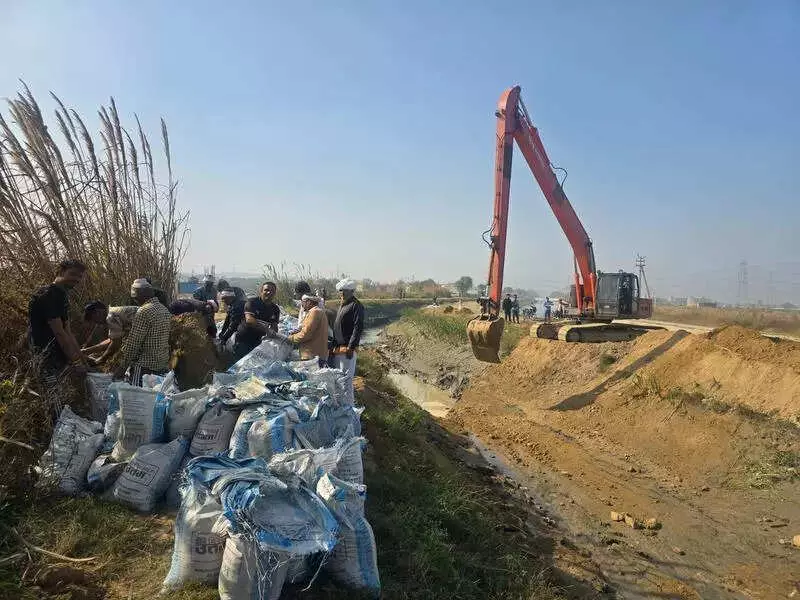
A major breach in the crucial Gurgaon Water Supply (GWS) canal on Sunday morning triggered emergency measures across the city, threatening a widespread water shortage. The incident disrupted the flow of raw water to the Basai water treatment plant, a key source of potable water for numerous residential and commercial areas.
Emergency Response to the Canal Breach
The crack in the canal was first detected around 7 am near Chandu village. A section of the canal developed a breach, causing water to gush out and flood adjacent agricultural fields. The force of the escaping water also led to significant soil erosion along parts of the embankment, exacerbating the damage.
Acting swiftly, the irrigation department took precautionary steps by shutting down the Mundakhera pump house. Repair teams were rushed to the site immediately to begin the critical work of plugging the breach. Ravinder, the executive engineer of the irrigation department, confirmed the immediate response, stating that although partial supply has been restored, full repairs are expected to be completed by Monday evening.

Impact on Gurgaon's Water Supply
The GWS canal normally channels approximately 100 cusecs of raw water to the Basai treatment plant. This plant is responsible for supplying treated water to vital sectors of Gurgaon, including Sectors 21, 22, 23, Udyog Vihar, DLF phases 1 to 3, MG Road, Palam Vihar, and Sushant Lok 1.
Following the breach, the discharge plummeted to about 50 cusecs, creating a substantial shortfall. To mitigate the crisis, the Gurugram Metropolitan Development Authority (GMDA) implemented contingency plans. Water was diverted from the Chandu Budhera treatment plant to supplement the supply at Basai.
A GMDA official detailed the measures, noting that while about 50 cusecs are currently being received and 20 cusecs have been diverted from Chandu Budhera, a shortfall of around 30 cusecs persists. The authority is utilizing stored water reserves and coordinating closely with the irrigation department to minimize disruption for residents until the canal is fully restored.
Aging Infrastructure and Future Plans
This incident has highlighted the fragile state of Gurgaon's water infrastructure. The city primarily depends on two treatment plants: Chandu Budhera, which supplies 400 million liters per day (MLD) from the NCR channel, and Basai, which provides 270 MLD from the GWS canal.
The 69.5 km long GWS canal, which originates from the Delhi branch at Kakroi Head and terminates at the Basai plant, was built in 1995 with a capacity of 175 cusecs. It serves the drinking water needs of Bahadurgarh and Gurgaon, along with 28 other water works. After decades of service, the canal is in poor condition.
Acknowledging the need for an overhaul, authorities have prepared a remodelling estimate of Rs 1,989 crore, which is currently awaiting government approval. This recent breach underscores the urgency of upgrading this critical piece of infrastructure to prevent future crises.