

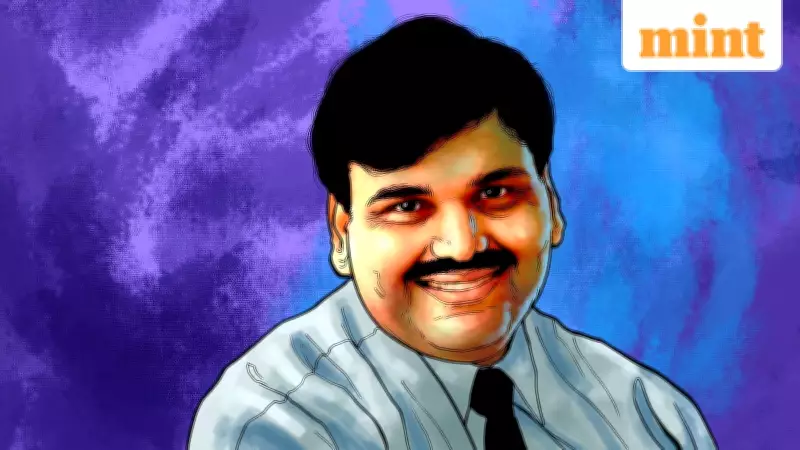
Harshad Mehta: The Architect of Chaos in India's Financial Reforms
The Harshad Mehta securities scam of 1992 stands as one of the most significant financial scandals in Indian history, revealing not just one man's fraudulent activities but the fundamental weaknesses in India's newly liberalized market architecture. This episode serves as a crucial case study in the complex relationship between economic freedom and regulatory oversight.
From Humble Beginnings to Market Titan
Born in 1954 in Gujarat to modest circumstances, Harshad Mehta's journey to becoming the Big Bull of Indian markets was anything but conventional. Before discovering his true calling on the Bombay Stock Exchange floor in the early 1980s, Mehta cycled through various odd jobs including selling hosiery, cement, and insurance policies. His remarkable ability to read market psychology and exploit information asymmetries—which were perfectly legal at the time—set him apart from his contemporaries.
Mehta's transformation from bear to bull operator mirrored India's own economic transition. In 1986, veteran bear operator Manu Manek (known as the Black Cobra) targeted Mehta by heavily short-selling shares of SPIC, a company where Mehta had significant investments. To protect his reputation amid rumors of impending bankruptcy, Mehta paid all his dues fourteen days early, absorbing a personal loss of ₹1.5 crore in the process.

The Perfect Storm: Liberalization and Market Euphoria
India's economic landscape underwent a seismic shift in July 1991 when the government dismantled the four-decade-old Licence Raj and embraced comprehensive economic liberalization. As unprecedented foreign capital began flowing into the country, a peculiar euphoria gripped the nation's financial markets. The Sensex surged spectacularly from approximately 1,000 points in mid-1990 to 4,091 points by March 1992, delivering over 300% returns during one of the index's most remarkable rallies.
First-time investors from all walks of life—including taxi drivers, paan wallahs, salaried employees, and small shopkeepers—poured their life savings into stocks, prompted by charismatic brokers who seemed to possess a Midas touch. Harshad Mehta emerged as the poster child for this new India of economic opportunity, though he would soon become its most prominent cautionary tale.
The Mechanics of Manipulation
Rather than following the patient investment approach of contemporaries like Rakesh Jhunjunwala and Radhakishan Damani, Mehta chose to exploit systemic weaknesses. His fraudulent scheme was deceptively simple in its mechanics. Banks at the time were required to maintain strict ratios of their assets in government securities but were prohibited from investing directly in equities. They operated a ready forward market involving short-term lending using bank receipts as collateral for government securities.
Mehta inserted himself as both broker and counterparty, convincing banks to issue him bank receipts for securities that either didn't exist or were never delivered. He then utilized this phantom capital to artificially hyper-inflate select stocks, creating an illusion of value that attracted countless unsuspecting investors.
The Collapse and Its Aftermath
The entire edifice came crashing down in April 1992 when journalist Sucheta Dalal exposed Mehta's fraudulent use of bank receipts. The Sensex plummeted from 4,467 points in April 1992 to 2,529 points by August of the same year. The total scam amount was estimated between ₹4,000-5,000 crore—a staggering figure that threatened to destabilize India's entire banking sector.
More devastating than the institutional impact was the human cost. The crash wiped out the life savings of countless first-time investors, many of whom never returned to the stock markets. This thinning of retail participation has had lasting consequences: while 62% of American adults own stocks today, India's participation rate remains at a mere 7%. Research consistently demonstrates that wider retail participation creates healthier, more resilient financial markets.

Regulatory Gaps and Systemic Failures
What made this catastrophic crash possible wasn't the absence of rules but rather fragmented enforcement and regulatory gaps. The Securities and Exchange Board of India (SEBI) had been established in 1988 but received statutory powers only in January 1992—mere months before the scam's exposure. Mehta essentially walked through doors left ajar by a system transitioning from state control to market freedom without building the necessary regulatory guardrails.
This pattern would repeat with depressing regularity in subsequent years through scams involving Ketan Parekh in 2001 and Abdul Karim Telgi, demonstrating that in free market systems, weak enforcement of existing laws and gaps in regulatory supervision inevitably enable fraudulent activities.
The Enduring Legacy and Lessons
Harshad Mehta spent his final years fighting dozens of criminal charges and civil suits. He was convicted in four cases before dying of cardiac arrest at Thane Civil Hospital in custody on December 31, 2001, at age 47. His story reveals that determined manipulators, especially those in collusion with system insiders, will always seek out and exploit regulatory cracks.
The reformers of 1991 had naively assumed that market discipline would naturally punish such operators. The real lesson from the Harshad Mehta saga isn't that free markets are inherently corrupt or that government control is preferable. Rather, it demonstrates that the architecture of economic freedom represents a complex engineering challenge. Every market is a designed system, and bad design inevitably invites bad actors.
In 1992, Harshad Mehta didn't break India's nascent capitalism—he revealed that the work of building robust market institutions had barely begun. His legacy serves as a permanent reminder that freer markets demand greater vigilance, not less, and that regulatory frameworks must evolve continuously to match the sophistication of market participants.





