

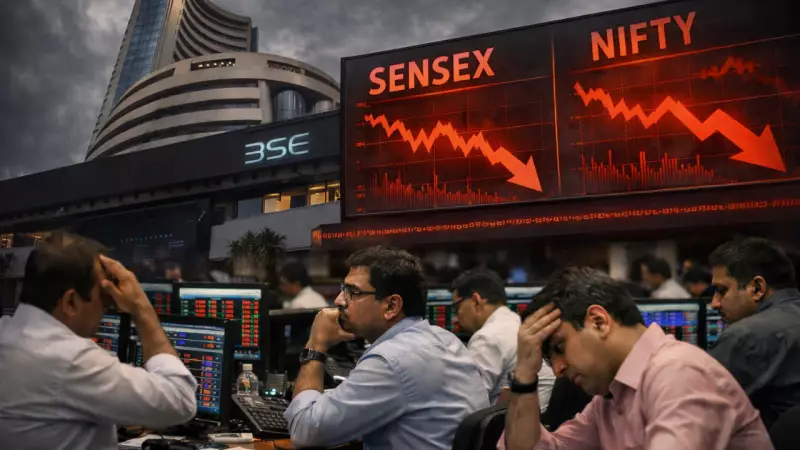
India's benchmark equity indices, the Sensex and Nifty, have experienced a significant decline of over 4% during January 2026, according to recent market data. This downturn has been driven by a combination of sustained foreign fund outflows, a weakening rupee, muted corporate earnings, geopolitical tensions, and renewed tariff concerns.
Market Performance Details
The 30-share BSE Sensex has fallen by 3,682.9 points, or 4.32%, while the 50-share NSE Nifty has dropped 1,080.95 points, or 4.13%, as reported by PTI. This marks a challenging start to the year for Indian equities, with both indices showing substantial losses amid a volatile trading environment.
Historical Context and Expert Insights
Santosh Meena, Head of Research at Swastika Investmart Ltd, noted that historically, similar pre-Budget trends in January have often seen sharp falls followed by recoveries post-Republic Day leading up to the Budget. Market participants are hopeful for a similar reversal this time, as January has traditionally been a weak month for equities. In January 2025, the Sensex declined 638.44 points, or 0.81%, and the benchmark also ended lower in January 2024, 2023, 2022, 2021, and 2020, highlighting a recurring pattern of January weakness.

Ponmudi R, CEO of Enrich Money, explained that geopolitical uncertainties and fresh tariff concerns have exerted a cascading impact on domestic equities in January 2026. The global risk-off environment has prompted aggressive selling by foreign portfolio investors, adding pressure on the rupee, which has slipped to record lows. The rupee hit a historic low of 92 against the US dollar on January 23 and has weakened by over 2% this month. Elevated crude oil prices and rising global bond yields have further fueled risk aversion, keeping investors cautious amid an uncertain global macro and geopolitical backdrop.
Earnings and Domestic Factors
Earnings disappointments from select heavyweight stocks across sectors, including IT, banking, and consumption-linked segments, have further dampened investor optimism, leading to a disappointing start to the year. Ravi Singh, Chief Research Officer at Master Capital Services Ltd, attributed the decline in domestic equities to a combination of persistent global and domestic headwinds. On the domestic front, underwhelming and cautious Q3 earnings commentary from several corporates emerged as a key trigger.
Renewed trade concerns involving the US and Europe, along with escalating geopolitical tensions in the Middle East, have kept global markets on edge. VK Vijayakumar, Chief Investment Strategist at Geojit Investments Ltd, added that foreign portfolio investors not only continued selling in the week ended January 23 but also stepped up the pace. Sentiments remained very weak due to sustained rupee depreciation, lack of finality on a US-India trade deal, and unimpressive Q3 results so far, which are not indicating any pick-up in corporate earnings.
Budget Expectations and Market Outlook
According to Axis Securities, with global uncertainty, domestic growth resilience, and fiscal discipline all in play, the Union Budget 2026-27 is expected to strike a balance between growth support and macro stability. Markets are likely to favour a Budget that sustains growth without compromising medium-term fiscal consolidation. Sudeep Shah, Head of Technical & Derivatives Research at SBI Securities, noted that geopolitical developments may influence near-term market moves, but earnings trends and domestic macro conditions will drive follow-through.
In the last week alone, the Sensex declined 2,032.65 points, or 2.43%, while the Nifty fell 645.7 points, or 2.51%, underscoring the ongoing volatility and challenges facing the Indian stock market as it navigates a complex landscape of domestic and international factors.






