

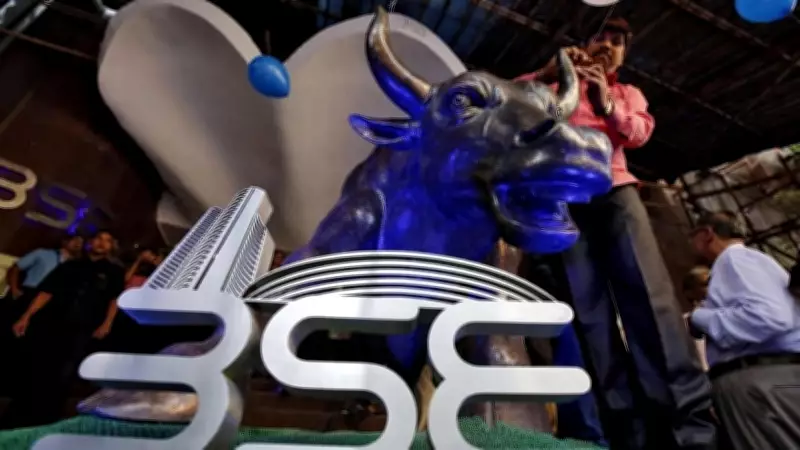
Indian Stock Markets Extend Losses Following RBI's Decision to Hold Interest Rates
The Indian stock markets continued their downward trajectory on Thursday, extending losses from the previous trading session. This persistent decline comes in the wake of the Reserve Bank of India's (RBI) recent decision to pause its cycle of interest rate cuts, a move that has injected uncertainty into investor sentiment across key sectors.
Major Indices Register Significant Declines in Morning Trade
In morning trading on February 6, 2026, the benchmark indices reflected the broader market unease. The 30-share BSE Sensex, a crucial barometer of the Indian equity market, edged lower by a substantial 368.37 points. This decline pushed the index down to a level of 82,945.56, marking a continuation of the bearish trend observed in recent sessions.
Similarly, the broader 50-share NSE Nifty was not immune to the selling pressure. The index dropped significantly by 146.7 points, settling at 25,496.10. The synchronized fall in both major indices underscores a widespread cautious approach among investors, who are reassessing their positions in light of the central bank's monetary policy stance.

RBI's Rate Pause Creates Market Headwinds
The primary catalyst for the current market weakness appears to be the RBI's announcement to maintain the status quo on interest rates. After a period of anticipated monetary easing, the pause has led to a recalibration of expectations. Market analysts suggest that the decision signals a cautious approach by the central bank towards inflation and economic growth, factors that directly influence corporate profitability and stock valuations.
This policy stance has particularly dampened sentiment in rate-sensitive sectors. The uncertainty surrounding future borrowing costs and economic momentum has prompted investors to book profits and adopt a wait-and-watch strategy, contributing to the downward pressure on the indices.
Information Technology Sector Bears the Brunt of the Sell-Off
A notable feature of today's trading session has been the pronounced weakness in the Information Technology (IT) sector. IT firms, which are significant constituents of both the Sensex and Nifty, have emerged as major laggards, leading the market decline.
The underperformance of IT stocks can be attributed to several interconnected factors:
- Valuation Concerns: Following a strong rally in previous quarters, many IT stocks were trading at elevated valuations, making them vulnerable to profit-taking in a risk-averse environment.
- Currency and Global Demand Fears: The RBI's policy can influence the rupee's trajectory. A stronger rupee, potentially stemming from the rate pause, can negatively impact the export-heavy IT sector's earnings. Furthermore, concerns about global economic slowdown affecting client spending in key markets like the US and Europe are weighing on the sector.
- Sector Rotation: Investors may be shifting funds from previously high-performing sectors like IT to others perceived as more resilient or undervalued in the current economic climate.
The collective drop in major IT stocks has had a disproportionate impact on the overall index performance, given their substantial weightage.
Market Outlook and Investor Sentiment
The immediate market outlook remains cautious. Traders and institutional investors are likely to closely monitor upcoming economic data, corporate earnings reports, and any further commentary from the RBI for directional cues. The persistence of selling pressure indicates that the market is in a consolidation phase, digesting the implications of the changed monetary policy landscape.
While the morning trade has set a negative tone, market participants will be watching for any potential recovery or increased volatility as the trading day progresses. The focus will remain on sector-specific developments and broader macroeconomic indicators to gauge the sustainability of this corrective phase in the Indian equity markets.






