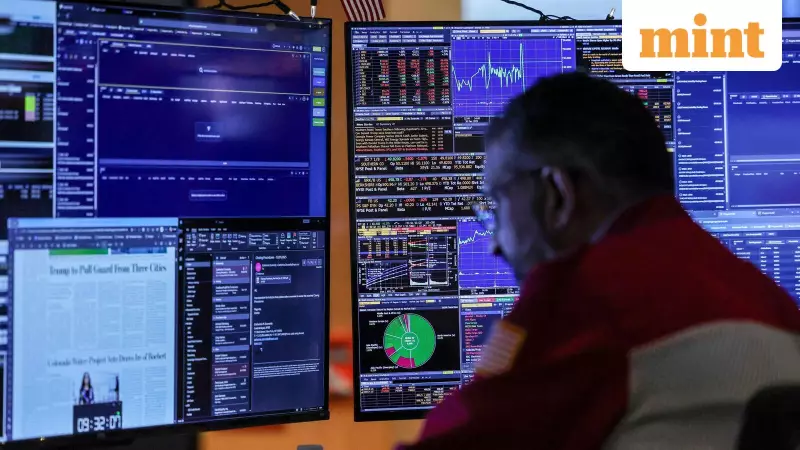
Geopolitical tensions stemming from former President Donald Trump's intervention in Venezuela are creating waves on Wall Street, but seasoned investors believe the underlying bull market remains firmly on track. The primary focus is squarely on domestic strengths: a robust U.S. economy, supportive government policies, and the transformative earnings potential of artificial intelligence.
Strong Fundamentals Underpin Market Confidence
Market experts point to solid pillars supporting equity prices. The S&P 500 surged an impressive 18% in 2025, recovering powerfully from an April low triggered by tariff fears. The benchmark index is now projected to see another year of double-digit growth. Major financial institutions have set a median price target near 7600 points for the S&P 500.
This optimism is fueled by expectations of expanding corporate profits, anticipated interest rate reductions from the Federal Reserve, and fiscal benefits from legislation like the One Big Beautiful Bill Act. "The S&P 500 can see another year of solid performance supported by continued solid economic growth, modest cutting from the Fed, and an eventual cooling of inflation," stated Lori Calvasina, head of U.S. equities at RBC Capital Markets.

Geopolitical Risks: A Manageable Threat?
While the ousting of Venezuelan leader Nicolás Maduro introduces uncertainty, analysts note that core market drivers are insulated for now. A significant factor is energy independence. With the U.S., Canada, and Latin America accounting for roughly 40% of global crude output, Washington holds substantial sway over oil markets, potentially mitigating price shocks.
"The equity market is more than capable of shrugging off oil price volatility, especially given the shift in the U.S.’s net oil export position," commented Thomas Mathews and Jonas Goltermann of Capital Economics. However, longer-term risks persist. Alex Veroude of Janus Henderson Investors warned that unilateral U.S. actions could set global precedents and complicate foreign policy, with potential ripple effects across supply chains.
The AI Boom and Concentrated Gains
The technology sector, powered by artificial intelligence, was the dominant force behind last year's market gains. This concentration brings both opportunity and risk. Savita Subramanian of Bank of America noted that S&P 500 earnings have hinged on two themes: Tech/AI and resilient U.S. consumer spending.
She raised a critical concern: "If AI reduces demand for professional service employees, this poses risk to the U.S.’s consumer-driven economy. The trillion dollar question becomes: what new jobs will be created by AI?"
Portfolio manager John Belton offers a nuanced view. He acknowledges that tech giants like Nvidia, Microsoft, Google, Apple, Amazon, and Meta are still expected to contribute significantly—around 50% of the S&P 500's anticipated 15.6% earnings growth. However, this is a decrease from approximately 70% in 2025, suggesting a broadening of market strength. Belton argues these 'Mag Six' companies still show robust growth and reasonable valuations.
The China-Taiwan Wildcard
The Venezuela situation carries an indirect risk for tech. As a major buyer of Venezuelan crude, China might feel emboldened to increase pressure on Taiwan, a critical hub for global semiconductor manufacturing. Any disruption there could directly impact the technology sector, which is currently trading at historically high valuations.
In conclusion, while eyes are on Venezuela, the market's trajectory in 2026 will likely be decided closer to home. The interplay between AI-driven earnings, Federal Reserve policy, and the enduring strength of the American consumer will determine if the bull market celebrates a fourth successful year.