

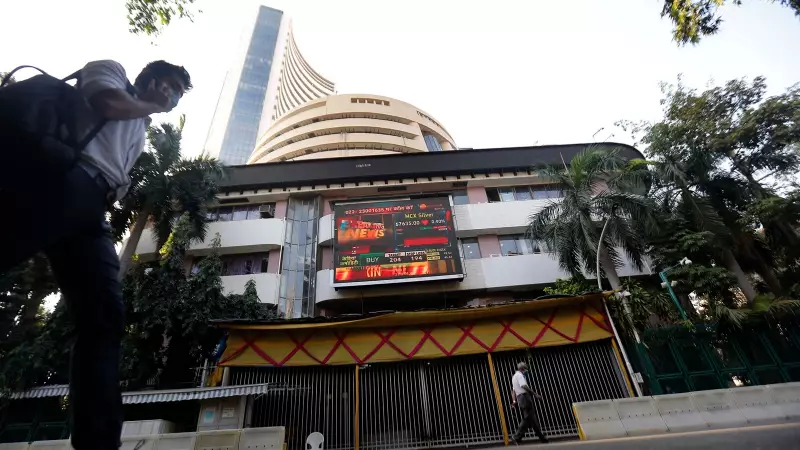
As the calendar turns to 2026, India's stock market stands at a promising juncture, with leading brokerages forecasting significant gains for benchmark indices. This optimism persists despite a turbulent 2025 marked by a weakening rupee and foreign investor outflows, with hopes now anchored on corporate earnings, macroeconomic stability, and a potential landmark trade agreement with the United States.
Analysts Bullish on Indices Despite a Volatile 2025
The year 2025 proved challenging for Indian equities, grappling with high valuations, geopolitical tensions, and global policy uncertainty stemming from US tariffs. A rapidly depreciating rupee triggered persistent foreign portfolio investor (FPI) outflows, yet the market demonstrated remarkable resilience. Both the Nifty 50 and the Sensex managed to end the year over 9% higher, closing at 25,969.85 on December 30, after recovering from a steep correction of around 18% earlier in the year.
This recovery culminated in both indices scaling new all-time highs in November, driven primarily by a rally in the financial sector and select large-cap stocks. Looking ahead, domestic brokerage Kotak Securities expects the Nifty 50 to surge over 12% to 29,120 points in 2026. Global firm Jefferies has set a slightly more conservative target of 28,300, implying a potential upside of 9%.

"Supported by lower inflation, tax reforms, and easier monetary policy, we believe Indian equities are set to be in a stronger position in 2026," HSBC analysts noted in a recent report. They highlighted consensus forecasts pointing to 10% earnings growth in FY26 and 16% in FY27. Valuations, they argue, have become more reasonable, with India's premium over other emerging markets returning to historical norms.
Rupee Weakness and the Promise of a US Trade Deal
The positive equity outlook exists alongside the rupee's significant weakness against the US dollar in 2025. The currency depreciated by approximately 5% over the year, breaching the 90 and 91 marks per dollar in December before intervention by the Reserve Bank of India (RBI) provided some support. It ended the year at 89.79 per dollar.
Analysts now believe this sharp decline has left the rupee undervalued. A key measure, the Real Effective Exchange Rate (REER), which values the rupee against a basket of 40 currencies adjusted for inflation, stood at 97.51 in November. A reading below 100 indicates undervaluation. This is a stark reversal from November 2024, when the REER was at 108.03, suggesting an overvaluation of about 8%.
Market participants see a potential catalyst for rupee stability and strength in the finalisation of a long-pending free trade agreement (FTA) between India and the US. Negotiations regained momentum after a period of strain caused by US tariffs on Indian imports of Russian arms and energy. An FTA is widely expected to restart foreign capital inflows, bolstering the currency.
Retail Investors Power the Market Amid FPI Exodus
A defining narrative of 2025 has been the contrasting behavior of foreign and domestic investors. While FPIs withdrew a net Rs 1.6 lakh crore ($18.22 billion) from Indian equities, domestic institutional investors (DIIs) poured in a massive Rs 7.7 lakh crore to more than compensate.
The retail segment has been instrumental in this domestic surge. November alone saw Rs 29,445 crore flow in via Systematic Investment Plans (SIPs), a figure close to an all-time high and 16% higher than the previous year. Demat accounts have swelled to 21.4 crore by end-November, a 20% annual increase. Despite this rapid growth, a SEBI survey from September reveals that only 9.5% of the Indian population currently invests in capital markets, indicating vast untapped potential.
Experts believe this retail momentum is likely to continue unless a severe and prolonged market downturn occurs. "They have got good returns in the last 5-6 years, so they have that bias to keep investing... only if there is a vast fall in the market, I believe, the flows could reduce," said Pravin Bokade, head of equity research at IDBI Capital.

In summary, the consensus among analysts is one of cautious optimism for 2026. With expectations of stronger earnings, a potential trade deal, and unwavering domestic investor support, Indian equities are poised for what could be another noteworthy year, building on the recovery and record-setting trends witnessed in late 2025.





