

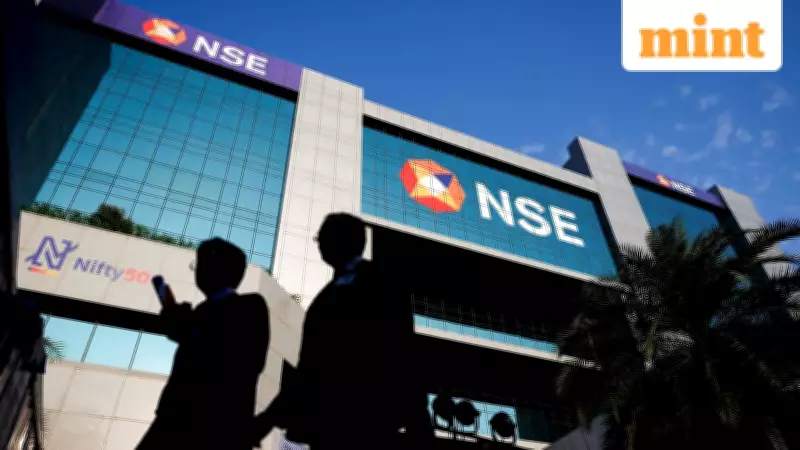
National Stock Exchange Calls for Government Review of STT Increase on Futures
Mumbai: India's premier stock exchange, the National Stock Exchange (NSE), has formally expressed hope that the government will reconsider the substantial hike in securities transaction tax (STT) on index and single-stock futures, as outlined in the Budget for fiscal year 2027. The exchange's leadership emphasized that this tax increase could negatively impact genuine hedging instruments used by long-term investors across market segments.
Exchange Leadership Voices Concerns About Hedging Instruments
Sriram Krishnan, Chief Business Development Officer at NSE, articulated the exchange's position during the third-quarter investor call. "The increase in STT is perceived as particularly detrimental for index and single stock futures," Krishnan stated. "These futures contracts are generally recognized as legitimate instruments for hedging purposes among long-term investors, rather than speculative trading vehicles."
Krishnan elaborated on the nature of these financial instruments, explaining that index futures involve contracts based on major indices like Nifty and Bank Nifty, while single-stock futures are derivatives tied to individual company stocks such as Reliance Industries and HDFC Bank. He noted that futures are not typically the preferred choice for traders due to the elevated costs associated with establishing positions through these instruments.

Formal Representations and Review Hopes
The NSE executive revealed that multiple industry representations are currently being made to government authorities regarding the STT adjustment. "We are aware that numerous appeals are being submitted to the government requesting a review or reconsideration of this STT hike," Krishnan confirmed. "We remain hopeful that some form of review might be undertaken, potentially examining the extent of the increase."
This appeal comes despite NSE's dominant market position, with the exchange commanding a remarkable 99.8% market share in equity futures as of December 2025. When questioned about potential volume impacts from the tax increase, Krishnan referenced historical precedents, noting that previous STT adjustments had not significantly diminished trading volumes, suggesting markets might absorb the forthcoming hike.
Budget Announcement Details and Tax Structure Changes
Finance Minister Nirmala Sitharaman announced a substantial 150% increase in STT on futures transactions during the budget presentation. The tax will rise to 5 paise per rupee effective April 1, up from the current rate of 2 paise on notional volumes. This represents the second STT adjustment on futures in recent years, following an increase from approximately 1 paise to 2 paise per rupee implemented in October 2024 through the FY25 budget.
For options contracts, which attract greater participation from traders, STT was increased by 50% to 15 paise per rupee from 10 paise per rupee on the seller. This calculation differs from futures taxation, as options tax is levied on premium turnover (traded value), whereas futures tax applies to the total contract or notional value. Notably, STT on equity cash transactions remained unchanged at 10 paise per rupee for both buyers and sellers.
Market Participants and Competitive Landscape
Futures contracts are predominantly utilized by several key market participants:
- Foreign Portfolio Investors (FPIs)
- Retail and High Net Worth Individual Investors
- Domestic Institutional Investors
- Proprietary Brokers
Within this ecosystem, retail/HNI investors and proprietary brokers typically serve as counterparties to domestic institutional investors and foreign portfolio investors, facilitating market liquidity and price discovery mechanisms.
Derivatives Dominance in Exchange Revenues
Derivatives continue to represent the most significant revenue stream for the National Stock Exchange. During the third quarter, equity options based on premium turnover accounted for 77% of NSE's standalone transaction fees, which totaled ₹3,006 crore. Equity futures contributed 11% to these fees, with equity cash transactions comprising the remaining portion.

Regarding market competition, NSE Managing Director and CEO Ashishkumar Chauhan addressed questions about market share in index options, stating, "In terms of competition taking market share, broadly that cycle is over." This comment came as NSE's market share in equity options stood at 73% in the December quarter, showing a slight decline from 76% in the previous quarter according to financial highlights presented to investors.
The exchange's leadership continues to monitor market developments while advocating for tax policies that support both market growth and investor protection objectives.





