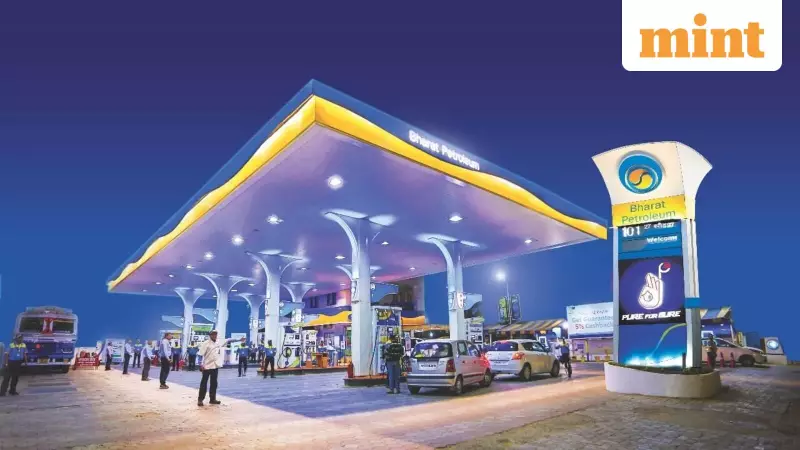
Shares of India's major state-run oil marketing companies witnessed a strong rally on Friday, January 16. Investors cheered a significant drop in global crude oil prices, which boosted sentiment for these counters after a period of weakness.
Sharp Gains for OMC Shares
Hindustan Petroleum Corporation Ltd (HPCL) led the charge, with its share price jumping as much as 3.7% to reach ₹456.50 per share. Bharat Petroleum Corporation Ltd (BPCL) rallied 3% to ₹367.75, while Indian Oil Corporation Ltd (IOC) gained up to 2% during the trading session.
Crude Prices Plunge on Easing Tensions
The rally followed the biggest single-day drop in crude prices after five straight sessions of gains. The likelihood of a US military strike on Iran receded late on Thursday. US President Donald Trump stated that Tehran's crackdown on protesters was easing, which allayed market fears about potential disruptions to oil supplies from the region.

Brent crude futures finished Thursday's session with a sharp decline of 4.15%, settling at $63.76 per barrel. West Texas Intermediate (WTI) crude futures fell even more, dropping 4.6% to $59.19 per barrel.
Why Middle East Developments Matter
Iran is one of the top producers within the Organization of the Petroleum Exporting Countries (OPEC). Earlier in the week, both Brent and WTI had climbed to multi-month highs. This surge came after protests flared in Iran and President Trump signaled the potential for US strikes. Reports on Thursday also indicated that Israel and several Middle Eastern allies had asked the US to delay any attack. They feared Iranian retaliation against their own countries.
This reduced the perceived risk of an immediate conflict that could have disrupted Iranian oil production or critical shipping routes in the strategically vital region.
How Falling Crude Helps OMCs
A decline in crude oil prices generally works in favor of oil marketing companies like BPCL, HPCL, and IOC. Crude oil forms the bulk of their input cost for refining operations. Cheaper crude directly lowers their overall expense of refining and producing fuels like petrol and diesel.
If retail pump prices are not reduced in proportion to the drop in crude, these companies can retain higher marketing margins. This scenario directly strengthens their earnings potential. Softer crude prices also help bring down India's massive oil import bill. They ease the working capital needs of the OMCs, leading to better cash flow management.
Furthermore, when OMCs carry inventory purchased at lower prices, they can book inventory gains. This happens if the final refined products are sold at current, relatively higher market prices.
Broader Market Context
On Wednesday, OPEC stated that oil supply and demand would remain balanced in 2026. The cartel projected demand rising in 2027 at a pace similar to growth seen this year. Separately, oil giant Shell released its 2026 Energy Security Scenarios on Thursday. The report made a bullish case for long-term energy demand and oil growth. Shell estimated that primary energy demand by 2050 could be 25% higher than last year's levels.
The sharp rebound in OMC shares highlights how sensitive these stocks are to global geopolitical developments and fluctuations in the underlying commodity price. For now, easing tensions have provided a much-needed boost to investor sentiment around these state-owned energy giants.