

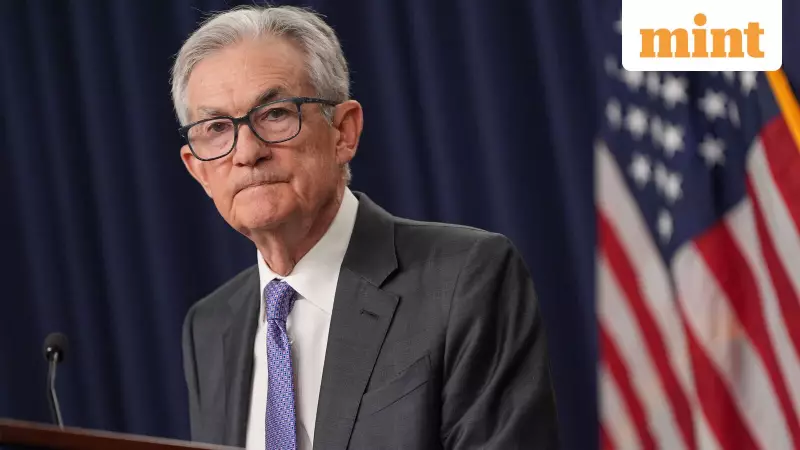
Powell's Final Fed Meetings: Political Pressure Amplifies Every Word
Federal Reserve Chair Jerome Powell enters the final stretch of his tenure with just three policy meetings remaining before his term concludes in May 2026. As the clock ticks down, every utterance from the central bank chief carries more significance than ever before, amplified by swirling political pressures and leadership uncertainty.
The Expected Pause and Powell's Pivotal Press Conference
The Federal Reserve is widely anticipated to maintain interest rates at their current level of 3.5% to 3.75% during this week's policy-setting meeting. This consensus extends across financial markets, policymakers, and even Powell himself. However, the real focus will shift to Powell's post-meeting news conference scheduled for January 28, which promises to be one of the most scrutinized events of his leadership period.
The central bank approaches 2026 having implemented three-quarters of a percentage point in rate cuts during the latter half of 2025. While inflation has retreated from its peak levels, it continues to hover above the Fed's 2% target, with recent economic indicators providing limited evidence of a definitive downward trajectory. The unemployment rate has gradually increased to 4.4%, though without dramatic spikes, while hiring has moderated without significant layoffs. This economic configuration naturally suggests a pause in rate adjustments.

According to Citi economists, Federal Reserve officials appear "comfortable leaving policy rates on hold." Yet the crucial signal, they emphasize, will emerge from Powell's communication style, particularly "how much Powell keeps the door open to future cuts."
Political Pressures and Market Sensitivity
Political headlines, trade uncertainties, and evolving expectations surrounding Federal Reserve leadership have rendered investors increasingly responsive to Powell's tone rather than pure economic data. Ben Fulton, chief executive of WEBs Investments, notes that investor sentiment can shift rapidly when policy speculation intersects with political developments, leaving financial markets susceptible to sharper movements should Powell's language alter expectations.
Powell has recently adjusted his approach regarding political interference. Last week, he attended Supreme Court arguments examining whether a president possesses authority to remove a sitting Fed governor. Days earlier, he released a video statement following Department of Justice subpoenas connected to a criminal investigation stemming from his congressional testimony about Federal Reserve headquarters renovations.
The White House has cited escalating costs as evidence of mismanagement and suggested Powell misled Congress regarding the project's scope—an allegation he firmly rejected in his video address. "The threat of criminal charges represents a consequence of the Federal Reserve establishing interest rates based on our optimal assessment of public benefit rather than presidential preferences," Powell declared.
Leadership Transition and Market Implications
This political turbulence has redirected attention from the Fed's post-meeting policy statement—expected to mirror December's version—toward Powell's news conference. Investors will closely monitor how Powell articulates the Federal Reserve's role amid mounting political pressures, with bond markets already displaying strain in response to geopolitical tensions and shifting U.S. policy expectations.
Leadership uncertainty introduces another complexity layer. President Donald Trump has indicated he will likely retain National Economic Council Director Kevin Hassett, redirecting speculation toward former Fed governor Kevin Warsh or BlackRock executive Rick Rieder as potential Powell successors. Financial markets interpret Warsh's potential selection as a more hawkish configuration, with Treasury yields rising as investors price in delayed rate cuts.

Powell's remaining three policy meetings unfold against this backdrop of transition. Trump is expected to nominate his successor shortly, potentially seating the new appointee on the Board of Governors alongside Powell as early as the March meeting. Whether Powell completely resigns from the board or continues as a governor until 2028 remains uncertain. For now, this period may represent among the final instances Powell speaks without a designated successor on the board.
The Data-Dependent Path Forward
Powell will likely reiterate on Wednesday that policy decisions occur meeting by meeting, emphasizing that Federal Reserve officials require additional economic data before considering further rate adjustments. Whether financial markets receive this message clearly may ultimately depend on the political environment surrounding these crucial final months of Powell's chairmanship.





