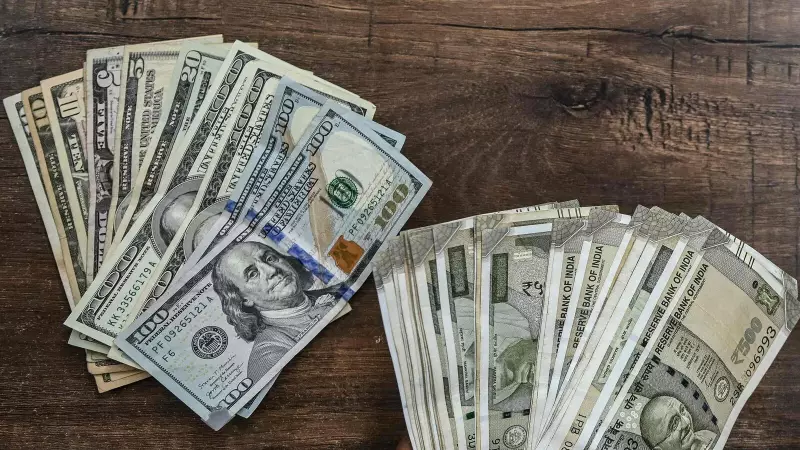
Market analysts predict the Indian rupee could decline to approximately ₹91.50 against the US dollar over the next three months. This forecast follows the currency's recent tumble to a historic low, driven by a combination of technical breakdowns, significant capital flight, and a deteriorating external account position.
Technical Charts Signal Further Weakness
After breaking past the psychological 90-per-dollar barrier on Wednesday, the rupee plummeted to an unprecedented low of 90.56 on Thursday before recovering slightly to settle at 89.98. According to Ajay Suresh Kedia, founder of Kedia Advisory, the dollar-rupee pair has executed a strong weekly breakout above 89.84, setting the stage for more gains for the greenback.
"The pair has completed a large cup-and-handle pattern, with the price rallying toward the 161.8% Fibonacci extension at 90.02, which has now been successfully tested," Kedia explained. He emphasized that as long as the pair trades consistently above 88.73, the bullish trend for USD/INR remains intact. His analysis points to a next target of 91.50 near the 200% Fibonacci level, with crucial support positioned at 89.64 and 87.63.

Fundamental Pressures Mounting
Beyond the charts, the rupee is confronting severe fundamental headwinds. Foreign portfolio investors (FPIs) have been relentless sellers, offloading Indian shares worth ₹13,121 crore as of December 4, 2025. This selling spree has pushed the net outflow for 2025 to a staggering ₹1,56,796 crore, as per NSDL data.
Kedia also highlighted that Foreign Direct Investment (FDI) inflows have hit their lowest point since 1990. "Reduced foreign investment weakens dollar supply and hurts currency stability," he stated. Simultaneously, India's current account deficit (CAD) is expected to widen significantly. Economists project the CAD for FY26 could reach 1.2% to 1.3% of GDP if high US tariffs persist, doubling from the 0.6% of GDP recorded in FY25.
The external trade situation adds to the worry. India's goods trade deficit ballooned to a record $41.68 billion in October, fueled by surging gold imports and the impact of US tariffs, far exceeding market expectations.
Analysts Weigh In on the Outlook
Rahul Kalantri, VP of Commodities at Mehta Equities Ltd., noted the rupee's underperformance. "The Indian rupee is trading at its lowest level against the US dollar despite the economy growing strongly at 8.2% last quarter. In 2025, the rupee has fallen about 4–5% so far, making it one of the poorest-performing Asian currencies," he said. He attributed the pressure to slow export growth, uncertainty around a US trade deal, and persistent FPI outflows.
Rahul Gupta, CBO of the Ashika Group, outlined the near-term trajectory. "In the near term, the rupee is likely to remain under pressure and could trade in the 89.50–91.20 range, especially if crude oil prices stay elevated and foreign investors remain risk-averse," Gupta said. He added that a sustained recovery hinges on a revival in foreign inflows, clarity on global interest rate cycles, and improved export momentum. Until then, the currency is expected to remain weak but orderly, with the Reserve Bank of India likely intervening selectively to curb volatility.
Providing a broader perspective, Nikunj Saraf, CEO of Choice Wealth, advised investors to look at both global and domestic factors. "When interpreting rupee weakness, investors should recognise both that global dollar strength is a headwind, but also that India's trade deficit and capital flow dynamics are the core domestic challenge requiring attention," Saraf concluded.