

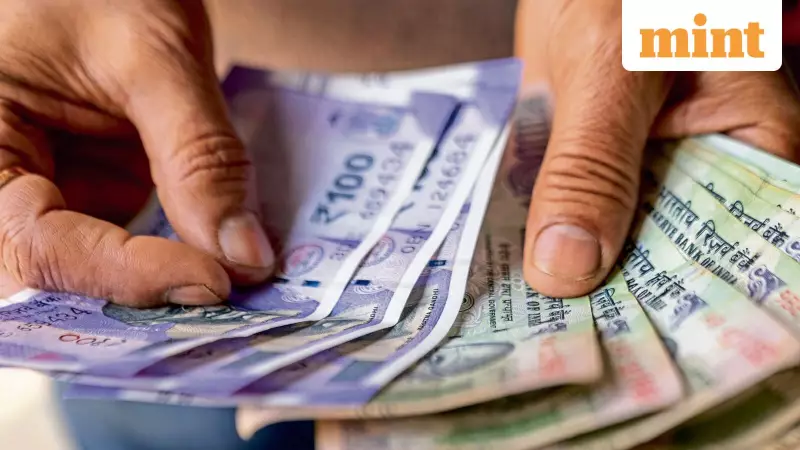
The Indian rupee reversed its recent downward trend on Tuesday, registering gains against the US dollar. The domestic currency appreciated by 12 paise to close at a provisional rate of 90.18 against the American currency, putting an end to a four-session decline.
Market Dynamics and Trading Session
Forex market experts attributed the rupee's recovery primarily to a softening US dollar index in global markets. However, they noted that significant appreciation was limited by weaker domestic stock markets and ongoing geopolitical concerns involving the United States and Venezuela.
During the trading session at the interbank foreign exchange market, the rupee commenced trading at 90.22 against the greenback. It moved within a narrow band, fluctuating between 90.08 and 90.25, before finally settling at the day's high of 90.18. This closing marks an improvement from Monday's finish, where the rupee had closed 10 paise lower at 90.30.

Analyst Views and Influencing Factors
Anuj Choudhary, Research Analyst at Mirae Asset Sharekhan, provided a mixed outlook. He stated that the rupee is expected to face downward pressure due to risk aversion in global markets, fueled by the US-Venezuela tensions. He further highlighted that rising crude oil prices and continued outflows of foreign institutional investor (FII) funds could weigh on the currency.
"We expect the Rupee to trade with a negative bias on risk aversion in global markets emanating out of geopolitical tensions between the US and Venezuela. Surge in crude oil prices and FII outflows may further pressurise the Rupee," Choudhary said.
On a positive note, he added that a weak US dollar, driven by disappointing economic data from America, and potential intervention by the Reserve Bank of India (RBI) could offer support to the rupee at lower levels.
Global and Domestic Backdrop
The US dollar index, which measures the currency's strength against a basket of six major rivals, was down 0.06% at 98.21. This decline followed the release of US ISM Manufacturing PMI data, which fell short of market expectations.
On the commodities front, Brent crude futures, the global oil benchmark, rose by 0.47% to trade at USD 62.05 per barrel. Higher oil prices are a concern for India, a major importer, as they can widen the trade deficit and pressure the rupee.
Domestic equity markets witnessed a sell-off. The benchmark S&P BSE Sensex dropped 376.28 points to end at 85,063.34. Similarly, the NSE Nifty 50 index declined by 71.60 points to close at 26,178.70. Adding to the negative sentiment, foreign institutional investors (FIIs) were net sellers, offloading equities worth ₹36.25 crore on Monday, as per exchange data.
The domestic economic landscape showed signs of moderation. The HSBC India Services PMI Business Activity Index eased to 58.0 in December from 59.8 in November. This indicates the slowest pace of expansion in the services sector in eleven months, since January 2025. The survey noted a deceleration in new work and output, leading companies to pause on hiring additional staff.
In summary, the rupee's brief recovery was a function of global dollar weakness, but its trajectory remains vulnerable to a complex mix of geopolitical risks, volatile crude oil prices, foreign fund movements, and domestic economic indicators.






