

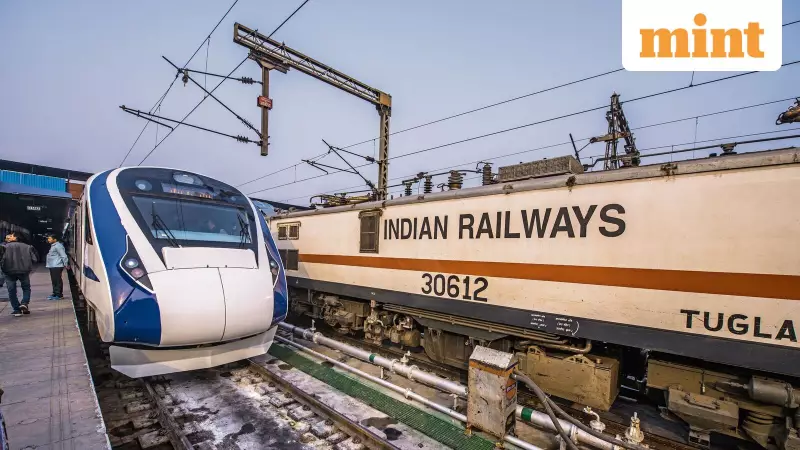
Shares of state-owned railway infrastructure company Rail Vikas Nigam Ltd (RVNL) have witnessed a sharp rally, climbing over 6% in just two trading sessions to reach ₹368. This surge was triggered by the Indian Railways implementing its second passenger fare revision this year, effective from 26 December 2025.
The Sentiment Boost vs. Financial Reality
The back-to-back fare hikes in July and December 2025 signal a strong government intent to bolster the financial health of Indian Railways. The cumulative annual revenue gain from these increases is estimated at approximately ₹4,000 crore. This improved financial position is seen as creating potential headroom for higher capital expenditure (capex) on modernization and expansion projects in the future.
However, the stock market reaction appears disproportionately large. In the same two days that RVNL's market capitalization expanded by roughly ₹4,000 crore, the estimated entire annual revenue gain for the Indian Railways from the fare hikes is also about ₹4,000 crore. This raises a critical question: is the market getting ahead of the actual numbers?

Analysts point out that not all of the additional ₹4,000 crore will be available for fresh capex. A significant portion is likely to be absorbed by rising operational costs, including manpower expenses and pension liabilities. Furthermore, RVNL is just one of several public sector units that execute railway projects, meaning any increased spending will be shared.
Underlying Fundamentals Tell a Cautious Tale
Beyond the sentiment-driven rally, RVNL's core financial performance has been subdued. Between FY22 and FY25, the company's revenue grew at a meagre 1% compound annual growth rate (CAGR) to ₹19,923 crore. More concerningly, its Earnings Before Interest, Tax, Depreciation, and Amortization (Ebitda) declined at a 2% CAGR to ₹1,125 crore.
The Ebitda margin has consistently eroded, falling from 6.1% in FY22 to 5.6% in FY25. This pressure is attributed to a shift in the project mix. The company is now executing more competitively bid projects, which carry thinner margins, compared to the higher share of nominated orders it received in the past due to its public sector status.
This weakness persisted into the first half of the current fiscal year, FY26. Revenue for the six months ended September 2025 was largely flat year-on-year at ₹9,032 crore. Ebitda plunged by a sharp 40% to ₹270 crore, dragging margins down by 210 basis points to just 3%.
Future Outlook and Rich Valuations
Despite the weak first half, RVNL's management has retained its FY26 revenue growth guidance of at least 5%, targeting around ₹21,000 crore. This optimism is based on expectations of a significant ramp-up in project execution in the second half (H2), which has historically been stronger. The company hopes that full-year Ebitda margins could recover to 6.5-7% if execution improves as planned.
A key strength for RVNL is its robust order book, which stood at around ₹90,000 crore as of 30 September 2025. This provides strong revenue visibility for the next three years. However, a notable 52% of this order book consists of the very same margin-dilutive, competitively bid contracts.
Even with expectations of order book-led growth and potential margin improvement, RVNL's current valuation gives many analysts pause. The stock is trading at a hefty price-to-earnings (P/E) multiple of 40x based on FY27 estimates. This represents a significant premium compared to the 22x-28x multiples assigned to the core engineering and construction business of industry giant Larsen & Toubro.
While the fare hikes have undoubtedly improved sentiment around the railways sector and its associated companies, long-term investors are advised to look beyond the short-term frenzy. The sustainability of RVNL's rally will ultimately depend on a meaningful translation of railway capex into improved profitability and stronger financial performance for the company itself.






