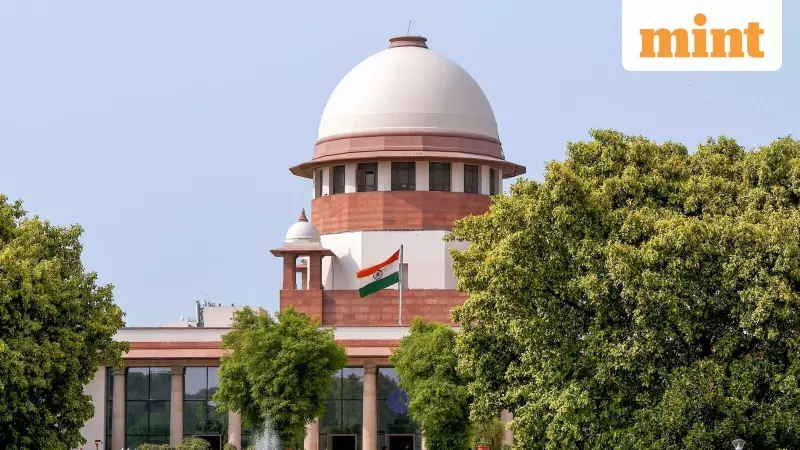
In a significant ruling, the Supreme Court of India has dismissed an appeal by Reliance Industries Ltd (RIL) challenging a penalty imposed by the capital markets regulator. The court upheld a Securities Appellate Tribunal (SAT) order that confirmed a ₹30-lakh fine on two RIL compliance officers for the delayed disclosure of the massive Facebook investment in Jio Platforms back in 2020.
The Court's Verdict and Key Arguments
A bench led by Chief Justice of India Surya Kant and Justice Joymalya Bagchi refused to intervene in the matter on Tuesday. The bench observed that the SAT order was based purely on factual findings and did not present any substantial question of law that warranted the Supreme Court's interference.
Representing RIL, senior counsel Ritin Rai argued before the court that the case did not involve any allegations of insider trading or claims of unfair benefit. He emphasized that the transaction involved a counterparty bound by a strict confidentiality agreement, which RIL could not unilaterally violate. Rai questioned whether the company could be reasonably expected to confirm or deny speculative media reports while being legally obligated to maintain confidentiality.

However, Chief Justice Surya Kant offered a contrasting perspective. He remarked that once information about such a substantial investment entered the public domain, RIL had a clear responsibility to clarify its accuracy. "When news of a massive investment like this comes out, you know how the speculative market will react. If it was incorrect, you should have immediately said so. Only you are in the best position to tell the public whether the information is right or wrong—you could have made a statement," the Chief Justice stated.
Chronology of the Deal and SEBI's Case
The case originates from the ₹43,574-crore investment deal between Facebook (now Meta) and Jio Platforms. According to the Securities and Exchange Board of India (SEBI), negotiations had advanced significantly by late 2019. A non-binding term sheet was signed on 4 March 2020, followed by due diligence and a final binding agreement on 21 April 2020. RIL formally announced the investment a day later, on 22 April.
The regulator's scrutiny focused on events in March 2020. On 24 March, international media outlets including Reuters and the Financial Times reported that Facebook was close to acquiring a 10% stake in Jio. Following these reports, RIL's share price witnessed a sharp increase.
SEBI contended that this information was unpublished price-sensitive information (UPSI). The regulator held that once such details appeared in the media during the UPSI period, RIL was obligated under the SEBI (Prohibition of Insider Trading) Regulations, 2015, to issue an immediate clarificatory disclosure. This ensures all investors have equal access to information and prevents an unfair advantage.
Consequently, on 20 June 2022, SEBI imposed penalties on RIL's compliance officers, Savithri Parekh and K. Sethuraman, for violating these regulations.
The Regulatory Journey and Final Outcome
RIL challenged the SEBI order before the Securities Appellate Tribunal. The company's defense rested on Regulation 30(11) of the SEBI (Listing Obligations and Disclosure Requirements) Regulations, LODR, which existed at the time. RIL argued that responding to market rumors was discretionary unless stock exchanges specifically sought clarification. The company also maintained that the information had not reached a definitive stage warranting formal disclosure.
However, SAT dismissed RIL's appeal on 2 May 2025. The tribunal held that the deal had reached a concrete and credible stage by February 2020 itself. It also noted that the significant movement in RIL's stock price was clear evidence of the information's price-sensitive nature. SAT ruled that media leaks do not make information "generally available" unless authenticated by the company, and RIL had a duty to clarify once the leak occurred.

With the Supreme Court's latest decision to not entertain RIL's appeal, the ₹30-lakh penalty on the two compliance officers stands firmly upheld. This ruling reinforces the stringent disclosure norms for listed companies in India, especially concerning major corporate developments that can influence market activity. Mint's emailed query to RIL regarding the Supreme Court's order remained unanswered at the time of publication.