

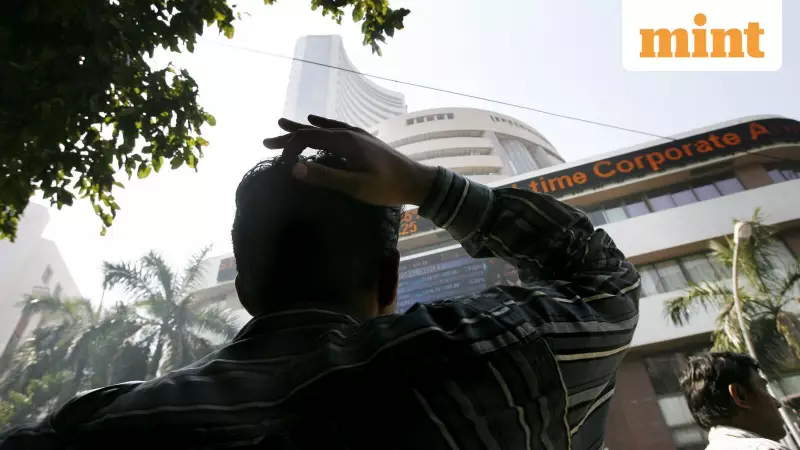
Indian stock markets found some relief on Friday, January 16, breaking a two-session losing streak. The benchmark indices closed higher, powered by strong buying in major information technology and banking companies.
Friday's Market Performance
The BSE Sensex climbed 188 points, or 0.23 percent, to finish the day at 83,570.35. The NSE Nifty 50 gained 29 points, or 0.11 percent, settling at 25,694.35. This upward move ended a brief period of declines for both indices.
Key Drivers of the Rally
Heavyweight IT stocks led the charge. Shares of Infosys, Tata Consultancy Services, and Tech Mahindra saw significant buying interest. The positive sentiment in the IT sector received a boost after Infosys upgraded its revenue growth outlook for the coming period.

Banking stocks also contributed to the gains. Investors showed optimism ahead of the third-quarter earnings reports from major banks. Expectations of solid financial results supported the sector.
Ajit Mishra, Senior Vice President of Research at Religare Broking, commented on the week's trading. He noted that markets largely consolidated amid mixed signals. After a volatile start, the benchmarks moved within a narrow range. Broader market indices followed a similar pattern, ending the week with modest gains.
Market Outlook for the Coming Week
Ponmudi R, CEO of Enrich Money, expects a cautious tone as the new week begins. He believes investors will focus on specific stocks rather than making broad market bets. The balance between domestic corporate earnings and global developments will be crucial.
Banking stocks are likely to remain in the spotlight. Markets will digest quarterly results from heavyweights like ICICI Bank and HDFC Bank. A host of other private and public sector lenders will also report their numbers.
Global Factors at Play
Uncertainty around U.S. trade negotiations continues to pose a challenge. The existing 50 percent tariff on certain Indian imports remains a headwind for market sentiment. However, attention is shifting toward the anticipated India-European Union trade agreement. A successful conclusion later this month could boost investor confidence.
Geopolitical tensions, particularly between the United States and Iran, also influence global markets. These developments affect oil prices and broader asset positioning. While recent comments suggest some de-escalation, rapidly changing headlines keep investors on edge. Energy and safe-haven assets may lead market moves based on risk appetite.
Overall, the near-term outlook remains guarded. Markets will likely respond to earnings outcomes, global trade signals, and geopolitical news. Selective, stock-specific opportunities may outperform broad market trends.
Top Triggers for the Indian Stock Market
Q3 Results 2026
The earnings season enters its second week. Several large and mid-cap companies across various sectors will announce their December quarter results. Marquee names include IRFC, Zomato, InterGlobe Aviation (IndiGo), BHEL, Coforge, JSW Steel, BPCL, and Cipla.
Ajit Mishra of Religare Broking highlighted the sequence of focus. Participants will first react to earnings from key heavyweights like Reliance Industries, HDFC Bank, and ICICI Bank. After that, attention will shift to the broader set of Q3 results from numerous companies.
India-US Trade Deal
Two U.S. lawmakers have urged President Donald Trump to seek better terms for American pulse crops in any future trade agreement with India. Republican Senators Steve Daines and Kevin Cramer argue that U.S. farmers face a competitive disadvantage due to Indian tariffs. Their states, Montana and North Dakota, are major producers of pulses like peas. India is the world's largest consumer, accounting for roughly 27 percent of global demand.
US Economic Data
On the global front, U.S. macroeconomic data will influence risk sentiment. Key figures to watch include GDP growth, inflation trends, jobless claims, and Purchasing Managers' Index (PMI) readings. These indicators affect currency movements and investor confidence worldwide.

Gold and Silver Rates
Precious metal prices remain important for the Indian stock market. Gold and silver have faced pressure from a strong U.S. Dollar and easing U.S.-Iran tensions. Anuj Gupta, a SEBI-registered analyst, noted that if gold and silver prices cool further, investors might shift funds from bullion to other assets, including equities.
Spot gold dipped slightly to $4,610.86 an ounce but remained on track for a weekly gain. Silver spot prices fell to $90.82 an ounce, though the metal also posted a weekly rise after hitting a record high earlier.
Foreign Institutional Investor (FII) Activity
Sustained selling by Foreign Institutional Investors continued through the week ending January 16. Total FII selling for January reached ₹22,529 crores. FIIs were net sellers on almost all trading days this month.
Dr. V.K. Vijayakumar, Chief Investment Strategist at Geojit Investments, pointed out India's underperformance relative to other major markets early in 2026. The Nifty's year-to-date return stood at -1.73 percent.
He highlighted a significant feature from 2025. Despite massive domestic institutional investment (DII) of ₹7.44 lakh crores, which offset total FII selling of ₹1.66 lakh crores, Nifty delivered a modest return of only 10 percent. Poor earnings growth and elevated valuations contributed to this tepid performance. Uncertainty over the U.S.-India trade agreement also weighed on sentiment.
Dr. Vijayakumar suggested the FII selling trend may persist until positive triggers emerge. The artificial intelligence (AI) trade, which dominated 2025, continues in early 2026. A reversal of this trend might occur later in the year.
Technical Outlook
Nifty 50
According to Ajit Mishra, the Nifty continues to trade near its 100-day exponential moving average (DEMA). This indicates a struggle between bullish and bearish forces. A decisive break below this level could lead to further downside toward 25,300, with key long-term support near the 200 DEMA at 25,150. On the upside, any rebound may face resistance in the 25,900–26,000 zone, with the next hurdle around 26,200.
Bank Nifty
The Bank Nifty shows relative strength, holding comfortably above its 20 DEMA. This outperformance is likely to continue. Immediate support lies at 59,200, with a stronger cushion at 58,700. On the higher side, the 60,500–61,200 zone remains the key target range.
Disclaimer: This story is for educational purposes only. Please consult with an investment advisor before making any investment decisions.





