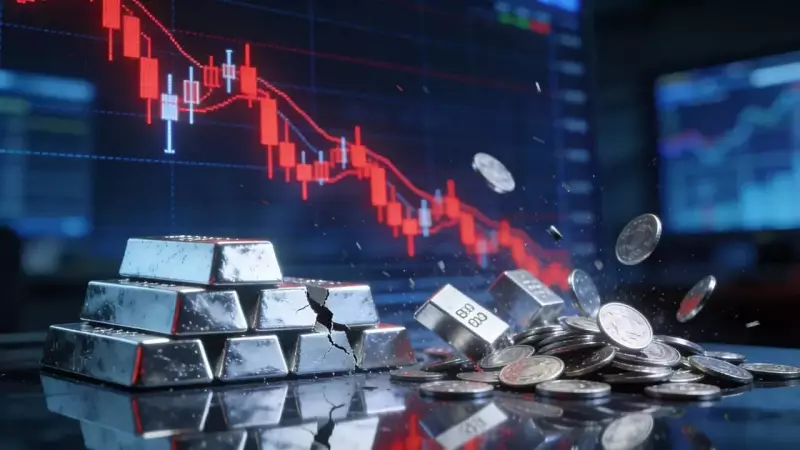
In a dramatic reversal of fortunes, silver prices on the Multi Commodity Exchange (MCX) witnessed a stunning crash on Monday, erasing a significant portion of their recent historic gains in a matter of hours. The white metal's March futures contract plummeted by a staggering Rs 21,000 per kilogram in just one hour during afternoon trade, sending shockwaves through the bullion market.
A Stunning Rally Meets a Sharp Reversal
The day had begun on an exceptionally strong note for silver. Earlier in the session, MCX Silver March futures had surged to a record high of Rs 2,54,174 per kg. This capped off a phenomenal year-to-date rally where the commodity had soared by an impressive 181%, significantly outperforming gold. The rally was fueled by its designation as a critical mineral in the United States, tight supplies, and robust industrial demand.
However, the momentum reversed violently. Prices crashed to an intraday low of Rs 2,33,120 per kg as investors rushed to lock in profits. The global market mirrored this volatility, with spot silver prices briefly crossing the $80 per ounce milestone for the first time ever, only to slide back below $75.

Key Drivers Behind the Sudden Silver Crash
Analysts pointed to a confluence of factors that triggered the sharp sell-off. The primary catalyst was widespread profit-taking after the parabolic rally. This was compounded by easing geopolitical tensions, which reduced the safe-haven appeal of precious metals. Reports suggesting progress in peace talks between US President Donald Trump and Ukrainian President Volodymyr Zelensky contributed to this shift in sentiment.
Adding significant pressure was a margin hike announced by the Chicago Mercantile Exchange (CME). Effective from Monday, the initial margin requirement for the March 2026 silver futures contract was raised to approximately $25,000 from $20,000 earlier this month. This move forced some leveraged investors to liquidate positions.
Expert Views and Historical Warnings
Market experts have cautioned that such rapid ascents are often followed by severe corrections. Jigar Trivedi, Senior Research Analyst at Reliance Securities, noted that while the broader outlook for silver remains constructive, it will be marked by sharp swings. He identified the Rs 2.4 lakh level as a crucial near-term support.
US firm BTIG warned that the precious metals rally had turned "parabolic," a pattern that typically ends with a swift and sharp reversal rather than a gradual decline. They highlighted that silver is currently trading about 89% above its 200-day moving average, a historically overbought signal. BTIG analyst Jonathan Krinsky drew parallels to a similar 10% surge in 1987, which was followed by a 25% drop in subsequent weeks.
Manish Banthia, Chief Investment Officer for Fixed Income at ICICI Prudential Mutual Fund, provided a sobering historical perspective. He recalled the 1979-80 episode where silver rose from $6 to $49 before crashing over 90%, and the 2011 peak near $48 followed by a 75% decline. "Since the pandemic lows, prices have increased more than six times," he stated, implying the market was ripe for a correction.
The consensus among analysts is clear: while the long-term fundamentals for silver, driven by industrial usage, remain strong, the recent price action suggests a period of heightened volatility and potential for significant corrections as the market digests its unprecedented gains.