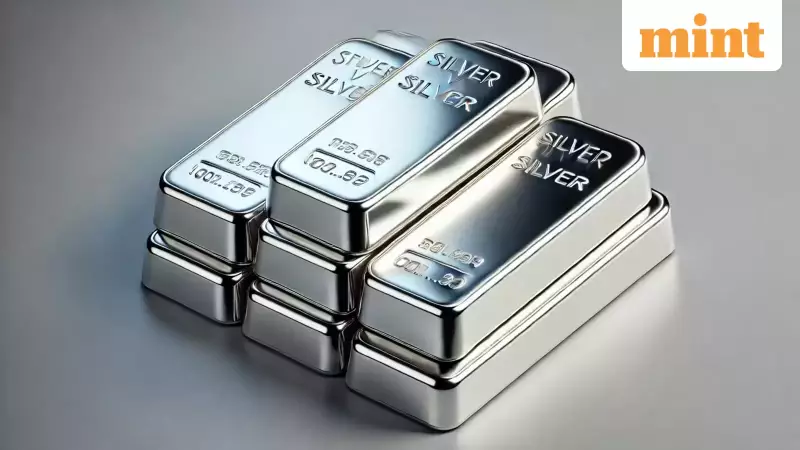
In an extraordinary market performance, silver has emerged as the top-performing asset class of 2025, delivering staggering returns that have left other investments far behind. The white metal is on track to record its most impressive annual gains in nearly five decades, fueled by a potent mix of geopolitical tensions and supply concerns.
A Historic Rally for the White Metal
The scale of the rally is nothing short of spectacular. Silver prices have surged by over 150% since the start of 2025, setting the stage for the metal's best year since 1979. The momentum reached a fever pitch in recent trading, with prices breaking critical barriers. In international markets, silver jumped 5% to cross the $75 per ounce mark for the very first time. The domestic market mirrored this euphoria, as prices on the Multi Commodity Exchange (MCX) soared 4% to a historic peak above ₹2,32,700 per kilogram.
Analysts point to multiple factors driving this safe-haven rush. The prolonged Russia-Ukraine conflict continues to create global uncertainty, while a recent flare-up in tensions between the United States and Venezuela has added to the risk-off sentiment. Furthermore, significant inventory hoarding by entities in both China and the United States has created a tangible supply deficit in the physical market, squeezing prices higher.

Is It Time to Book Profits? Experts Weigh In
With such a vertical climb, a critical question now faces investors: is it time to take profits? Some market experts are turning cautious, pointing to technical indicators that suggest the rally may be due for a pause. The primary gauge under scrutiny is the gold-silver ratio, which measures how many ounces of silver are needed to buy one ounce of gold.
This ratio has plummeted by 40% in 2025, falling from 107 to 64, underscoring silver's dramatic outperformance. However, data from Kedia Advisory indicates the ratio is now approaching a key structural support level of 62.5. This zone aligns with past reversal points seen in 2016 and 2021, potentially signaling a shift in momentum.
"Historically, such moves are followed by phases where gold stabilises, and silver corrects," said Justin Khoo, Senior Market Analyst - APAC at VT Market. He clarified that this points to a rotation within the precious metals complex rather than a broader breakdown. Khoo believes any pullback should be seen as a correction, as underlying supports like inflation concerns and fiscal stress remain intact.
Price Outlook for Gold and Silver in 2026
Despite the caution, the long-term view for many remains bullish. Ajay Suresh Kedia, founder of Kedia Advisory, projects that silver could ultimately reach $100 per ounce within the next three years. He identifies a key support level of 45.232 and resistance of 76.190 for the gold-silver ratio over the next six months.
Other analysts see the rally continuing unabated. Kaveri More, Commodity Analyst at Choice Broking, argues that the bull market for silver is not over. "Gold-silver ratio indicates continued silver outperformance in this bull market, as ratios below 70 historically favour silver," More stated, citing its strong industrial demand dynamics which diverge from gold's purely safe-haven appeal.
More provided specific price projections for the coming year. For COMEX gold, near-term resistance is seen at $4,600-5,000 per ounce, with support at $4,250-4,150. In India, MCX gold faces resistance in the ₹140,000-151,000 per 10 grams range. For silver, the potential upside extends to $75-80 per ounce, with support at $60-65. Domestically, silver futures could trade between ₹208,000-190,000 in 2026, with a near-term range of ₹230,000-250,000.
The remarkable journey of silver in 2025 highlights its dual role as both a monetary and industrial metal. While technical indicators flash warnings of a short-term correction, the fundamental backdrop of geopolitical risk and supply constraints suggests the long-term story for the white metal remains firmly bullish.