

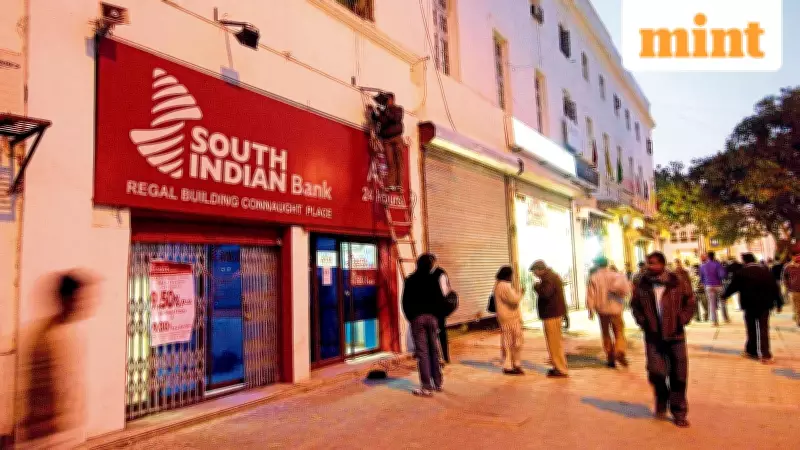
South Indian Bank shares experienced a dramatic sell-off during Friday's trading session, plunging nearly 19 percent to reach their lowest valuation in over three months. The stock tumbled to approximately ₹36 per share, marking one of the steepest single-day declines in recent memory for the Kerala-based private sector lender.
Leadership Transition Triggers Market Panic
The sharp downward spiral followed Thursday's exchange filing where the bank disclosed that Managing Director and Chief Executive Officer PR Seshadri has informed the board of his decision not to seek reappointment after his current term concludes. Seshadri cited personal reasons for this significant development, though he will continue leading the bank until September 30, 2026, when his present tenure officially ends.
In response to this announcement, the board has initiated the formal process to identify a suitable successor for the top leadership position. The bank stated that necessary approvals from both the Reserve Bank of India and shareholders will be sought once potential candidates have been shortlisted through this comprehensive selection procedure.

Strong Fundamentals Contrast With Market Reaction
Interestingly, this leadership uncertainty emerged against the backdrop of remarkably strong quarterly performance. South Indian Bank reported its highest-ever quarterly net profit of ₹374.32 crore for the December-ending quarter, representing a healthy 9.5 percent growth compared to ₹341.87 crore recorded during the same period last year.
The bank's net interest income, a crucial profitability metric reflecting the difference between interest earned from loans and interest paid to depositors, increased to ₹881 crore in Q3 from ₹869 crore in the corresponding quarter of the previous fiscal year. Pre-provision operating profit demonstrated robust expansion, climbing to ₹584 crore from ₹529 crore year-on-year, translating to a 10.5 percent growth rate.
Asset Quality Shows Significant Improvement
On the asset quality front, South Indian Bank displayed substantial progress with gross non-performing assets declining by 163 basis points year-on-year to 2.67 percent. Net NPAs showed even more impressive improvement, falling by 80 basis points year-on-year to reach 0.45 percent, indicating strengthened risk management and recovery mechanisms.
The bank's deposit base witnessed healthy expansion with retail deposits growing by ₹13,142 crore to ₹1,02,421 crore, reflecting a 13 percent increase year-on-year. In the advances segment, corporate lending recorded particularly strong performance with an increase of ₹3,397 crore, rising from ₹34,956 crore to ₹38,353 crore, marking a 10 percent year-on-year growth according to the bank's January 15 earnings report.
Volatile Share Price Trajectory
South Indian Bank's stock had begun 2025 on an exceptionally strong note, surging 15 percent during the first eleven trading sessions and scaling a fresh peak of ₹47 per share. However, Friday's dramatic 19 percent plunge completely erased these gains, leaving the stock with a 1 percent decline for the month of January.
Despite today's sharp correction, the bank's shares have delivered impressive returns over longer time horizons. After hitting a one-year low in April 2025, the stock rebounded vigorously to end the year with a substantial 53 percent gain. This remarkable performance marked the bank's fourth consecutive year of positive returns, accumulating to an extraordinary 371 percent rise over this extended period.
Market analysts suggest that while the bank's fundamental metrics remain strong, investor concerns about leadership continuity have triggered this significant sell-off. The banking sector typically reacts sensitively to top management changes, particularly when current leadership has overseen periods of substantial growth and transformation.
Investors are now closely monitoring the succession planning process, with particular attention to the timeline for identifying a new CEO and obtaining regulatory approvals. The bank's ability to maintain its growth trajectory during this transition period will likely influence market sentiment in the coming months.






