

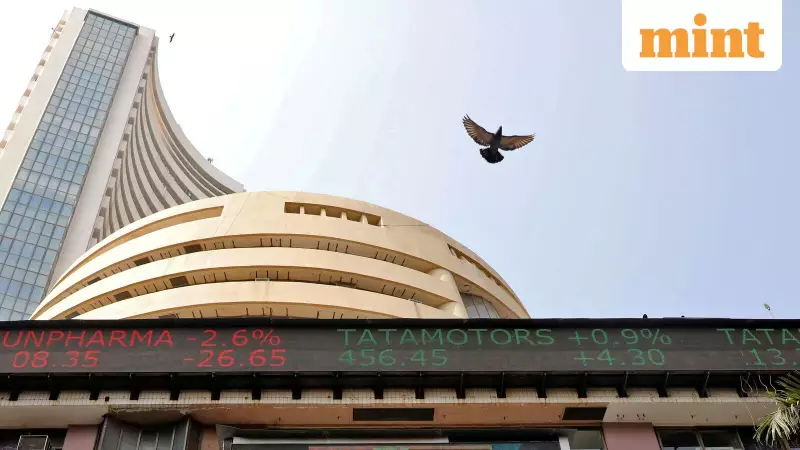
Indian Stock Market Downturn: Analyzing the Fall and Recovery Prospects
The initial optimism that characterized the beginning of 2026 among investors has swiftly transformed into a wave of pessimism. The remarkable achievement of the Nifty starting the year at an unprecedented peak has now faded from memory. Over the past few weeks, market sentiment has undergone a dramatic shift, with clear indications of a downward trajectory emerging. At present, the Nifty has registered a decline of approximately 3% since the start of 2026. This downturn has been even more pronounced in the broader market segments, where midcaps and smallcaps have experienced steeper falls compared to their bluechip counterparts.
The BSE SmallCap index has plummeted by nearly 8%, while the BSE MidCap index has dropped by 5%. Given that mid-cap and small-cap stocks constitute a significant portion of retail investors' portfolios, the financial distress has been particularly severe. This, in turn, has profoundly negatively affected the overall mood on Dalal Street. A critical question now arises: Is this market correction merely a transient phase preceding another bullish rally, or does it signal deeper underlying concerns that warrant serious attention?
Primary Factors Driving the Market Decline
Broadly speaking, three major factors are contributing to the current stock market decline. Understanding these elements is crucial for investors navigating this volatile period.


- Uncertainty Surrounding the Pending US Trade Deal
India and the United States have been engaged in trade negotiations for several months, yet certain contentious issues have emerged as significant obstacles. One major point of dispute involves India's imports of Russian oil. US President Donald Trump has supported legislative measures that could impose tariffs as high as 500% on nations importing Russian oil. Despite media reports suggesting that talks have reached an advanced stage with many agreements in principle, there remains a lack of clarity regarding the final status and timeline. Initial expectations pointed towards a deal by March, but neither side has provided concrete assurances or transparent updates. Financial markets inherently dislike uncertainty, especially on matters of such economic importance. Dalal Street is eagerly awaiting the removal of the 50% tariff on India and the swift conclusion of a mutually beneficial trade agreement. Prolonged delays in resolving this issue are likely to further deteriorate investor sentiment. - Sluggish Corporate Earnings Recovery
While the Indian stock market holds strong potential for long-term gains, this is contingent upon a robust revival in corporate earnings growth. Recent quarters have not demonstrated satisfactory performance from Indian corporations in this regard, leading investors to adopt a cautious wait-and-see approach. The market had pinned hopes on the ongoing earnings season to indicate a resurgence in sales and profit growth. However, as companies begin to release their results, the prevailing view on Dalal Street is that a comprehensive earnings recovery may require several more quarters. Consequently, investors are advised not to factor in high earnings growth prematurely. The scaling back of expectations for a rapid earnings rebound is causing hesitation, particularly among institutional investors. - Escalating Geopolitical Tensions
Recent geopolitical developments, including US actions in Venezuela, President Trump's threats against Greenland, and heightened tensions with Iran, have unsettled investors. The financial markets are particularly wary of the possibility of another major conflict. Trump's assertive foreign policy stance has rattled global markets, contributing to sustained selling by Foreign Institutional Investors (FIIs). This persistent FII selling, combined with the pending US trade deal and a depreciating rupee, has collectively heightened investor anxiety. In an already uncertain economic climate, these intensified geopolitical risks have amplified the perceived risk among market participants.
When Can Investors Expect a Market Recovery?
Predicting the exact timing of a market recovery is notoriously challenging, yet it is reasonable to assert with confidence that a rebound is inevitable. Historically, the stock market has witnessed numerous corrections over the years, none of which have escalated into full-blown crashes or prolonged bear markets. This resilience can largely be attributed to substantial fund inflows from Domestic Institutional Investors (DIIs). According to a report published in Mint, in 2025 alone, massive DII inflows amounting to ₹7.44 trillion overwhelmingly offset FII selling of ₹1.66 trillion. Therefore, as long as DII investments continue to pour in, the markets are not at imminent risk of a collapse.
Regarding the recovery itself, it will primarily hinge on two key factors that investors should monitor closely:
- A reversal from FII outflows to inflows
- A noticeable acceleration in earnings growth
Additional elements to track include progress on the US trade deal, any new geopolitical flare-ups, and, in the near term, the implications of the upcoming Union Budget.
Strategic Investment Approach in Volatile Times
With over three decades of experience in the market, one fundamental principle remains clear: predicting the future is impossible, and attempting to do so is inadvisable. Time in the market consistently proves more valuable than timing the market. In the long run, the Indian stock market is poised to rise in tandem with the growth of the Indian economy. Rather than attempting to anticipate or react to every minor market fluctuation, a more prudent strategy involves constructing a watchlist of high-quality stocks and acting when valuations become attractive.
Conduct thorough due diligence by evaluating factors such as valuation metrics, industry trends, corporate governance standards, and overarching market risks before making any investment decisions. In the current uncertain environment, if you are worried about the stocks in your portfolio, consider asking the following critical questions:
- Are the company's underlying fundamentals weak?
- Have there been any recent adverse changes in the company's fundamental health?
- Did the price-to-earnings (P/E) ratio surge without a corresponding improvement in the company's earnings?
- Did you possibly err in your initial analysis at the time of purchase?
Affirmative answers to these questions may justify selling or reducing your holdings. However, if the answers are a clear 'no', and valuations are not excessively high, holding onto your investments could be wise. Furthermore, if fundamentally strong stocks on your watchlist become available at reasonable, low valuations, they may present compelling buying opportunities. Often, the best stocks to invest in are those that have declined due to short-term, sentiment-driven reasons, provided their long-term fundamentals remain robust.
Disclaimer: This article is intended for informational purposes only. It does not constitute stock recommendations and should not be interpreted as such.





