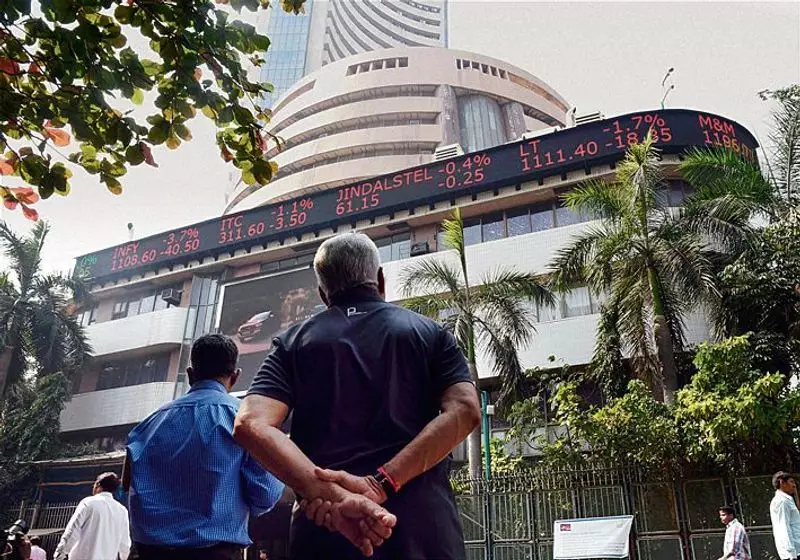
Indian stock markets witnessed another day of significant declines, marking the third consecutive session of losses as foreign institutional investors continued to pull money out of domestic equities. The benchmark indices closed in negative territory on Wednesday, reflecting growing concerns among market participants.
Market Performance Details
The 30-share BSE Sensex experienced a substantial decline of 313.90 points, settling at 73,745.35 after a volatile trading session. The index moved between a high of 74,189.19 and a low of 73,484.44 during the day, showing significant investor uncertainty.
Similarly, the broader NSE Nifty didn't fare any better, dropping 109.70 points to close at 22,398.90. The selling pressure was widespread across multiple sectors, with particular weakness observed in banking and financial stocks.

Foreign Fund Outflows Drive Decline
The primary catalyst behind the market's downward movement remained the continued exodus of foreign capital. According to exchange data, Foreign Institutional Investors (FIIs) offloaded equities worth Rs 5,841.84 crore on Tuesday, adding to the selling pressure that has characterized recent sessions.
Among the major Sensex constituents, several prominent companies saw significant declines. Nestle India emerged as the biggest loser, falling by 2.51 percent. Other notable declines included Titan Company, which dropped 2.17 percent, and Kotak Mahindra Bank, which fell 1.54 percent.
The banking sector showed particular weakness, with HDFC Bank declining by 1.15 percent and Axis Bank dropping 0.97 percent. State Bank of India also joined the downward trend, falling 0.65 percent amid the broader market pessimism.
Mixed Performance Across Sectors
While the overall market sentiment remained negative, some companies managed to buck the trend. Power Grid Corporation emerged as the top gainer among Sensex stocks, rising by 1.89 percent. Other notable performers included Mahindra & Mahindra, which gained 1.63 percent, and Reliance Industries, which added 0.90 percent despite the challenging market conditions.
The broader market indices reflected the negative sentiment, with the BSE Smallcap gauge falling 0.61 percent and the Midcap index declining 0.46 percent. Among sectoral indices, realty stocks were hit the hardest, dropping 1.63 percent, followed by consumer discretionary goods and services, which fell 1.10 percent.
However, not all sectors experienced losses. The capital goods index managed to gain 0.67 percent, while industrials rose 0.60 percent, and utilities added 0.52 percent, indicating selective buying interest in specific segments.
Global Context and Expert Analysis
Market analysts pointed to multiple factors contributing to the sustained selling pressure. The strengthening US dollar and rising US bond yields have made emerging markets like India less attractive to foreign investors seeking higher returns in safer American assets.
Additionally, concerns about geopolitical tensions and their potential impact on global economic growth have prompted investors to adopt a more cautious approach. The uncertainty surrounding crude oil prices and their effect on India's import bill and inflation dynamics has also weighed on market sentiment.
Technical analysts noted that the Nifty breaking below the 22,400 level could signal further downside in the near term unless there's a significant change in market dynamics or fresh positive triggers emerge.
Despite the recent correction, many market experts maintain that India's long-term growth story remains intact, with the current decline potentially offering buying opportunities for investors with a longer time horizon. However, they caution that volatility may persist in the short term as markets navigate global uncertainties and domestic factors.