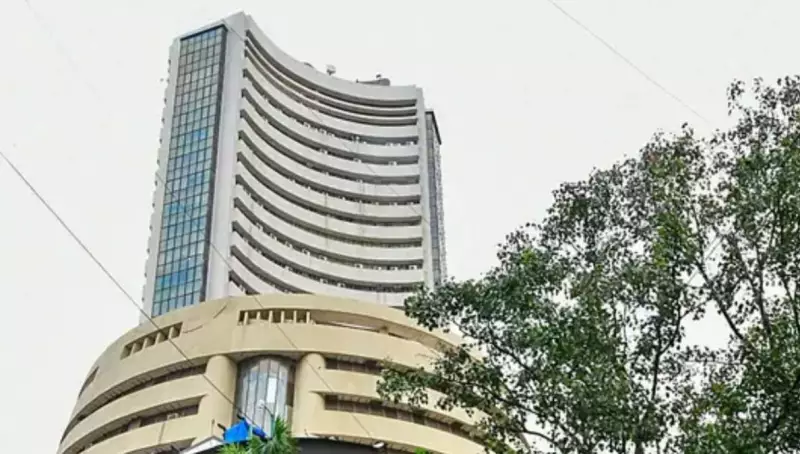
Indian equity benchmarks kicked off the trading week on a negative note, mirroring cautious sentiment across global markets. The key indices, the BSE Sensex and the NSE Nifty 50, opened in the red on Monday, December 8, as investors turned their attention to the upcoming US Federal Reserve meeting and its implications for interest rates.
Global Headwinds Weigh on Market Sentiment
The primary drag on market sentiment stemmed from weak cues emanating from Asian markets. Major indices across the region traded lower, reflecting a broader sense of apprehension among global investors. This cautious stance is largely attributed to the anticipation surrounding the US Federal Reserve's policy meeting scheduled for later this month. Market participants are keenly awaiting signals on the potential timing and pace of interest rate cuts, a factor that significantly influences foreign capital flows into emerging markets like India.
Domestically, the BSE Sensex opened lower by over 150 points, while the Nifty 50 began trading below the 23,800 mark. The sell-off was broad-based, with sectors such as banking, information technology, and metals witnessing notable pressure. The market's opening performance underscores the sensitivity of Indian equities to global monetary policy developments and international fund movement.

Stock-Specific Action: Indigo and TMPV in Focus
Amid the overall bearish trend, specific stocks captured investor attention due to company-specific developments. Shares of InterGlobe Aviation, which operates the airline IndiGo, were actively traded. The stock price movement was influenced by a combination of sectoral dynamics, crude oil price fluctuations, and the company's operational updates.
Similarly, shares of TMPV (The Mandhana Power Ventures Limited) were in focus during the early trading session. The stock's activity is often monitored by traders for its volatility and news flow related to the power and infrastructure sector. Analysts advised investors to track these stocks closely for any fresh announcements or technical breakout levels that could dictate short-term direction.
Market Outlook and Key Factors to Watch
The immediate trajectory for the Indian stock markets will depend on a confluence of local and international factors. The most critical external event is the Federal Open Market Committee (FOMC) meeting. Any hints regarding a delay in rate cuts could prolong the phase of risk aversion, potentially leading to continued foreign institutional investor (FII) selling. Conversely, a dovish tone from the Fed might revive bullish sentiment.
On the domestic front, market participants will also monitor the following:
- Macroeconomic Data: Upcoming releases on inflation and industrial production.
- Rupee Movement: The Indian rupee's performance against the US dollar.
- Crude Oil Prices: Any sharp movement in global oil benchmarks.
- Institutional Activity: The trading patterns of domestic institutional investors (DIIs) and FIIs.
Technical analysts suggest that the Nifty needs to hold above crucial support levels to prevent a deeper correction. The market's ability to recover from the day's opening losses will be a key test of underlying strength. For retail investors, experts recommend a stock-specific approach, focusing on companies with strong fundamentals and clear earnings visibility, while maintaining caution in the near term due to elevated global volatility.